

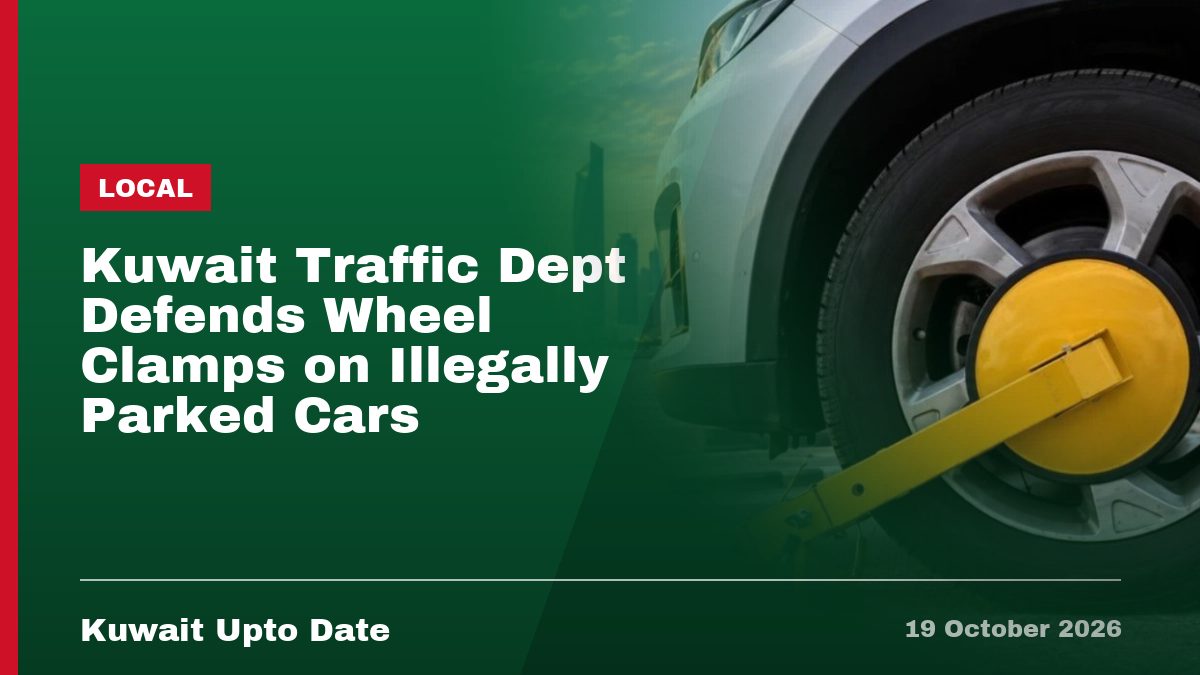
So, you know how sometimes you see a car parked half on the road, half on the pavement, with that big yellow clamp locked onto its wheel? Turns out that’s not random. Kuwait’s traffic police have just come out and explained exactly why they’re doing it, and it’s worth knowing before you’re tempted to leave your car somewhere “just for five minutes.”
Lieutenant Colonel Abdullah Bu Hassan, who heads traffic awareness at the General Directorate of Traffic, went on Kuwait State Radio’s General Programme to address photos that had been doing the rounds on social media. The pictures showed cars fitted with wheel clamps after being parked badly on a road, blocking traffic. He wanted to set the record straight on why that happens and whether it’s even legal.
- Kuwait’s traffic police say clamping illegally parked cars is fully within the law, based on Article 1 of the Traffic Law.
- It applies to any vehicle blocking a road or taking up public space it shouldn’t.
- Complaints come in 24/7 through the Ministry of Interior’s operations room and the traffic directorate’s WhatsApp line.
- Officials say the goal isn’t just to fine people, it’s to get drivers to change the habit altogether.
So why clamp a car instead of just towing it?
Bu Hassan’s point was pretty simple: the road belongs to everyone, not just whoever got there first. He said no person or group has the right to use public roads in a way that blocks others or puts safety at risk. A car dumped across a lane or on a corner isn’t just annoying, it can genuinely cause an accident.
He leaned on Article 1 of the Traffic Law to back this up. That article, he explained, covers all kinds of vehicles and also sets out how pedestrians and even animals should move on public roads. So it’s not a new rule invented for this. It’s the same law that’s always been there, just being enforced more visibly right now, which is probably why it’s suddenly all over people’s phones.
We’ve already written about how parking in the wrong spot in Kuwait could get your car clamped, so if you missed that one, it’s worth a quick read alongside this.
Who’s watching, and how do they even know?
This is the part people don’t always realise: it’s not just patrol officers driving past and spotting a bad park job. Bu Hassan said the directorate handles these cases around the clock, responding to reports and complaints that come in through the Ministry of Interior’s operations room, plus the traffic department’s own WhatsApp service.
So basically, if your neighbour is fed up with a car blocking the shared driveway, or someone can’t get their own car out because you’ve boxed them in, they can report it. And apparently that happens often enough that the department felt the need to explain itself publicly.
This fits a pattern we’ve been seeing all month. Kuwait logged over 1.1 million traffic violations in five months, which tells you enforcement has been ramping up across the board, not just for parking.
What this actually means for you
If you’re an expat or a citizen who drives in Kuwait, the message is pretty plain: don’t park somewhere just because it’s convenient if it’s clearly a no-parking zone, blocks a lane, or sits on a pavement meant for people walking. It’s not about catching you out. Bu Hassan said the whole point of issuing violations is to correct behaviour, build awareness, and stop the same mistakes happening again and again, not just to collect fines.
For expats especially, getting clamped can be a bigger hassle than it sounds. You’ll need to sort the fine and get the clamp removed before you can move the car at all, and that usually means a trip or a call you didn’t plan for. If your car ends up properly impounded rather than just clamped, we’ve put together a guide on exactly how to get an impounded car back, which is handy to bookmark just in case.
Part of a bigger push on the roads
This isn’t happening in isolation. Kuwait has been tightening up road enforcement generally this month, from new rules on delivery riders with impound warnings to fresh checks on who can even sit for a driving licence. The clamping explanation seems to be part of the same push: officials are trying to shift how people treat public roads, not just hand out punishments.
You can keep up with all of this kind of thing under our local news coverage, since traffic rules in Kuwait have a habit of shifting quietly and then suddenly mattering to everyone at once.
Quick answers
Is wheel clamping actually legal in Kuwait?
Yes. The traffic department says it’s based on Article 1 of the Traffic Law, which covers vehicles obstructing public roads.
How do people report a badly parked car?
Through the Ministry of Interior’s operations room or the General Directorate of Traffic’s WhatsApp service, which the department says it monitors around the clock.
Is this only about fining drivers?
Officials say no. Bu Hassan described the goal as correcting behaviour and raising awareness, not just penalising people for the sake of it.
Honestly, the easiest way to avoid all this drama is just giving yourself an extra two minutes to find a proper spot. Ever had your car clamped here, or seen one get clamped right in front of you? Drop your story in the comments, it genuinely helps other readers know what to expect.
📌 Related stories



Latest News
 Local
Kuwait court gives death sentence to expat in heroin trafficking case
 2
Local Best Bank for a Loan in Kuwait 2026: Every Bank Compared
Read more →
 3
Local Kuwait cuts fresh water to Hawally, Jabriya, Bayan on Wednesday
Read more →
 4
International Video Interview – Flydubai Captain Recalls Axe Attack by Co-Pilot Mid-Flight
Read more →
 5
International Unusual Egypt marriage request: one dowry, two brides
Read more →
 6
International Indian patient dies after mid-air scare on air ambulance to Kolkata
Read more →
 7
Local Kuwait’s ‘Report Me’ Service Now Covers if Mandoob ask you for excess money.
Read more →
 8
International Bangladesh says Saudi executed two Bangladeshi without notice
Read more →
 9
Local Kuwait warns public over phone and SIM resale cash schemes
Read more →
 10
International Baby born on Jazeera flight from Kuwait to Colombo
Read more →
 11
Local 50 fils only, Kuwait’s Al-Omariya Nursery offers plants from 50 fils.
Read more →
 12
International Yousra, Laila Elwi warn Gouna audience over AI’s risks
Read more →
 13
International Americans Warned of Travel Chaos Risk as Gulf Tensions Rise
Read more →
 14
Local Best time to watch meteor shower this week from 10 PM until dawn
Read more →
 15
Local 5 men wearing women’s dancewear arrested in Kuwait
Read more →
Leave a Reply