

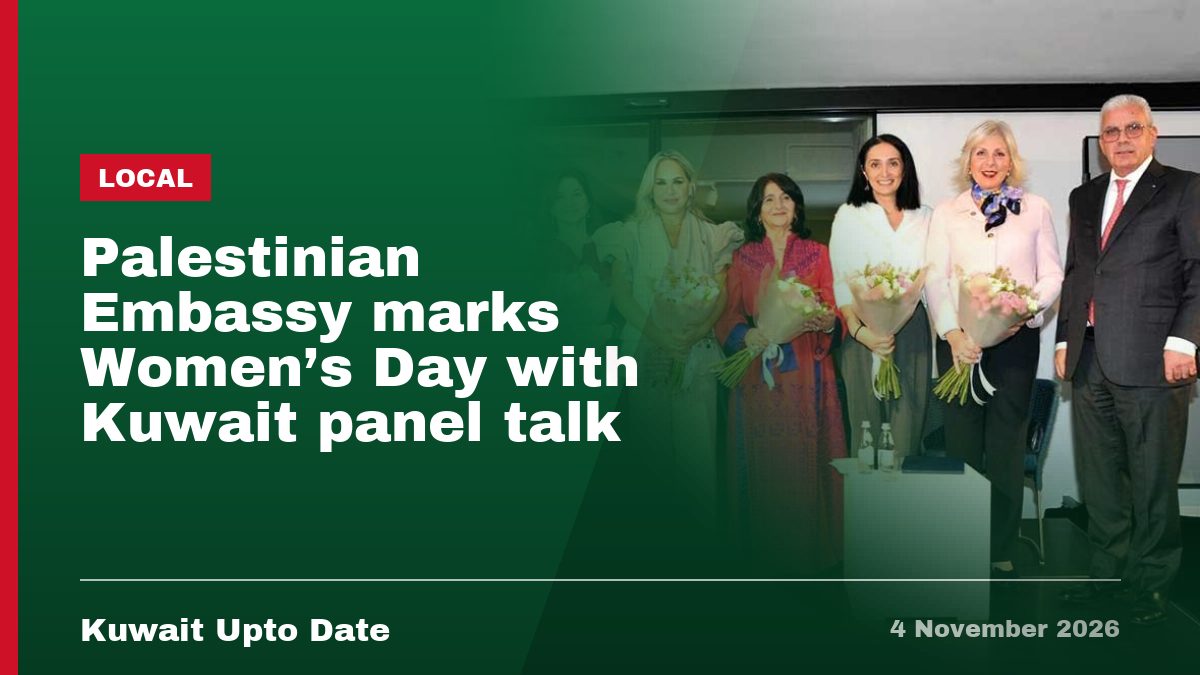
If you live in Kuwait, you’ve probably noticed how many communities here work hard to keep their traditions alive while building a life far from home. On Monday evening, 2 November, that effort took centre stage at a panel discussion hosted by the Embassy of the State of Palestine in Kuwait.
The event, held with the Contemporary Art Platform (CAP), marked the National Day of Palestinian Women. It also honoured renowned Palestinian artist Suleiman Mansour. If you’ve followed our earlier coverage of Palestine-related news in Kuwait, you’ll know this community has a strong, visible presence here, and this event was another example of it.
- The Palestinian Embassy and CAP held a panel on 2 November for the National Day of Palestinian Women.
- Four Palestinian women and one Kuwaiti participant spoke about culture, heritage, food and education.
- A piano performance and a documentary on Palestinian women opened the evening.
- Ambassador Rami Tahboub thanked Kuwait’s leadership and people for their support of the Palestinian cause.
Who spoke, and what they said
The panel was moderated by Reem Shurrab, Media and Communications Officer at the Palestinian Embassy. It brought together Hooda Shawa, Lamies Al-Shakhsheer, Faten Abu Ghazaleh and Sawsan Daana, alongside a Kuwaiti guest, to talk about keeping Palestinian identity alive through culture, education, heritage and traditional food.
Hooda Shawa is a children’s and young adult literature writer and founder of TAQA Productions, a theatre company in Kuwait. She has spent 20 years writing children’s books in Arabic. She said she started writing in Arabic after noticing that her own daughters’ schoolbooks and reading material were mostly in English.
During the panel, Shawa read from her new book, My Grandmother’s Key, which looks at how grandmothers keep Palestinian memory alive. She also put on a short musical performance using puppets. She has won several awards for her work in children’s literature.
Embroidery, food and education as tools of memory
Faten Abu Ghazaleh represented the Palestinian Heritage Centre. She spoke about the work of her late mother, Siham Abu Ghazaleh, and other Palestinian women who helped set up both the Heritage Centre and the General Union of Palestinian Women.
Abu Ghazaleh focused on Palestinian embroidery, which she called a central part of Palestinian identity. She said the embroidery has featured in more than 60 exhibitions over the years. She also pointed to UNESCO’s 2021 decision to add Palestinian embroidery to its Representative List of the Intangible Cultural Heritage of Humanity, calling it an important step in protecting the tradition.
Chef Sawsan Daana, who founded Matbakhi, a project built around traditional Palestinian cooking, spoke about food as part of Palestinian identity. She said traditional recipes need to be preserved and shared on digital platforms, so people outside the region can learn about Palestinian cuisine too.
Veteran educator and music teacher Lamies Al-Shakhsheer talked about education as one of the strongest tools available to Palestinians. She said Palestinians have done well in education and academic fields, and have helped shape school systems in other countries. She also spoke about music as a key part of cultural and educational growth.
Why this matters for people in Kuwait
Kuwait is home to a large Palestinian community, along with many other Arab and international residents who have close ties to Palestinian culture. Events like this one give that community a public space to talk about identity, in a country that has long supported the Palestinian cause at government level.
For Kuwaiti and expat readers interested in the region’s communities, it’s also a reminder that cultural preservation isn’t only about politics. It happens through children’s books, embroidery, recipes and music lessons, the everyday things people pass down at home.
You can find more stories like this one on our Local news page, where we cover community events and gatherings across Kuwait.
How the evening began and ended
The programme opened with a piano performance by young musician Taya Muath Al-Shanaq, who played ‘Zahrat Al-Mada’en’ (Flower of the Cities), a song made famous by Fairuz. After the performance, organisers showed a documentary about Palestinian women living in the occupied Palestinian territories and the challenges they’ve overcome.
At the end of the evening, Ambassador Rami Tahboub thanked the pianist and the panel speakers, saying their contributions had helped the audience understand Palestinian identity and its national story. He presented flowers to each of the participants.
Tahboub also thanked Kuwait directly. He expressed gratitude to His Highness the Amir, the Kuwaiti government and the Kuwaiti people for what he described as their continued support for the Palestinian people and their cause. He thanked CAP as well, represented by Amer Al-Hunaidi and Ofelia Vardanyan, for organising the event with the embassy.
Several Arab and foreign ambassadors and diplomats based in Kuwait attended, along with members of the Palestinian, Arab and international communities, and Kuwaiti guests.
Quick answers
What is the National Day of Palestinian Women?
It’s a day marked by Palestinians and supporters to recognise the role of Palestinian women in society, culture and the national cause. This year it was marked in Kuwait with the panel discussion described above.
Who organised the event?
The Embassy of the State of Palestine in Kuwait organised it together with the Contemporary Art Platform (CAP), a Kuwait-based arts organisation.
Where can I see Palestinian embroidery recognised by UNESCO?
UNESCO added Palestinian embroidery to its Representative List of the Intangible Cultural Heritage of Humanity in 2021. The Palestinian Heritage Centre, mentioned at this event, works to preserve and promote this craft.
Stories like this one show how much community life sits behind the headlines in Kuwait. If you’ve been to similar cultural events here, or know of ones coming up, we’d like to hear about them in the comments.
📌 Related stories
Latest News
 International
Now allowed to drive car for more than 9 hours in 24 hours
2 Local If your salary is 300 KD and transfers 25 KD or more that salary, you will be checked.. Read more → 3 International Stolen KD 89,000 watch mailed back to shop with apology letter Read more → 4 Local Egyptian delivery worker vanished with KD 1,900. SHOOO KER KAY.. Read more → 5 Local Winter Bazaar 2026 Read more → 6 Local What a flashing red traffic light really means in Kuwait Read more → 7 Local I am Amna Sharif Read more → 8 International Pakistan to replace Rs10 note with a coin, cabinet confirms Read more → 9 Local India House hosts two-day Diwali Diwaniya for 65th anniversary Read more → 10 Local Six sky events to watch over Kuwait this November Read more → 11 How to Get a Job in Kuwait : Step-by-Step Guide Read more → 12 Local Ministry of Education offers KD 54,000 in school awards Read more → 13 Local Indian fashion brand BIBA to open stores in Kuwait Read more → 14 International Democrats retake US Senate as Trump suffers midterm blow Read more → 15 International HIGH ALERT – Israel warns US, Iran may use chemical weapons, report says Read more →
Leave a Reply