

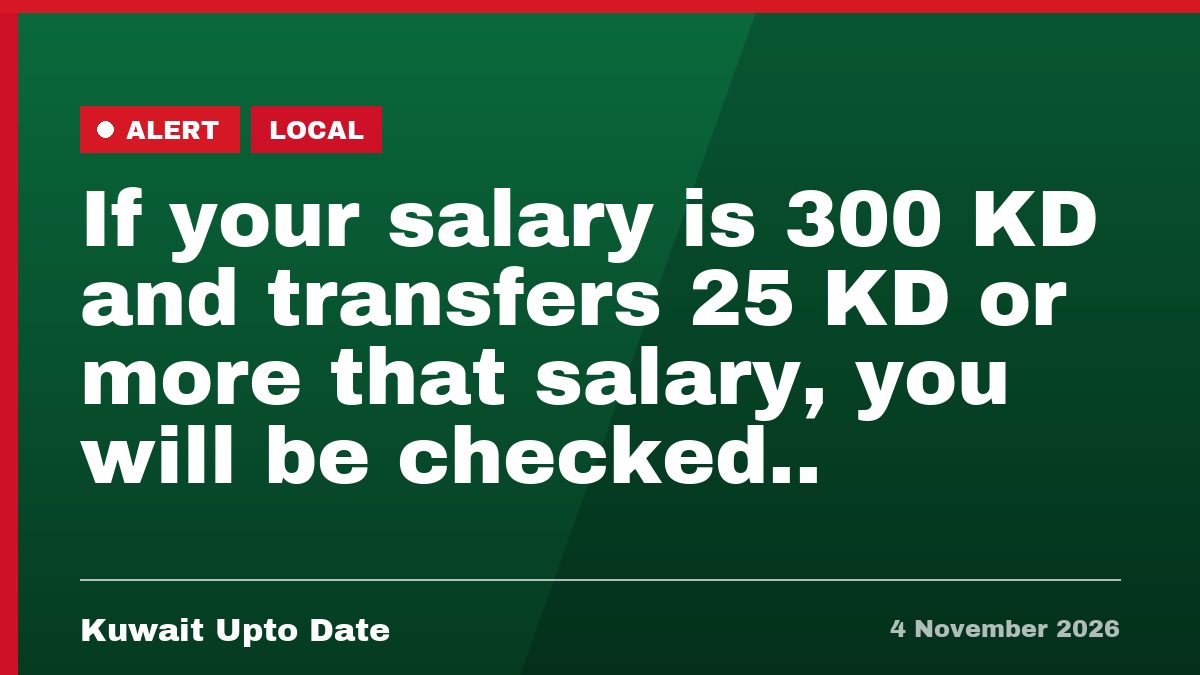
If you earn KD 300 or less a month in Kuwait’s private sector, the way you withdraw or transfer your own salary is about to change a little. Nothing about your pay itself changes. But your bank will start watching your account more closely, and some transactions will need an extra step before they go through.
The Central Bank of Kuwait (CBK) has told local banks to tighten monitoring on salary accounts belonging to lower-paid private-sector employees. The goal is simple: stop employers from faking salary payments, or quietly pressuring workers to hand back money that was just deposited into their accounts. This builds on the Kuwait Wage Payment System launched on 28 September, which already checks that salaries actually reach the right person.
- From 31 December 2026, banks must apply two-factor authentication to withdrawals, transfers or payments of KD 25 or more from salary accounts of private-sector employees earning KD 300 or less a month.
- The salary deposit itself needs no extra authentication – only what you do with the money afterwards.
- Banks must check up to six months of past transactions whenever something looks suspicious, and report serious cases within strict deadlines.
- Withdrawing your whole salary in cash is not, by itself, proof of wrongdoing – CBK has made that clear.
Who exactly does this affect?
This applies to private-sector employees whose latest recorded monthly salary is KD 300 or less. That covers a large share of Kuwait’s expat workforce, especially those in retail, cleaning, construction, security and other lower-wage jobs. Your bank decides whether you’re covered based on your actual salary on record, not your account balance and not the size of any single transfer. If your salary changes – say you get a raise above KD 300 – your bank must update your classification.
Kuwaiti employees on similar salaries are covered too. This isn’t about nationality, it’s about income level and employment sector.
What changes when you use your own money?
Once your salary lands in your account, nothing extra happens at that moment. But any withdrawal, transfer or payment of KD 25 or more – whether at an ATM, through a banking app, a linked payment method, or another banking channel – will need two-factor authentication. That means two separate checks confirming it’s really you, not just logging into the app once.
Banks must use two different verification employees from different categories to confirm your identity and consent for each transaction. Before approving anything, the bank has to show you the transaction type, the amount, and who the money is going to. CBK was clear that simply authenticating your login session into the banking app isn’t enough on its own.
Banks must also directly verify your contact details themselves, rather than just trusting whatever your employer submitted. And if you don’t own a smartphone or can’t use a banking app, your bank still has to give you a secure alternative way to confirm transactions.
Why is CBK doing this?
The instructions are designed to catch two specific problems: employers recording salary payments that never really happen, and employers forcing staff to return money after it’s deposited, to make it look like wages were paid when they weren’t. This follows other recent steps to protect wages here, including the wage protection system and the recent move to flag companies over late payments, like the 8,849 firms flagged for salary violations in October. CBK has also been pushing banks to watch for unlicensed financial activity more broadly, as covered in our piece on the unlicensed money transfer warnings.
How do banks decide something is suspicious?
CBK’s instructions list indicators that may point to fictitious salary payments or pressure on workers, and classify cases by risk level. High-risk cases need strong evidence. Medium-risk cases involve repeated suspicious behaviour backed by extra signs. Low-risk cases involve just one suspicious indicator on its own.
When something trips these flags, the bank must look back at six months of the employee’s transaction history, compare it against the person’s usual financial habits, and check for any links to the employer or related parties. Everything found has to be documented properly, not just noted informally.
What happens after a bank flags something?
There’s a tight timeline. Banks must complete an initial review within two days of spotting a concern. If there’s enough ground for suspicion, they must report it by the end of that same day. A further three-day window is allowed to finish a more detailed investigation, though genuinely urgent cases must be reported immediately, with no delay.
Importantly, CBK stressed that banks cannot hold back your salary deposit or block you from using your own money purely because something looks suspicious – unless there’s an actual legal basis to do so. Suspicion alone isn’t grounds to freeze a worker’s access to their wages.
Monitoring employer violations more broadly, and protecting workers’ rights overall, still falls under the Public Authority for Manpower and other relevant authorities, not the banks themselves.
Two things CBK wanted to make very clear: salary deposits themselves don’t need extra authentication, and taking out your whole salary in cash is not, on its own, evidence of a fake salary scheme. The point of these rules is to catch patterns that suggest manipulation, not to stop ordinary workers from spending or saving their own wages normally.
What this means for expats and citizens in Kuwait
For most lower-paid workers, daily banking will feel a bit slower once this starts. Expect an extra confirmation step for transfers, bill payments or cash withdrawals of KD 25 or more, similar in spirit to recent changes around internal bank transfer rules. It’s worth keeping your phone number and contact details updated with your bank, since CBK now requires banks to verify these directly rather than relying only on employer-supplied information.
Workers who suspect their employer is pressuring them to return salary money, or recording payments that never actually reach them, now have a system specifically built to catch that pattern over a six-month window. If your pay situation looks wrong, it may be worth keeping your own simple record of deposits and withdrawals, just in case a review ever needs to compare your usual habits.
For more on how these wage protections fit together, our local news coverage has tracked the Kuwait Wage Payment System since it launched, along with the salary deduction caps introduced in October, covered in our report on Kuwait’s salary deduction limits.
Quick answers
Does this affect my salary amount or payday?
No. This is only about extra verification when you move money out of your account – transfers, withdrawals and payments of KD 25 or more. Your salary itself and when it’s paid stay the same.
Will my bank block my salary if it looks suspicious?
No. CBK has told banks they cannot delay salary deposits or stop you using your own money just because of suspicion, unless there’s a real legal reason.
What if I don’t have a smartphone?
Banks must offer you a secure alternative way to verify transactions if you can’t use a banking app or don’t own a smartphone.
When do banks have to be ready?
Banks must finish their technical and operational preparations before 31 December 2026 and start submitting monthly monitoring reports from early the following month.
If you’re on a salary near KD 300, it’s worth checking with your bank branch before the end of December so you know exactly what extra steps to expect. Has your bank already mentioned these changes to you? Let us know in the comments.
📌 Related stories
Latest News
 International
Now allowed to drive car for more than 9 hours in 24 hours
2 International Stolen KD 89,000 watch mailed back to shop with apology letter Read more → 3 International Pakistan’s cabinet approves defence pact with Kuwait Read more → 4 Local Egyptian delivery worker vanished with KD 1,900. SHOOO KER KAY.. Read more → 5 Local Winter Bazaar 2026 Read more → 6 Local What a flashing red traffic light really means in Kuwait Read more → 7 Local I am Amna Sharif Read more → 8 International Pakistan to replace Rs10 note with a coin, cabinet confirms Read more → 9 Local India House hosts two-day Diwali Diwaniya for 65th anniversary Read more → 10 Local Six sky events to watch over Kuwait this November Read more → 11 How to Get a Job in Kuwait : Step-by-Step Guide Read more → 12 Local Ministry of Education offers KD 54,000 in school awards Read more → 13 Local Indian fashion brand BIBA to open stores in Kuwait Read more → 14 International Democrats retake US Senate as Trump suffers midterm blow Read more → 15 International HIGH ALERT – Israel warns US, Iran may use chemical weapons, report says Read more →
Leave a Reply