

Out of every ten domestic workers in Kuwait, more than eight come from just four countries. That’s the number the Public Authority for Civil Information (PACI) landed on after counting every single one of them – all 883,308.

It sounds like a simple headline figure. But to get there, PACI had to work through a household workforce that’s become one of the largest in the Gulf, and the final tally tells you a lot about who actually keeps Kuwaiti homes running day to day.
So how did the count break down, and what does it mean if you’re an employer, a domestic worker, or just curious about the makeup of the country you live in? Let’s go through it.
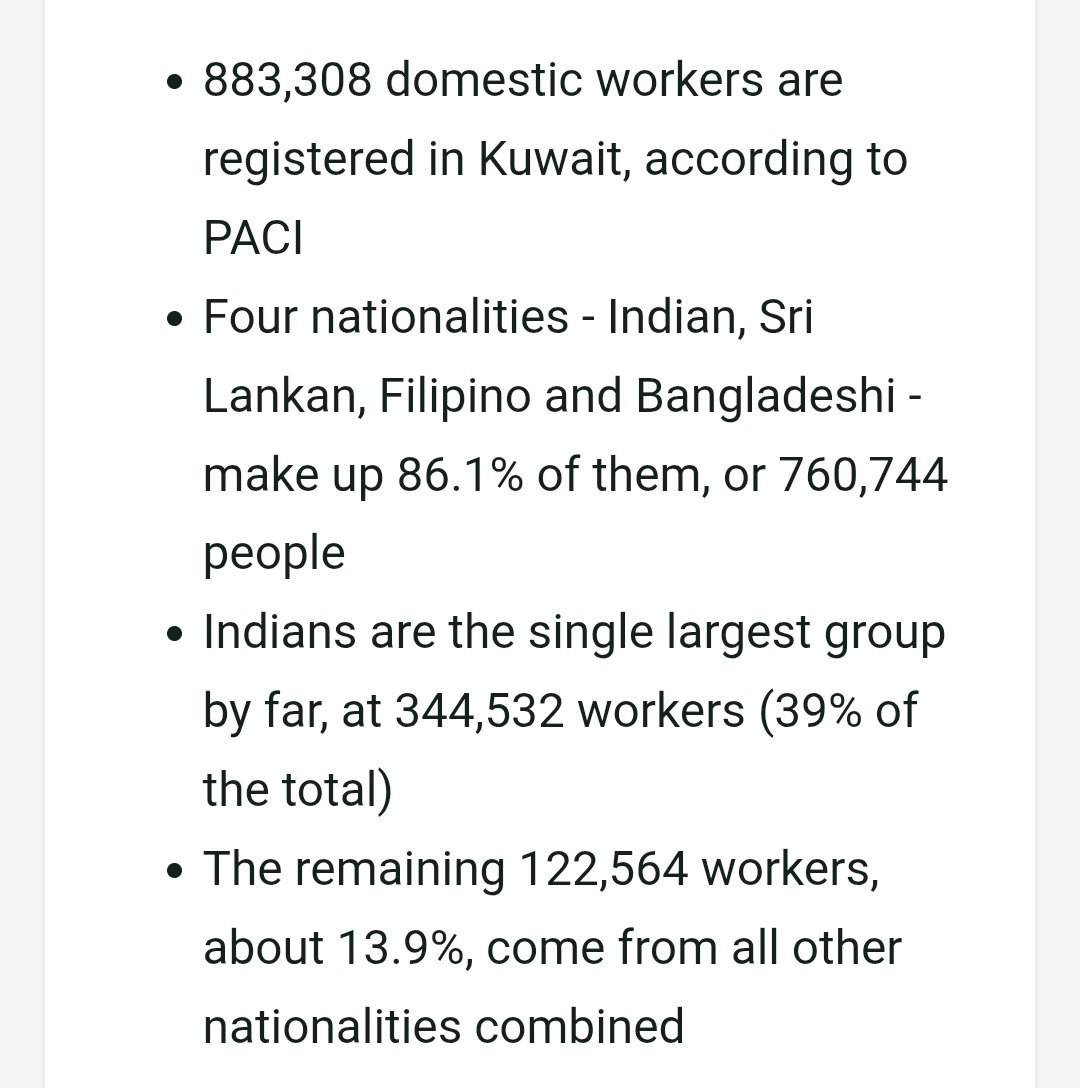
WhatsApp ChannelJoin our WhatsApp ChannelGet Kuwait news, new rules, fees and deadlines straight on WhatsApp. Free – no spam, no group chat.Join Channel →- 883,308 domestic workers are registered in Kuwait, according to PACI
- Four nationalities – Indian, Sri Lankan, Filipino and Bangladeshi – make up 86.1% of them, or 760,744 people
- Indians are the single largest group by far, at 344,532 workers (39% of the total)
- The remaining 122,564 workers, about 13.9%, come from all other nationalities combined
How the final number was reached
PACI’s count starts with the full nationwide register of domestic workers – everyone from housemaids and drivers to cooks and nannies employed in private households across Kuwait. That register currently stands at 883,308 people.
When PACI broke that figure down by nationality, one group stood out immediately. Indian domestic workers numbered 344,532, which works out to roughly 39 percent of the entire workforce – nearly four out of every ten domestic workers in the country come from India alone.
Sri Lankans came in second with 157,901 workers, or 17.9 percent of the total. Filipinos followed closely behind at 151,369, making up 17.1 percent. Rounding out the top four, Bangladeshis accounted for 106,942 workers, or 12.1 percent.
Add those four nationalities together and you get 760,744 people – 86.1 percent of every domestic worker registered in Kuwait. That leaves just 122,564 workers, or 13.9 percent, spread across every other nationality combined.
Why the numbers are so concentrated
This isn’t a new pattern so much as a confirmation of one. Indian, Sri Lankan, Filipino and Bangladeshi workers have long formed the backbone of domestic employment across the Gulf, and Kuwait is no exception. These figures simply put hard numbers on something most households here already know from experience.
What’s striking is just how top-heavy the list is. Indians alone outnumber the combined total of Sri Lankan and Bangladeshi workers. And the gap between the top four and everyone else is wide – the fourth-placed nationality, Bangladesh, has nearly nine times more workers than the average spread across all the remaining nationalities would suggest.
What this means if you live in Kuwait
For households employing domestic staff, the data doesn’t change anything about your legal obligations or the hiring process. But it does put real numbers behind what’s become one of the most common working arrangements in the country – and it’s a reminder of how many lives, across such a small number of source countries, are tied directly to Kuwaiti households.
For domestic workers themselves, particularly those from the four leading nationalities, the figures confirm they’re part of a very large community here, not a small or isolated group. That matters for things like access to community support networks, embassy services, and informal information-sharing among workers from the same country.
It’s also worth remembering that domestic labour sits alongside other parts of Kuwait’s foreign workforce that have seen their own policy changes recently. We’ve covered Kuwait’s digital salary system and what it means for expat workers, and separately looked at what workers need to know about changing jobs before a contract ends – both relevant background for anyone navigating employment rules here, domestic work included.
You can find more coverage of local statistics and policy on our Local news page.
Quick answers
How many domestic workers are there in Kuwait in total?
According to PACI, there are 883,308 domestic workers registered in the country.
Which nationality has the most domestic workers in Kuwait?
Indian nationals top the list with 344,532 workers, about 39 percent of the total.
Which four nationalities make up most of the workforce?
Indian, Sri Lankan, Filipino and Bangladeshi workers together account for 86.1 percent, or 760,744 people.
Did PACI explain why these nationalities dominate the sector?
No, the data released only covers the numbers and percentages by nationality – PACI did not give reasons behind the concentration.
Numbers like these are easy to skim past, but they represent close to a million people living and working in homes across Kuwait. If you employ domestic staff or are one yourself, how does this match what you’ve seen day to day? Let us know in the comments.
Latest News
International
UK warns Britons in Saudi Arabia as Houthi attacks rise
2 Local How to apply for Kuwait’s new freelance business licence Read more → 3 Local Kuwait to fine overloaded trucks instantly for road damage Read more → 4 International Kuwait to link deportee fingerprint data electronically with GCC Read more → 5 International ‘Instagram King’ arrested. Read more → 6 Local New Jira Park in Kuwait Read more → 7 Local Kuwait is checking small repeated transfers Read more → 8 Local Kuwait to fine vehicles on the spot for damaging roads Read more → 9 International Saudi coalition shoots down two Houthi drones over Mecca Read more → 10 Local Puppy found at Kuwait base reunites with US couple after 6 months Read more → 11 Local Kuwait warns of fake Interior Ministry scam on WhatsApp Read more → 12 Local Kuwait lawyers told to stop promoting on TikTok Live Read more → 13 International Saudi forces down 3 Houthi missiles aimed at Riyadh Read more → 14 International Kuwait, Pakistan PMs meet at COP31 to boost ties Read more → 15 Local What Warba Bank’s MENA award win means for Kuwait banking Read more →
Leave a Reply