

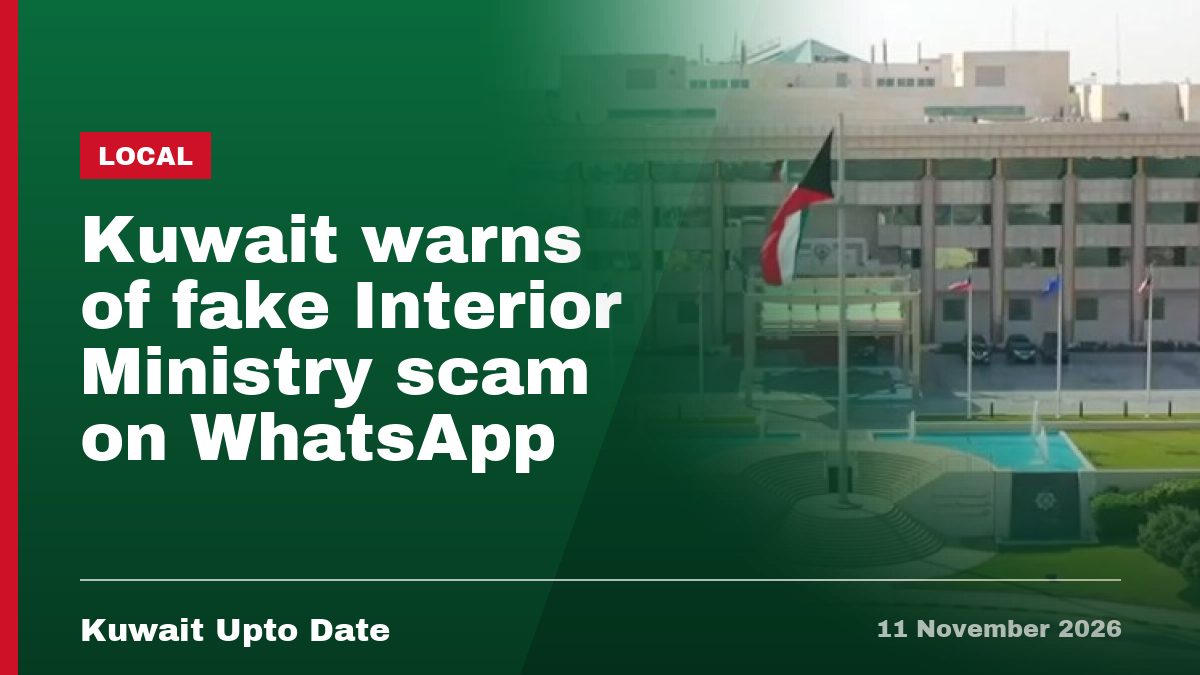
Someone using the Interior Ministry’s name is trying to steal your bank details on WhatsApp.
Kuwait’s Ministry of Interior says fake documents are going around that carry the ministry’s official seal and even the interior minister’s name. The messages claim there’s suspicious activity on your bank account, then push you to hand over your banking information through WhatsApp.
It’s a simple trick, but a dangerous one if you’re not paying attention. Here’s exactly what the ministry said and what you should do if you get one of these messages.
- Fake documents are circulating with the Interior Ministry’s name and the minister’s name on them
- They claim to have spotted suspicious transactions in your bank account
- The goal is to get you to share bank details or verification codes over WhatsApp
- The ministry’s Cyber Crime Combating Department is already investigating
What exactly did the ministry say?
In a press statement, the Ministry of Interior confirmed that forged documents are being passed around online. These documents use the ministry’s official identity and the minister’s title to look convincing. They contain claims about suspicious operations detected in people’s bank accounts.
The real aim, according to the ministry, is to lure people into sharing their banking data through WhatsApp. That’s the key detail here: a government body doesn’t normally chase you down on WhatsApp about your bank account.
The ministry said its Cyber Crime Combating Department is already following up on the case. The department will take the legal steps needed once it identifies who is behind it.
Why this matters if you live in Kuwait
This kind of scam works because it looks official. A document with a government logo and a minister’s name feels trustworthy, especially to someone who isn’t used to how Kuwaiti ministries actually communicate. Expats who recently moved here, and older residents who may not check every detail closely, are often the easiest targets.
The ministry’s message was blunt: don’t respond to these messages, and never share your banking data or verification codes (the one-time passcodes your bank sends by SMS or app) with anyone who contacts you this way. No bank or ministry needs your verification code to help you. If someone asks for it, that alone is a red flag.
You can find more local news updates for Kuwait as this story and others like it develop.
What should you actually do if you get one of these messages?
- Don’t click any links inside the message, and don’t reply.
- Don’t share your bank account number, card details, or any verification code, no matter how official the message looks.
- Contact your bank directly using the number on the back of your card or on their official app, not any number given in the suspicious message.
- If you’ve already shared details, call your bank immediately to freeze your card or account.
- Report the message to the Ministry of Interior’s Cyber Crime Combating Department so they can add it to their investigation.
- Delete the message once you’ve reported it, so you’re not tempted to open it again.
It’s worth remembering that real government communication in Kuwait doesn’t usually happen through random WhatsApp forwards asking for personal banking information. If a message feels rushed or urgent, that’s often the point. Scammers want you to react fast, before you stop and think.
We’ve seen similar patterns before with fake messages pretending to be from banks or government offices, so this isn’t an isolated trick. It’s part of a wider pattern of fraud attempts that use fear and official-looking branding to pressure people into acting quickly.
Quick answers
Is this document real?
No. The Ministry of Interior has confirmed it is forged and does not come from the ministry or the minister.
What if I already shared my bank details?
Contact your bank right away to secure your account, and report the incident to the Cyber Crime Combating Department.
Does the ministry actually contact people about bank accounts?
The ministry gave no indication it ever reaches out this way. Messages asking for bank details over WhatsApp should be treated as suspicious by default.
Who is investigating this?
The Cyber Crime Combating Department under the Ministry of Interior is handling the case and says it will take legal action once it has more information.
If you’ve come across one of these fake messages yourself, it’s worth sharing details in the comments so others in Kuwait know what to watch for.
Latest News
 Local
New Jira Park in Kuwait
2 Local Kuwait is checking small repeated transfers Read more → 3 Local Kuwait to fine vehicles on the spot for damaging roads Read more → 4 International Saudi coalition shoots down two Houthi drones over Mecca Read more → 5 Local Puppy found at Kuwait base reunites with US couple after 6 months Read more → 6 Local Kuwait lawyers told to stop promoting on TikTok Live Read more → 7 International Saudi forces down 3 Houthi missiles aimed at Riyadh Read more → 8 International Kuwait, Pakistan PMs meet at COP31 to boost ties Read more → 9 Local What Warba Bank’s MENA award win means for Kuwait banking Read more → 10 International New Covid variant PJ.2.1 spreads worldwide Read more → 11 International Canada makes rural immigration permanent from 2027 Read more → 12 International Lahore tops pollution because of Diwali in India Read more → 13 Local Sahel app now sends you entry and exit notifications Read more → 14 International Ebola outbreak now ranks second-worst ever Read more → 15 International Student killed in flat-tyre roadside crash Read more →
Leave a Reply