

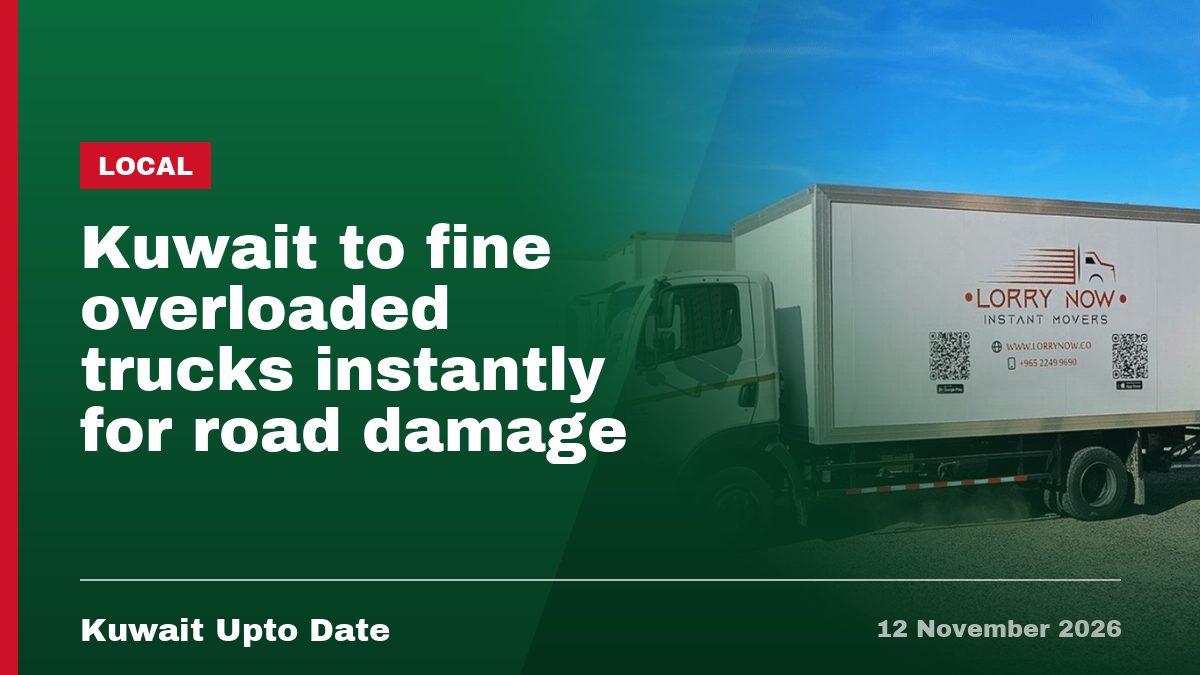
If you drive behind a heavy truck on Kuwait’s highways and wonder why the road surface looks cracked or sunken in places, the government has an answer – and a new way to deal with it.
First Deputy Prime Minister and Minister of Interior Sheikh Fahad Al-Yousef says owners and transport companies whose overloaded trucks are proven to have damaged roads will now face immediate fines, instead of waiting months for court cases to finish.
- Fines will be issued once road damage is proven, without waiting for legal proceedings to end
- The crackdown targets overloading, driving outside designated truck lanes, and poor brakes or tyres
- The move follows visible road deterioration caused by heavy vehicles exceeding weight limits
- The ministry wants closer coordination with transport companies to stop repeat violations
Why the ministry is acting now
Sheikh Fahad Al-Yousef linked the decision directly to worsening road conditions around Kuwait. Heavy trucks carrying loads beyond their permitted weight limits have been blamed for cracked asphalt and weakened road surfaces on routes used daily by ordinary drivers.
This isn’t the ministry’s first move against heavy vehicles this month. As we reported on 11 November, Kuwait announced plans to fine vehicles on the spot for damaging roads. Today’s statement from Sheikh Fahad Al-Yousef confirms and expands on that plan, making clear the fines won’t wait for court proceedings to wrap up.
What exactly gets fined
The tougher penalties don’t stop at overloading alone. Three separate violations are now covered under the crackdown:
- Carrying loads heavier than a truck’s permitted weight limit
- Driving outside designated truck lanes on highways
- Failing to maintain brakes and tyres in safe working condition
Together, these three issues are the most common reasons heavy vehicles cause both road damage and accidents involving smaller cars sharing the same lanes.
So who does this affect?
The fines target truck owners and the transport companies that operate them, not ordinary car drivers. But the knock-on effect reaches everyone who uses Kuwait’s roads.
Worn, overloaded trucks are a safety risk for every driver nearby, and road repairs funded by taxpayers add up over time. If this crackdown reduces overloading, drivers should eventually see fewer potholes, fewer sudden lane changes by trucks trying to avoid weighing stations, and safer highways overall.
Transport companies, meanwhile, will need to review their fleets closely. Brakes, tyres and load limits that used to be minor paperwork issues could now mean an immediate financial penalty, with no chance to argue the case in court first.
Read more Local news from Kuwait on how transport rules are changing.
The story so far
- 11 November: Kuwait first announced it would fine vehicles on the spot for damaging roads.
- 12 November: Sheikh Fahad Al-Yousef confirmed fines will be immediate, covering overloading, lane violations and poor brakes or tyres.
This fits a wider pattern of stricter enforcement on Kuwait’s roads this year. Authorities have already logged over 1.1 million traffic violations in five months, stepped up checks on delivery bikes and cycle riders, and even jailed a driver over repeated speeding. Heavy trucks appear to be the next focus.
What this means for people living in Kuwait
For ordinary residents and citizens, nothing changes about how you drive. But you may start noticing fewer overloaded trucks on main routes, and possibly more inspection points where weight and vehicle condition get checked.
For businesses that rely on heavy transport – construction firms, logistics companies, import-export operators – this is a clear signal to review vehicle maintenance schedules and load limits now, rather than waiting for an inspection to catch a problem.
Quick answers
Who gets fined – the driver or the company?
The statement names both owners and transport companies as responsible once road damage from an overloaded truck is proven.
Do fines still require a court case?
No. Sheikh Fahad Al-Yousef said fines will be enforced once responsibility is established, without waiting for legal proceedings to finish.
What other issues are covered besides overloading?
Driving outside designated truck lanes and failing to maintain brakes or tyres are both included in the tougher penalties.
If you drive a truck for work, or run a transport company, this is the moment to check your fleet before an inspection checks it for you. Have you noticed more truck inspections on Kuwait’s highways lately? Share what you’ve seen in the comments.
Latest News
 Local
How to apply for Kuwait’s new freelance business licence
2 International Kuwait to link deportee fingerprint data electronically with GCC Read more → 3 International ‘Instagram King’ arrested. Read more → 4 Local New Jira Park in Kuwait Read more → 5 Local Kuwait is checking small repeated transfers Read more → 6 Local Kuwait to fine vehicles on the spot for damaging roads Read more → 7 International Saudi coalition shoots down two Houthi drones over Mecca Read more → 8 Local Puppy found at Kuwait base reunites with US couple after 6 months Read more → 9 Local Kuwait warns of fake Interior Ministry scam on WhatsApp Read more → 10 Local Kuwait lawyers told to stop promoting on TikTok Live Read more → 11 International Saudi forces down 3 Houthi missiles aimed at Riyadh Read more → 12 International Kuwait, Pakistan PMs meet at COP31 to boost ties Read more → 13 Local What Warba Bank’s MENA award win means for Kuwait banking Read more → 14 International New Covid variant PJ.2.1 spreads worldwide Read more → 15 International Canada makes rural immigration permanent from 2027 Read more →
Leave a Reply