


By the time the first wall came down in Jleeb Al-Shuyoukh, the owners already knew one thing for certain: they would be the ones paying for it. Kuwait Municipality confirmed that property owners must bear the full cost of demolition and removal, not the government.
https://twitter.com/Awwalkwt/status/2115143478552485895
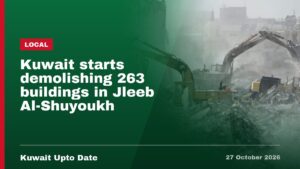
That detail landed hard for people already watching their buildings disappear. As we reported when demolition began on 27 October, the municipality started pulling down structures across the area after weeks of warnings. Now the financial side of the story is becoming clear too.
- Kuwait Municipality has started demolishing violating buildings in Jleeb Al-Shuyoukh.
- Property owners must pay the full cost of demolition and removal themselves.
- This follows an earlier order covering 263 buildings in the area.
- The municipality has not yet detailed exact costs or payment deadlines.
How this all started
This story didn’t begin with the bulldozers. It began weeks earlier, when the municipality ordered the demolition of 263 buildings in Jleeb Al-Shuyoukh on 4 October. Officials said the buildings had violations serious enough to require full removal, though the exact nature of each violation was not detailed publicly at the time.
For nearly three weeks, the order sat on paper. Owners presumably had time to respond, appeal, or prepare. Then, on 27 October, the municipality moved from paperwork to action and began tearing down the first structures.
Now, barely a day later, the municipality has confirmed the part many owners were probably dreading: they will not just lose their buildings, they will also have to pay to have them removed. The announcement does not specify how much this will cost, how the municipality will calculate the fees, or when owners must settle the bill.
Who does this affect?
Anyone who owns a building in Jleeb Al-Shuyoukh named in the 263-building demolition order is affected. This is a densely populated area of Kuwait, home to many expat workers who rent rooms and flats in exactly these kinds of buildings. If you’re a tenant there, your immediate concern is finding new accommodation. If you’re an owner, the concern is now financial as well as legal.
It’s worth remembering that Jleeb Al-Shuyoukh has been under close municipal and police attention for other reasons too. Earlier this month, authorities investigated a case involving children used to mask drug drops in the same area, and in a separate but related enforcement push, Kuwait cut power to homes over bachelor housing violations earlier in October. Together, these actions paint a picture of a sustained crackdown on unlicensed housing and building violations across the district.
A similar enforcement drive happened in Farwaniya, where officials recently shut illegal businesses and arrested 15 workers. Jleeb Al-Shuyoukh’s demolition drive looks like part of a wider municipal effort to clean up violations across several governorates.
What owners should do now
The municipality’s announcement does not include a step-by-step process for owners, but based on how these orders usually work in Kuwait, here is what owners in the affected buildings should expect to deal with:
- Check whether your building is on the municipality’s list of 263 violating properties from the 4 October order.
- Contact Kuwait Municipality directly to confirm your building’s demolition status and ask about cost estimates.
- Ask about any appeal process still open to you, if demolition at your property has not yet started.
- Arrange for any tenants to vacate the property if this has not already happened.
- Keep records of any payments or notices from the municipality, in case disputes arise later over the cost charged.
More local news in Kuwait is likely to follow as the municipality works through the remaining buildings on its list.
What this means for people living in Kuwait
For citizens and expats renting in Jleeb Al-Shuyoukh, this mainly means disruption: buildings coming down, people needing to move, and landlords dealing with sudden costs. For owners, it’s a direct financial hit on top of losing the property itself. For the wider area, it signals that the municipality is serious about enforcing its 4 October order and is not backing down on cost responsibility.
Quick answers
Does the government cover any of the demolition cost?
No. The municipality has stated that property owners bear the full cost of demolition and removal.
How many buildings are affected in total?
The original order covered 263 buildings in Jleeb Al-Shuyoukh, issued on 4 October.
When did demolition actually start?
Demolition work began on 27 October, according to earlier reporting on this story.
If you own property in Jleeb Al-Shuyoukh, now is the time to call the municipality and get clarity on where your building stands, before the costs catch you off guard. Have you or someone you know been affected by this? Let us know in the comments.
📌 Related stories


Latest News
 International
US tells Gulf states to brace for possible Iran strikes
 2
Kuwait Facts
Read more →
 3
Local Kuwait approves excise tax plan
Read more →
 4
Local Kuwait Zoo chimp death reveals first case
Read more →
 5
International Philippines e-Visa Launches in Dubai: What It Means for You
Read more →
 6
International Saudi Arabia Launches Digital Entry App for GCC residents.
Read more →
 7
International 315 people are missing
Read more →
 8
Local Kuwait court sentences 3 to death over plot to kill minister
Read more →
 9
Local Kuwait minister warns firms over late salaries to expats
Read more →
 10
Local Indian expat held in Kuwait over maid-hiring fraud scam
Read more →
 11
Local Kuwait sets KD 200 fee to appeal medical liability
Read more →
 12
International US Orders Non-Emergency Staff to Leave Saudi Arabia
Read more →
 13
International Trump: Iran strike possible ‘tomorrow’, deal still open
Read more →
 14
Local Transfer your money in seconds
Read more →
 15
International world’s first 24-carat gold walking path.
Read more →
Leave a Reply