

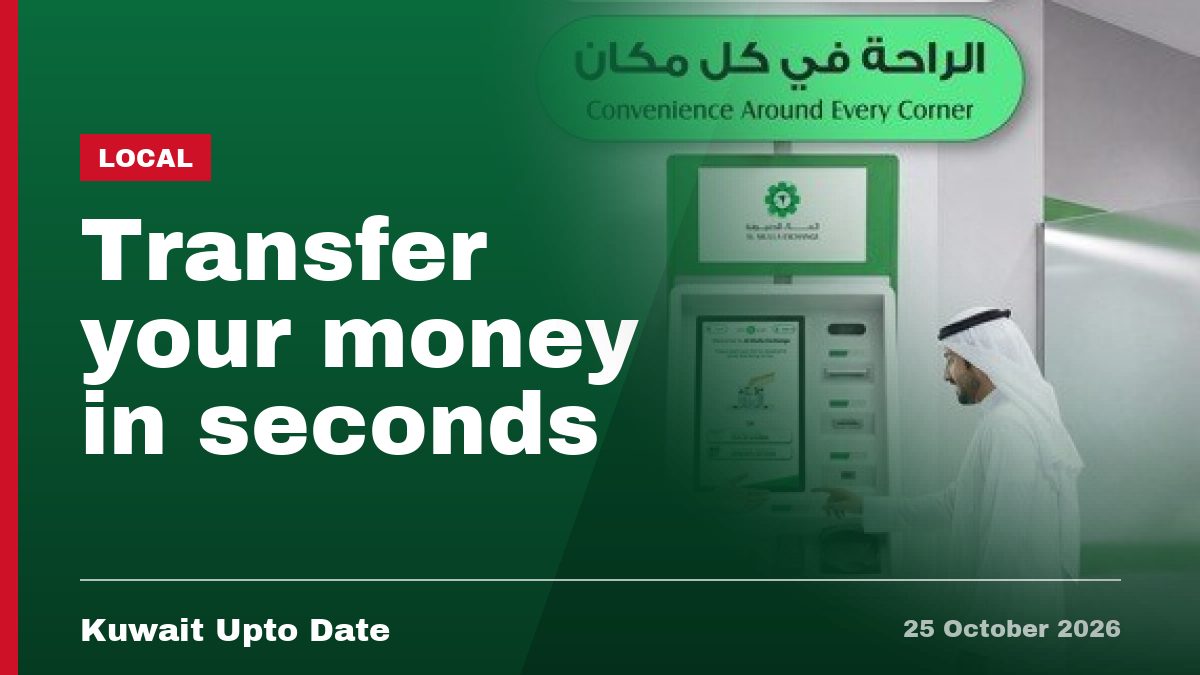
Workers in Kuwait sent out $16.7 billion in 2025, and most of them never had to stand in a queue to do it.
That’s the real story behind a quiet change in how money leaves Kuwait. A few years ago, sending your salary home meant a trip to the nearest exchange house, a wait for your turn, and a paper receipt you kept until the money landed. Today, many people never leave their sofa. They open an app, pick the person they’re sending to, check the exchange rate, confirm the transfer, and watch it go through on the same screen.
The distance between Kuwait and a worker’s family hasn’t changed. But the journey the money takes has become much shorter. For more on how daily life in Kuwait is changing, see our latest local news.
- Kuwait’s outward remittances reached about $16.7 billion in 2025, up 18.2% on the year before, according to the Gulf Statistical Centre.
- Banks and exchange companies are now competing mainly through their apps, not just branch numbers or exchange rates.
- Transfers can land in minutes or instantly in some cases, depending on the destination country, receiving bank and verification steps.
- Branches haven’t disappeared. Many people still use them for cash transactions or help with beneficiary details.
So why is the remittance figure going up?
The $16.7 billion figure covers money sent by workers in Kuwait to families and accounts abroad during 2025. It’s a jump of 18.2% from the previous year, based on data from the Gulf Statistical Centre. This isn’t a one-off transaction. It reflects a market that runs all year round, driven by workers who regularly send part of their income to relatives in different countries.
That steady, repeated demand is exactly why banks and exchange companies keep investing in both digital channels and physical branches at the same time. More transfers happening more often means more pressure to make each one fast, clear and reliable.
How did the branch end up in your pocket?
Smart apps changed a big part of the experience. Someone who used to need a branch visit just to ask about transfer details can now enter the recipient’s information, check the amount, the fees and the exchange rate on offer, then send the money and track it, all from the same app.
On some transfer routes, the money reaches the beneficiary’s account quickly, sometimes instantly, sometimes within minutes. It depends on the destination country, the receiving bank or payment method, and the verification checks each institution applies. For someone who transfers money regularly, that difference matters. A task that once needed a slot in your day can now be done from home or work, whenever suits you.
This isn’t only about expat workers
It’s easy to assume this story is only about expatriate workers sending salaries home, but it’s wider than that. Kuwaiti citizens also use these same transfer services, sending money to other Gulf countries and around the world, for family needs, education costs, medical treatment, or to pay for goods, services or obligations outside Kuwait.
As banking apps and exchange company platforms have improved, these transactions have become easier and faster too. Users can send and track transfers from wherever they are, and choose between a bank or an exchange company depending on where the money needs to go, the type of transaction, and how fast it needs to arrive. In other words, the user base for transfer services has widened. It’s no longer just about sending a salary home. It now covers a much broader range of cross-border financial needs for citizens and residents alike.
Do exchange house branches still matter?
Yes, despite the digital shift, branches haven’t gone away. Networks of exchange company branches spread across Kuwait still make up an important part of the market, especially for people who prefer dealing with someone face to face, want to use cash, or need help entering beneficiary details or asking about transfer and collection options.
So the choice today isn’t really branch versus app. It’s both together. A nearby branch when you want to deal with someone in person, and an app in your pocket when you want to finish the job without leaving where you are. This mix lets banks and exchange companies serve different kinds of customers and reach more people, instead of being tied to one place or one method.
<p>[EDITOR NOTE: your own experience comparing sending money through an exchange house branch versus a banking app in Kuwait]</p>
What changed in the competition between banks and exchange companies?
The rules of competition have shifted too. The number and location of branches is no longer the only thing that draws a customer, and the exchange rate alone is no longer the only point of comparison between providers.
Today, the decision includes how easy the app is to use, how many steps the transfer takes, how clear the fees are, the exchange rate on offer, how fast the money arrives, the ways it can be collected, and whether the sender can track the transfer. Competition has gradually moved from the exchange house counter to the phone screen, and the user experience has become part of the value of the service itself.
What about safety, if everything happens on a screen?
Faster transfers don’t mean fewer protections. Behind the few steps a customer sees on their phone, there’s a system working to verify identity and beneficiary details, monitor transactions, and secure login access to the app. This sits alongside compliance requirements and anti-money-laundering and counter-terrorism-financing rules.
This is one of the more important parts of the digital shift: the process looks simple to the user, while a more complex system works behind the screen to protect it. At the end of the month, a worker sending part of their salary home, or a citizen transferring money to settle a payment abroad, isn’t thinking about any of that. They just want their money to arrive quickly and safely, with as little time and hassle as possible.
Quick answers
How much money left Kuwait through remittances in 2025?
About $16.7 billion, according to the Gulf Statistical Centre, an increase of 18.2% compared with the previous year.
Is this only relevant to expat workers?
No. Kuwaiti citizens also use banks and exchange companies to send money abroad, for family, education, medical and other payments.
How fast do transfers arrive now?
It varies by destination, receiving bank or payment method, and verification steps. Some transfers can be instant or arrive within minutes.
What should I do to keep my transfer safe?
Use official apps and channels, double-check the beneficiary’s details before confirming, and never share your password or verification codes with anyone.
What this means for you
If you’re one of the thousands of residents sending part of your pay home each month, this shift means less time spent on the errand and, often, faster delivery. If you’re a citizen sending money abroad for family, education or medical costs, the same apps now work for you too.
Either way, the advice behind the scenes stays the same: pick a licensed bank or exchange company, check the fees and exchange rate before you confirm, and keep your login details to yourself. Do you send money abroad from Kuwait regularly, and has switching to an app actually made it faster for you? Tell us in the comments.
📌 Related stories
 Local Video – Kuwait traffic police step up checks on delivery riders
 Local ** New Rule – If you drive car of someone else then you will be responsible of all traffic fines.
 Local Kuwait deports 194 expats in September drug crackdown
 Local Shopping of KD 700 in Kuwait Just by registering yourself in app, enjoy.
Latest News
 International
world’s first 24-carat gold walking path.
 2
International What the New US Travel Advisory for Saudi Arabia and UAE
Read more →
 3
International What Trump’s latest Iran strike warning mean.
Read more →
 4
Local Fake Germany job offer costs Hawally woman KD 1,000
Read more →
 5
Local 8,849 Kuwait firms flagged over late salary payments
Read more →
 6
International Russia in talks with Kuwait on visa-free travel deal
Read more →
 7
International USA Loaded missiles on warships against Iran
Read more →
 8
Local Kuwait arrests 3 for hiding e-cigarettes in food deliveries to teens
Read more →
 9
Local Jazeera Airways surprises passengers with mid-air orchestra show
Read more →
 10
International 5 new K-dramas Kuwait is streaming now: from Make Me Tingle to Doctor X
Read more →
 11
International Trump threatens new Iran strikes
Read more →
 12
Part Time Job in Kuwait: How to Earn Extra Money Legally (2026 Expat Guide)
Read more →
 13
Local Two Sri Lankan women found dead, the mysterious case
Read more →
 14
Local Life in Kuwait for the Filipino community: what to know
Read more →
 15
International US weighs ‘Mother of All Bombs’ strike plan on Iran
Read more →
Leave a Reply