

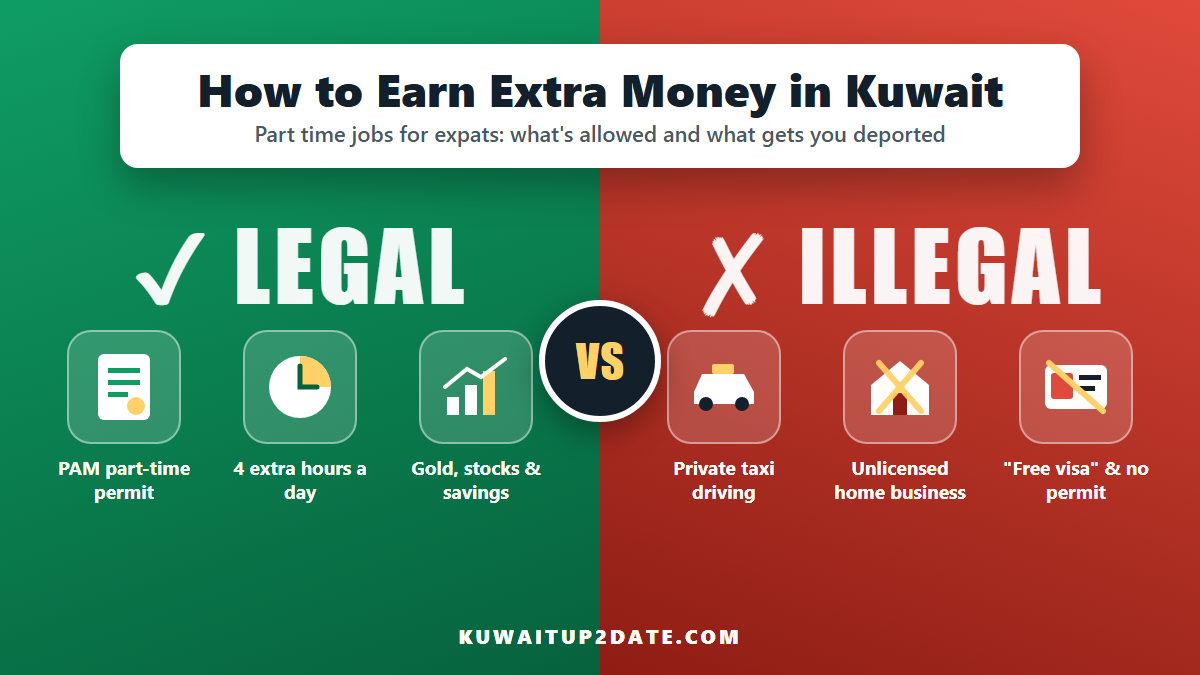
Your salary arrives on the 1st. By the 20th, it’s gone. Rent, school fees, money sent home, the car loan, and that one surprise bill. If that sounds familiar, you’re in good company. Thousands of expats in Kuwait search every month for one thing: “How can I earn extra money without getting into trouble?”
That last part is the important bit. In Kuwait, picking the wrong side hustle can cost you far more than it pays: your residency, your job, and sometimes a ban on coming back. The good news is that there are legal ways to earn more. Most people just don’t know how they work.
This guide covers all of them in clear categories with step-by-step instructions: the official part-time work permit, overtime rights, smart investing, income from your home country, and the new freelance residency Kuwait has announced. We also list the “easy money” ideas that get expats deported, so you know what to stay away from.
- The golden rule: why “just helping a friend’s company” can get you deported
- Category 1: The official part-time work permit (step by step)
- Category 2: Earn more from your current job
- Category 3: Make your money work (investing & saving)
- Category 4: Income from outside Kuwait
- Category 5: Bigger moves: freelance visa, investor residency, your own company
- The red zone: side jobs that get expats deported
- Your 30-day action plan
- FAQs
1. The Golden Rule: You Belong to One Employer, Unless the Law Says Otherwise
Most expats in Kuwait’s private sector hold an Article 18 residency. Your work permit is tied to one employer, your sponsor. Legally, that is the only company you can work for.
That means each of these is illegal without the proper permit, even if it’s “only on weekends” or “just for a friend”:
- Doing evening shifts at a restaurant or shop owned by someone else
- Doing paid accounting, IT, or design work for another Kuwaiti company
- Working at a cousin’s business “unofficially”
Kuwait has been strict about this. The Ministry of Interior runs regular inspection campaigns, and officials have said that around 39,000 expatriate workers were deported in one year for breaching labour-market rules. The worker usually pays the price: deportation, a cancelled residency, and often a ban on returning. Employers who hire illegally face heavy fines and can lose their licence.
Government employees on Article 17 residency face even tighter limits. They cannot take outside work unless their government employer formally approves it.
2. Category 1: The Official Part-Time Work Permit 100% LEGAL
This is the change many expats still haven’t heard about. Since January 2024, the Public Authority for Manpower (PAM) has allowed private-sector expats who already live and work in Kuwait to take a second, part-time job with another employer, legally, with a dedicated permit.
The key rules at a glance
| Rule | What it means for you |
|---|---|
| Who can apply | Expats already resident in Kuwait with a valid private-sector work permit (Article 18) |
| Main employer’s approval | Mandatory. You need your sponsor’s written approval / No Objection Certificate (NOC) |
| Maximum hours | Up to 4 hours per day with the second employer (the contracting sector is exempt from this cap) |
| Who applies | The second employer applies on PAM’s Ashal portal |
| Sector | Private sector only |
| Not eligible | Government (Article 17) employees without official approval from their ministry |
Permit fees
| Permit duration | Fee |
|---|---|
| 1 month | KD 5 |
| 3 months | KD 10 |
| 6 months | KD 20 |
| 12 months | KD 30 |
Fees as announced at launch. Check the current amount on Ashal/Sahel before paying.
For KD 30 a year, you can earn extra income every month with no risk to your residency. That’s one of the best deals available to expats in Kuwait.
Step by step: how to get a part-time permit
- Find a licensed second employer. The company must hold a valid commercial licence and be able to hire expats (it needs available quota). Check our Jobs in Kuwait page for openings, and look for evening or weekend roles in retail, training, F&B, IT support, and accounting.
- Talk to your current employer, honestly. Explain that the part-time role won’t affect your main job’s hours or performance. Ask for a written approval / NOC. Without it, nothing moves forward.
- Agree on a 4-hour-a-day schedule with the new employer, outside your main working hours.
- Hand your documents to the second employer. These usually include:
- A copy of your passport and Civil ID
- A copy of your residency and current work permit
- A copy of your main employment contract
- Your main employer’s NOC
- The part-time offer letter
- The second employer applies on PAM’s Ashal portal and pays the permit fee for the duration you agreed.
- Track the approval in the Sahel app. Keep the approved permit saved on your phone and carry a copy while working. Inspectors may ask for it.
- Renew before expiry. If the permit expires and you keep working, you’re back in illegal territory.
3. Category 2: Earn More From the Job You Already Have LEGAL
The safest extra income is often hidden inside your current contract. Here’s how to unlock it.
Step 1: Claim your overtime properly
Under Kuwait’s Private Sector Labour Law (No. 6 of 2010), overtime must be paid at a higher rate than your normal hourly wage, and there are higher rates for work on your weekly rest day and on official holidays. There are also legal caps on how many overtime hours you can be asked to work. If you’re putting in long hours without overtime pay, you may be owed money. Check the exact percentages in our Kuwait Labour Law guide.
Step 2: Use internal opportunities
- Volunteer for projects with bonuses, sales incentives, or commission
- Ask about allowances you may qualify for: transport, housing, phone, or a “skill allowance”
- Ask HR about remote-work arrangements. PAM has allowed employers to let some staff work remotely, which saves you commute time and fuel
Step 3: Get certified and negotiate a raise
In Kuwait, the gap between a certified and an uncertified professional can be hundreds of dinars a month. Accountants (CPA/ACCA/CMA), IT staff (cloud and cybersecurity certifications), engineers (Kuwait Society of Engineers accreditation), nurses, and HR professionals (CIPD/SHRM) all see clear pay jumps. Many certifications can be studied online in your free time. That’s legal, and it’s an investment in yourself.
Step 4: Switch to a better-paying employer, the legal way
Sometimes the biggest raise is a new job. PAM allows private-sector residency transfers between employers, subject to conditions such as time served and sponsor approval. These rules are updated regularly, so check the current transfer conditions in the Sahel app before you resign. Before you move, calculate what you’ll walk away with using our Indemnity Calculator, and compare offers using the Kuwait Cost of Living & Salary Savings Calculator.
4. Category 3: Make Your Money Work for You LEGAL
Here’s what many people miss: earning more and keeping more add up to the same thing. Investing your own savings is not “work,” so it doesn’t break any sponsorship rule. It’s personal financial management.
Option A: Gold
Gold is a classic for Kuwait residents. It’s easy to buy at Gold Souq Mubarakiya or from banks, simple to hold, and you can take it home when you leave. The secret is buying at the right price and knowing the making charges. Watch rates daily on our Kuwait Gold Tracker.
Option B: Boursa Kuwait shares and funds
Residents can open an investment account through a licensed brokerage or bank and invest in listed Kuwaiti companies, mutual funds, or sukuk. Steps:
- Choose a brokerage licensed by the Capital Markets Authority (CMA)
- Open an account with your Civil ID and passport
- Start small, and only invest money you won’t need for at least 2–3 years
- Prefer dividend-paying companies or diversified funds if you’re a beginner
Option C: Savings and deposit products
Fixed deposits, Islamic investment deposits, and savings accounts from Kuwaiti banks pay a predictable return. They won’t make you rich, but they beat cash sitting in your current account.
Option D: Cut the “silent costs”
- Use our Kuwait Loan Calculator before taking any loan. Paying off a high-interest loan early is a guaranteed “return”
- Compare remittance exchange rates instead of always using the same exchange company
- Use credit-card cashback and bank reward programmes on spending you already do
- Sell your own unused items (furniture, electronics) when you move. That’s fine; buying and reselling as a business is not
5. Category 4: Income From Outside Kuwait LEGAL, WITH CARE
Many expats build a second income stream back home. This is generally the safest long-term plan, because it keeps paying even after you leave Kuwait.
Ideas that work for Kuwait expats
- Property back home: buy or build and rent it out. Your family can manage tenants
- A family business at home: invest in a shop, farm, or small franchise run by a trusted relative
- Home-country investments: pension schemes, mutual funds, and NRI/overseas-worker accounts (many countries offer tax benefits for overseas workers)
- Digital products: e-books, courses, templates, or stock photos you create once and sell globally
About online freelancing from Kuwait
Doing paid online work for foreign clients (on Upwork or Fiverr, for example) while on an Article 18 visa is a grey area. Kuwaiti law doesn’t clearly regulate it, and freelance licences inside Kuwait are reserved for citizens (see below). To stay on the safe side:
- Never do it during your sponsor’s working hours or with company equipment
- Read your employment contract. Many include clauses that ban outside work or competing work
- Never serve clients inside Kuwait without a proper permit. That is clearly illegal
- Get advice from a Kuwaiti lawyer if it becomes a serious income
About social media and influencer income
Paid advertising and promotions on social media in Kuwait are regulated, and expats can’t simply start a commercial page selling products or services locally. Personal content is fine. Commercial promotion inside Kuwait needs the right licensing, so check before accepting paid deals.
6. Category 5: The Bigger Moves FOR THE AMBITIOUS
A. The new freelance residency (announced)
In February 2026, Kuwait’s First Deputy Prime Minister and Interior Minister, Sheikh Fahad Al-Yousef, announced plans for a freelance residency permit. It would let expats live and work in Kuwait without a traditional sponsor. Here’s what was reported:
- An annual government fee of around KD 750 – 1,000
- The main aim is to end “visa trading,” where workers pay illegal fees to fake sponsors
- The first phase focuses on simpler professions, with skilled freelancers (IT, design, consulting) expected to benefit
- Expected requirements include a verified residential address, an approved email account, and clean personal records
Status: at the time of writing, full eligibility rules and the official launch date had not been confirmed. Don’t pay any agent who claims to “sell” this visa. When it opens, it will be through official Ministry of Interior channels. We’ll cover the launch on Kuwait Up2Date, so check back.
B. Freelance and home-business licences: citizens only
Kuwait has a modern freelance licence with low capital and online issuance. But a 2025 Ministry of Commerce decision restricted 120 freelance activities to Kuwaiti citizens, and expats cannot be founders, partners or managers. Home-business licences are also for citizens. If someone offers to “put a licence in a Kuwaiti’s name” for you, that’s a front arrangement and risky for both parties.
C. Investor and property-owner residency
Kuwait has introduced long-term residency routes for foreign investors, reported as up to 15 years, and for real-estate owners, reported as 10 years, with applications reviewed case by case. Foreign investors can also set up companies through the Kuwait Direct Investment Promotion Authority (KDIPA). These routes suit people with serious capital. They aren’t a side hustle, but they’re worth knowing about if you plan a long future in Kuwait.
7. The Red Zone: Side Jobs That Get Expats Deported AVOID
These are the most common “easy money” ideas, and the most common reasons expats lose everything:
| ❌ Side job | Why it’s risky |
|---|---|
| Working for another company without a part-time permit | Breaks residency and labour law. Can lead to deportation and a ban |
| Driving people for money in your private car (illegal taxi) | Traffic and residency violation. Car impounding and deportation are common |
| Private home tuition without authorisation | Repeatedly targeted by authorities. Teachers have been deported |
| Cooking or baking from home and selling it | Needs a licence that expats can’t hold. Also breaks health regulations |
| Unlicensed beauty, salon, or massage services at home | Illegal activity and frequently raided |
| Buying a “free visa” or working for a sponsor who doesn’t actually employ you | Visa trading is a major crime focus in Kuwait. You can be deported even if you paid |
| Running a business in a Kuwaiti’s name (front business) | Illegal for both parties. You have no legal protection if things go wrong |
| “Investment” schemes promising fixed monthly profits | Usually scams or illegal fund collection |
8. Your 30-Day Action Plan
- Days 1–3: Audit your money. Run your numbers through the Cost of Living & Savings Calculator. Find out how much you actually need extra each month.
- Days 4–7: Check what you’re already owed. Review overtime, allowances, and your end-of-service benefit (Indemnity Calculator).
- Days 8–14: Look for a part-time role. Browse Jobs in Kuwait and shortlist employers willing to apply for a PAM part-time permit.
- Days 15–20: Get your sponsor’s NOC. Present the schedule and request written approval.
- Days 21–25: Permit in hand. The new employer applies on Ashal, and you track it on Sahel.
- Days 26–30: Put the extra income to work. Set up an automatic monthly transfer to savings, gold, or an investment account, so the extra money doesn’t quietly get spent.
9. Frequently Asked Questions
Can I do a part-time job in Kuwait on a family (Article 22) visa?
A dependant on a family visa can’t simply work. They usually need to transfer to a work residency (Article 18) through an employer first, under PAM’s current transfer rules. Check the latest conditions on Sahel.
My sponsor refuses to give an NOC. What can I do?
Without your main employer’s approval, you can’t legally get a part-time permit. Your options are to negotiate (fewer hours, non-competing field), focus on the investing and home-country options above, or move to an employer who is more flexible.
Can government (Article 17) employees do part-time work?
Only with formal approval from their government employer. The PAM part-time permit is designed for the private sector.
Is selling my own used items on 4Sale or Instagram legal?
Selling your personal belongings is normal. Regularly buying goods to resell for profit, however, is commercial activity that needs a licence.
Has the freelance residency launched?
It was announced in February 2026 with an expected fee of KD 750–1,000 per year, but the final rules had not been confirmed when this article was written. Only trust announcements from the Ministry of Interior.
Does the new exit permit affect part-time workers?
Since July 2025, private-sector expats need an employer-approved exit permit (via Sahel/Ashal) before travelling. It doesn’t stop part-time work, but your main sponsor still controls your exit permit. That’s one more reason to keep a good relationship with them.
Final Word
Earning extra money in Kuwait is possible. It just has to be done the right way. Start with the PAM part-time permit, claim everything your current job owes you, invest what you save, and build income back home. Watch for the freelance residency, which could become the biggest change for expats in years.
Found this useful? Share it with a friend who’s always asking about side jobs. It might save their residency. And bookmark Kuwait Up2Date for the latest updates on Kuwait labour law, jobs, and expat life.
Sources: Fragomen: Kuwait launch of part-time work permits · Arab Times: part-time work now a viable option · Lexis Middle East: part-time work permits launched · Gulf News: Kuwait plans freelance visa · Gulf News: 120 freelance activities restricted to citizens · Deloitte: Kuwait exit permit for expatriate workers
Latest News
 Local
Two Sri Lankan women found dead, the mysterious case
 2
Local Life in Kuwait for the Filipino community: what to know
Read more →
 3
International US weighs ‘Mother of All Bombs’ strike plan on Iran
Read more →
 4
International Trump signals more US strikes possible against Iran
Read more →
 5
Local Driver tries to stab another with a pen in Abu Halifa
Read more →
 6
Local Kuwait Orders Airport Fees Shown Clearly on Air Tickets
Read more →
 7
Local The best country to live in GCC ?
Read more →
 8
Local Kuwait suspend the license of 2,000 companies
Read more →
 9
Local Kuwait frees prisoners under Amiri pardon.
Read more →
 10
Local Sahel app adds lost passport service for Kuwait expats
Read more →
 11
Local Kuwait jails 2 Egyptians 7 years over KD 161,000 web scam
Read more →
 12
Local Kuwait studies cap on workers of one nationality per firm
Read more →
 13
Local Video – Kuwait traffic police step up checks on delivery riders
Read more →
 14
International Pakistan-Iran border tension: trucks blocked, Iran warns of closure
Read more →
 15
International Soon will be action, Trump says no Iran talks.
Read more →
Leave a Reply