

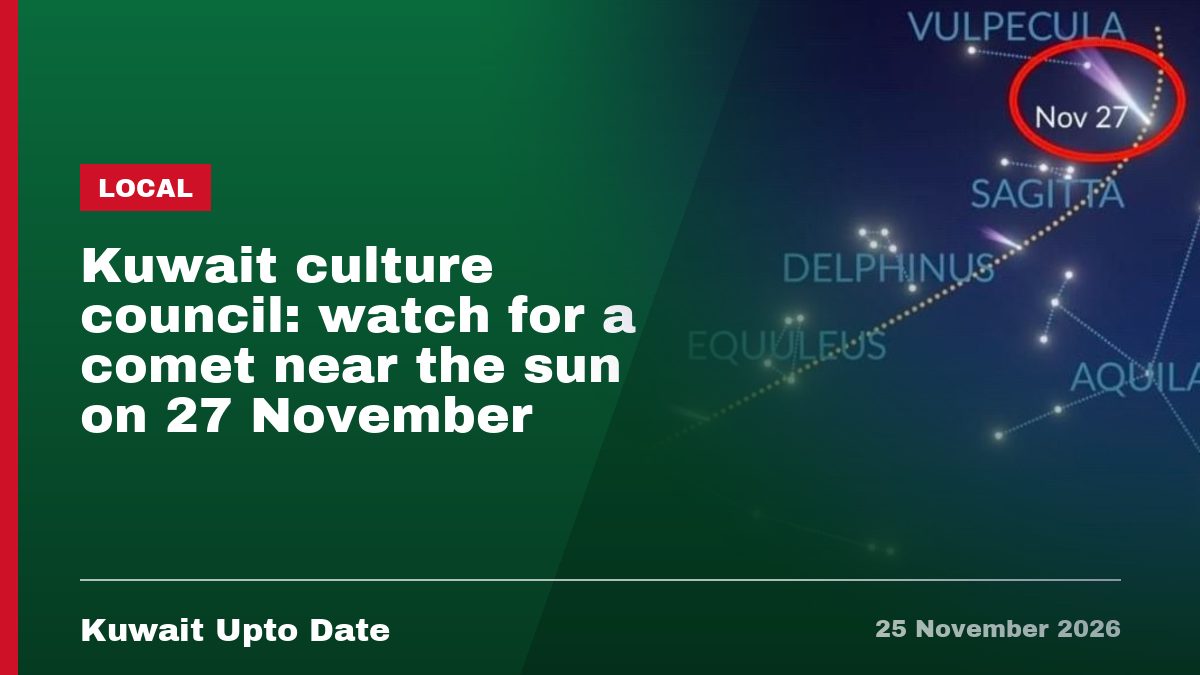
A comet is heading for its closest point to the sun this Friday, 27 November.
That’s the word from Kuwait’s National Council for Culture, Arts and Letters (NCCAL), which says a comet is currently passing through the solar system this month. The council is asking anyone interested in astronomy or space to try to observe and photograph it as it goes by.

If you’ve been keeping an eye on the sky lately, this fits into a busy run of events. We’ve already covered six sky events to watch over Kuwait this November, and now there’s one more to add to the list.
- A comet is passing through the solar system during November 2026, according to NCCAL.
- It reaches its closest point to the sun, called perihelion, on 27 November.
- NCCAL is calling on astronomy and space fans in Kuwait to watch and photograph it.
- No name, size, visibility details or exact viewing times have been given yet.
So what comet is this, exactly?
Here’s the honest answer: we don’t fully know yet. NCCAL’s announcement names no specific comet, and gives no details on its size, brightness or orbit. That’s a real gap, and it matters, because not every comet is visible to the naked eye. Many need a telescope or strong binoculars to see at all.
What we do know is the timing. The council says the comet is moving through the solar system this month and will hit its closest approach to the sun on 27 November. That moment is called perihelion, and it’s often when a comet is at its brightest, because the sun’s heat is causing more of its ice and dust to vaporise into the glowing tail we associate with comets.
Until NCCAL or an observatory shares more, treat any claim about naming the comet, its exact brightness, or whether it’ll be visible without equipment as unconfirmed.
Why does the closest point to the sun matter?
Perihelion is the part of a comet’s journey when it’s nearest the sun, and usually when it puts on its best show. The heat causes the comet to release more gas and dust, which is what makes the tail brighter and sometimes longer. This is also, though, a stage when some comets break apart if they can’t handle the heat and gravity pulling at them. NCCAL hasn’t said whether there’s any risk of that with this particular comet.
For regular skywatchers, the days right around perihelion are typically the window worth watching. With the date set as 27 November, that gives Kuwait residents a specific point to aim for, even without a confirmed comet name.
What this means if you live in Kuwait
This announcement is aimed squarely at the public, not just professional astronomers. NCCAL’s call for people to observe and photograph the comet suggests this is meant to be a shared, accessible moment, not a specialist-only event.
In practice, that means: if you’ve got binoculars, a basic telescope, or even just a clear view away from city lights, this is worth a look around 27 November. Kuwait’s desert surroundings outside the main cities can offer darker skies than you’ll get from a balcony in a busy area, which usually makes a real difference for anything faint.
We’ve seen plenty of interest in sky events in Kuwait lately. Back on 2 November, we covered the Moon, Jupiter and Mars lining up over Kuwait between 2:00am and 5:00am, and just days before that we wrote about Earth’s new mini-moon, which is due to leave by early 2027. A comet reaching perihelion fits right into that same stretch of an unusually active month for skywatchers here.
For more on what else is happening above Kuwait, you can check our local news coverage, where we’ll post any update if NCCAL names the comet or gives clearer viewing times.
Quick answers
Will I be able to see the comet with my eyes alone?
It’s not yet confirmed. NCCAL hasn’t said how bright this comet will be, so it may need binoculars or a telescope to spot clearly.
What time should I look on 27 November?
No specific viewing time has been given. Perihelion is a date, not an exact hour, so the comet may be visible, if at all, over a range of nights around that date rather than only on it.
Is there any danger from the comet passing close to the sun?
NCCAL’s statement doesn’t mention any risk to Earth. Perihelion is a normal part of a comet’s orbit and happens regularly for comets that swing near the sun.
Where can I get updates if more details come out?
Keep an eye on NCCAL’s own announcements, and we’ll update our coverage here if a name, brightness estimate, or clearer viewing guidance is released.
If you do try to catch it, we’d love to hear in the comments whether you managed to spot anything on or around 27 November.
Latest News
International
Indian travellers need visa from January 2027
2 International Trump unveils fresh tariffs of up to 20% on 14 countries including India Read more → 3 In Kuwait, You’re Punished Today for a Mistake You Made 15 to 30 Years Ago Read more → 4 International Plane crash kills family of six, including two boys Read more → 5 Local Kuwait lets teens apply for learner permit via Sahel app Read more → 6 International Emirates hiring 120+ staff, cabin crew pay near KD 940 a month Read more → 7 International Israel accuses Iran of chemical weapons programme, more strikes possible Read more → 8 International GTA 6 sales hit 47.8 million copies Read more → 9 Local Kuwait’s population mix from 1990 to 2025, explained Read more → 10 International Puerto Rico’s Jennifer Barreto wins Miss Universe, mom of two kids. Read more → 11 International New US alert: Gulf told to stay alert on Iran threat Read more → 12 Local Flydubai flight makes emergency landing at Kuwait airport Read more → 13 International Yemen war risks peace process, UN envoy tells Kuwait seminar Read more → 14 Local Asian’s video ends with car sent to crusher in Kuwait Read more → 15 Local Manila ends Kuwait deployment ban for Filipino workers Read more →
Leave a Reply