

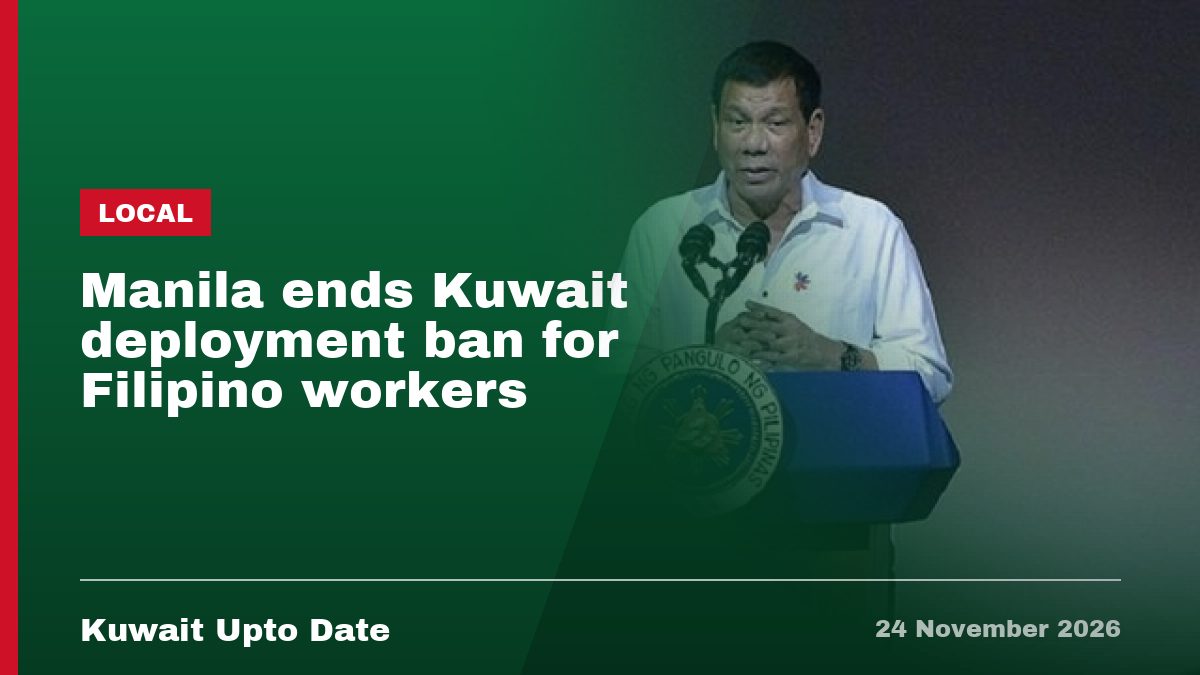
If you’re a Filipino worker in Kuwait, or you’re a family here waiting on a new household helper from the Philippines, this is the news you’ve been waiting for. Manila has lifted its ban on sending workers to Kuwait, closing one of the toughest chapters in relations between the two countries.
The decision came straight from President Rodrigo Roa Duterte. Presidential spokesperson Harry Roque said Duterte had instructed Labor Secretary Silvestre Bello to totally lift the deployment ban. It’s a big moment for the roughly 260,000 Filipinos who already call Kuwait home, as our earlier piece on life in Kuwait for the Filipino community explains.
- The Philippines lifted its deployment ban to Kuwait on Wednesday.
- The ban had been in place since February, after several Filipino workers died in Kuwait.
- A new agreement between the two governments aims to protect overseas Filipino workers (OFWs).
- The lifted ban covers both domestic workers and skilled professionals.
Why was the ban put in place to begin with?
The Philippines imposed the ban after a string of deaths among Filipino workers in Kuwait. Those cases put huge pressure on Manila to act, and the government responded by stopping new deployments altogether.
Things got worse before they got better. Kuwait expelled the Philippine envoy after the Philippine embassy released videos of its own rescue missions for distressed Filipino workers. Kuwait’s government saw this as a breach of its sovereignty, and relations between the two countries soured further.
What changed to end the standoff?
Newly appointed Special Envoy to Kuwait, Abdullah Mama-o, recommended lifting the ban after the two governments signed a memorandum of agreement (MOA) to protect OFWs working in Kuwait. Mama-o told ABS-CBN News he had seen the sincerity and commitment of Kuwait’s leaders to strictly enforce the terms of that agreement.
That assurance was enough for Duterte to act. The ban wasn’t eased gradually or tested with a pilot phase. It was lifted in full, in one announcement.
Who exactly does this cover?
Labor Secretary Bello confirmed the lifting applies to both domestic and skilled workers. That matters because more than half of the roughly 260,000 Filipinos in Kuwait work as household service workers, according to Philippine government estimates. The rest work across skilled and professional roles.
This isn’t a small community. It’s part of why domestic help here has become such a sensitive topic. Our recent reporting found that domestic workers now make up 1 in 4 of Kuwait’s workforce, and disputes over their treatment keep surfacing, including a troubling case we covered where a pregnant maid in Bayan alleged her sponsor tried to kill her.
What this means for people in Kuwait
For households in Kuwait hoping to hire Filipino staff, the lifted ban reopens a route that had been closed for months. Families who had deployments stuck in limbo should now be able to move forward again, though the exact pace of new approvals wasn’t detailed in the announcement.
For Filipino workers already here, the new MOA is meant to give them stronger protection if something goes wrong, through clearer enforcement from both governments. For those still in the Philippines hoping to work in Kuwait, this reopens the door, but it comes after a hard-fought diplomatic dispute that shows just how seriously Manila treats the safety of its citizens abroad.
It’s worth remembering this ban didn’t happen in isolation. We’ve seen similar tension play out elsewhere in the region too, including when 149 Filipino workers flew home from Kuwait and Saudi amid unrest. Worker safety in the Gulf keeps coming up as a flashpoint, and this deal is one attempt to settle it.
For more on how regional news affects expats and residents here, check our latest local coverage.
Quick answers
Does this affect workers already in Kuwait?
Yes, indirectly. The new memorandum of agreement is meant to strengthen protection for Filipino workers already employed in Kuwait, not just new arrivals.
Does the lifted ban cover all job types?
Yes. Secretary Bello confirmed it applies to both domestic workers and skilled professionals, not just one group.
Why did Kuwait expel the Philippine envoy earlier?
Kuwait’s government said releasing videos of embassy rescue missions breached its sovereignty, which led to the envoy’s expulsion and further strained relations before this deal.
If you’ve gone through the process of hiring a Filipino worker in Kuwait recently, or you’re an OFW navigating these changes yourself, tell us about it in the comments. Real experiences help other readers more than any official statement does.
Latest News
 Local
Kuwait court jails 4 for life over drone drug smuggling into prison
2 Local Kuwait approved the excise tax Read more → 3 Local Kuwait father demands KD 1,200 back from daughter for surgery Read more → 4 Local 70 sheep worth KD 15,000 stolen from Kabd farm Read more → 5 Local WhatsApp Web left open? Why Kuwait users should log out Read more → 6 Local Kuwait schools launch ‘Waw’ app for parents to track kids Read more → 7 International Singer got 74 lashes over hijab-free online show in Iran Read more → 8 International Actress Rogena: Dad chose Italy over me after I picked acting Read more → 9 Local Kuwait to see warm, humid weather with highs of 31°C Read more → 10 International US spies tracked Jensen Huang’s ex over China spy contacts Read more → 11 Local Ahmadi police probe KD 8,000 theft from expat’s bank account Read more → 12 Local Shoplifter caught on camera in Kuwait cosmetics theft hunt Read more → 13 Local Rare salt flats appear in Khor Al-Subiyah, north Kuwait Read more → 14 Local Kuwait arrest suspect in scam network Read more → 15 Local Kuwait court jails lawyer 3 years Read more →
Leave a Reply