

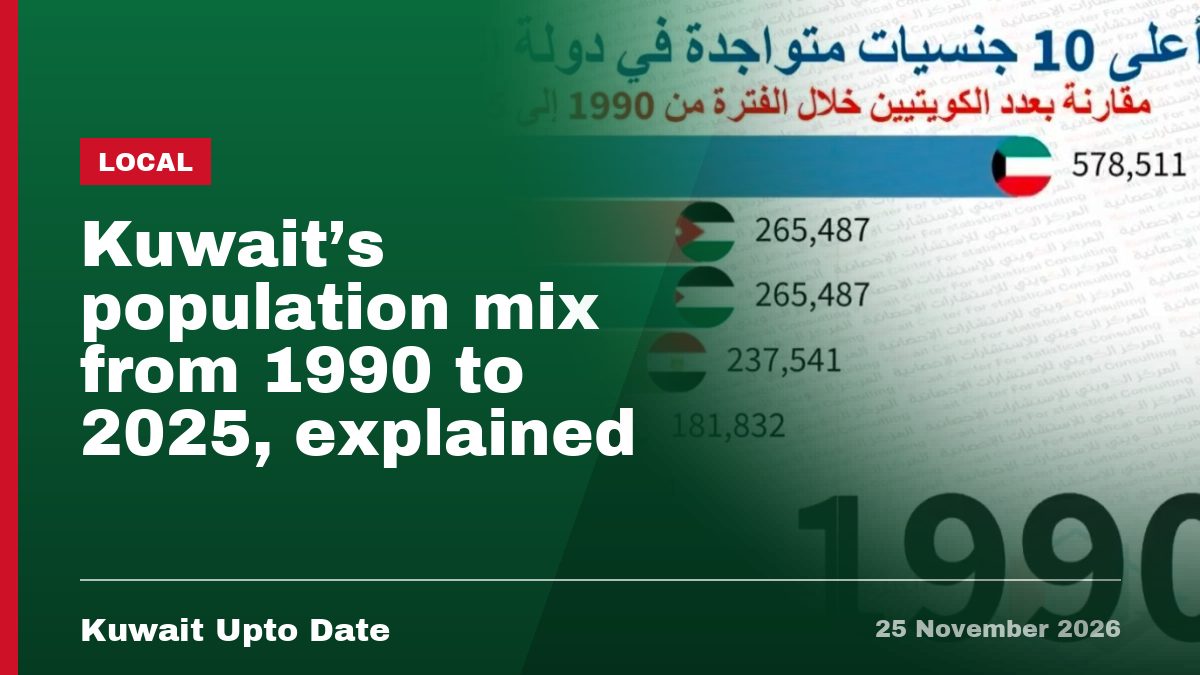
If you’ve ever wondered how many people from your own country actually live in Kuwait, and how that’s changed over the decades, a video now going around answers part of that question. It compares the top 10 nationalities living in Kuwait with the number of Kuwaiti citizens, tracking the shift from 1990 right up to 2025.
https://twitter.com/Ahdath_kw/status/2125339392717816003
One detail stands out. Before the Iraqi invasion of Kuwait in 1990, Jordanians held second place among the largest nationality groups in the country. That’s no longer the case today, and the video uses that change as one marker of how much Kuwait’s population has shifted since then.
- A video compares Kuwait’s top 10 nationalities against the number of Kuwaiti citizens, from 1990 to 2025.
- Jordanians were in second place among nationalities in Kuwait before the 1990 Iraqi invasion.
- That ranking has since changed, reflecting broader shifts in who lives and works in Kuwait.
- The exact current rankings, population figures and the source of the video are not yet confirmed.
Why 1990 is the turning point
The Iraqi invasion of Kuwait in August 1990 is the hinge point in this story. Before it, Jordanians formed one of the largest expat communities in the country, second only to another nationality group.
After the invasion and the Gulf War that followed, Kuwait’s population makeup changed significantly. Many residents left the country during and after the occupation, and the composition of who returned, and who arrived in the years after, was different from before. The video appears to use this moment as a clear before-and-after marker for the wider changes in Kuwait’s demographics over the following decades.
This single data point – Jordanians slipping from second place – is one of the clearest illustrations in the video of how the 1990 invasion reshaped Kuwait’s population beyond just the political and economic damage most people already know about.
What the video actually shows
Based on what’s been shared, the video tracks 35 years of population change, from 1990 to 2025, comparing the top 10 nationalities in Kuwait with the number of Kuwaiti citizens over that same period.
What isn’t yet confirmed is which nationalities currently make up that top 10 list, or the specific population figures the video uses for each year. Without that detail, it’s hard to say exactly how dramatic the swings have been for each community, only that the Jordanian example shows real change did happen.
It’s also not clear who produced the video or which data source it draws from, whether that’s Kuwait’s Public Authority for Civil Information, another government body, or an independent analysis. That matters for how much weight to put on the numbers it shows.
What this means if you live in Kuwait
For long-term residents and citizens alike, this kind of population snapshot is a reminder that Kuwait’s expat communities aren’t fixed. Nationalities that were once among the largest groups here can shrink in relative size, while others grow, often because of events far outside Kuwait’s borders, like regional conflicts, changing labour demand, or shifts in visa policy.
If you’re Jordanian, Egyptian, Indian, Filipino, or from any of the other communities that make up Kuwait’s expat population, this kind of long-view data is useful context. It shows your community’s position in Kuwait today is the result of decades of change, not something fixed in place. You can read more on how different communities in Kuwait are faring in our latest local news.
For Kuwaiti citizens, the comparison also puts the citizen population in context against the much larger expat population, a ratio that has shaped policy debates on housing, jobs, and residency rules for years.
Quick answers
Why did Jordanians drop in the rankings?
The video doesn’t give a detailed reason, only that Jordanians held second place before the 1990 Iraqi invasion and no longer do. The broader population shifts after the invasion are the likely context, though the exact cause for this specific community isn’t spelled out in the source.
Which nationalities are in the top 10 now?
That’s not confirmed yet. The video is described as comparing the top 10 nationalities with Kuwaiti citizens from 1990 to 2025, but the current list and figures haven’t been detailed in what’s been shared so far.
Where can I see the actual numbers?
Official population breakdowns by nationality are usually published by Kuwait’s government statistics bodies. If you want precise, year-by-year figures rather than a video summary, that’s the place to check.
Numbers like these are easy to scroll past, but they say a lot about who’s actually building daily life in Kuwait. If you’ve seen the video or know more about where it came from, it would be worth sharing in the comments.
Latest News
 International
Emirates hiring 120+ staff, cabin crew pay near KD 940 a month
2 International Israel accuses Iran of chemical weapons programme, more strikes possible Read more → 3 International GTA 6 sales hit 47.8 million copies Read more → 4 International Puerto Rico’s Jennifer Barreto wins Miss Universe, mom of two kids. Read more → 5 International New US alert: Gulf told to stay alert on Iran threat Read more → 6 Local Flydubai flight makes emergency landing at Kuwait airport Read more → 7 International Yemen war risks peace process, UN envoy tells Kuwait seminar Read more → 8 Local Asian’s video ends with car sent to crusher in Kuwait Read more → 9 Local Manila ends Kuwait deployment ban for Filipino workers Read more → 10 Local Kuwait court jails 4 for life over drone drug smuggling into prison Read more → 11 Local Kuwait approved the excise tax Read more → 12 Local Kuwait father demands KD 1,200 back from daughter for surgery Read more → 13 Local 70 sheep worth KD 15,000 stolen from Kabd farm Read more → 14 Local WhatsApp Web left open? Why Kuwait users should log out Read more → 15 Local Kuwait schools launch ‘Waw’ app for parents to track kids Read more →
Leave a Reply