

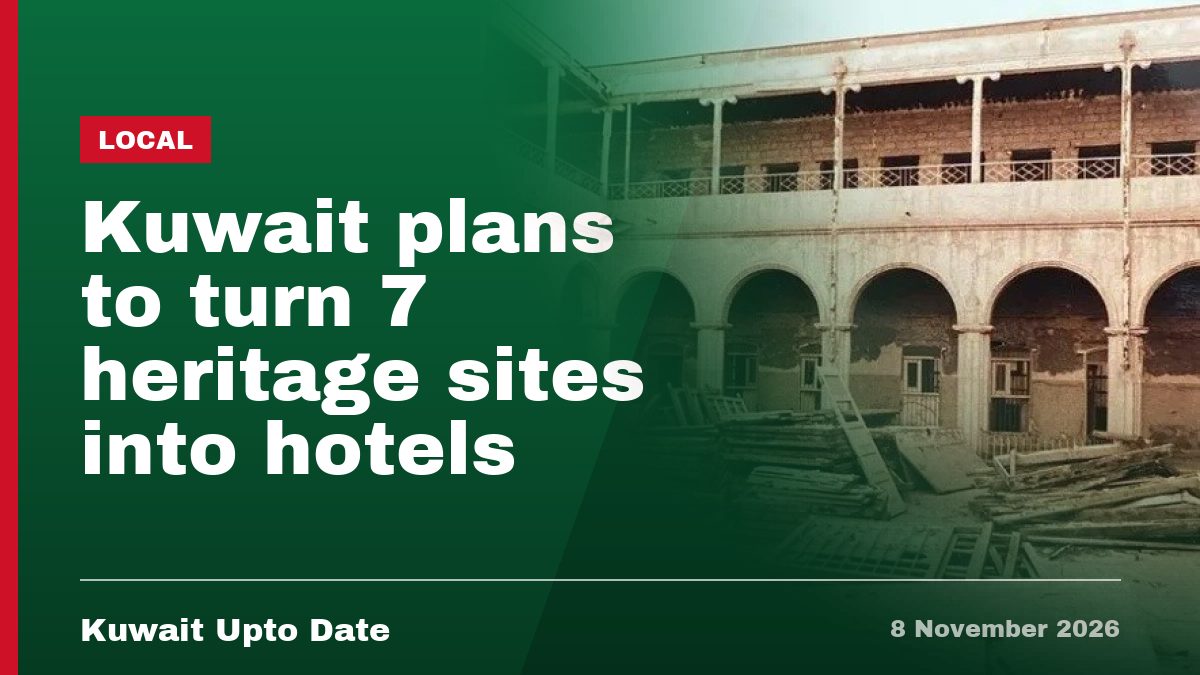
If you’ve ever walked past the old Chest Hospital or through Mubarakiya and wondered why so many historic buildings in Kuwait City sit empty, there’s finally movement on that front. Authorities are studying plans to turn seven heritage sites into hotels, cultural venues and commercial spaces, hoping to pull in private investors and bring life back to the city centre.
This comes shortly after other projects aimed at reshaping Kuwait’s waterfront and old districts, like the planned seaside makeover for Souq Sharq and the new waterfront development in Salmiya. This heritage plan is a different idea though: instead of building something new, it reuses old, historic buildings that already mean something to Kuwaitis.
- Kuwait is reviewing seven historic sites for conversion into hotels, cultural hubs or commercial spaces.
- The first phase covers Mishref Palace, the old Chest Hospital and Al-Mubarakiya School.
- Four more sites are under study: Fahad Al-Salem Palace, the Awqaf Complex, the Palace of Justice and Safafir Market.
- Nothing is confirmed yet – this is still at the study and feasibility stage, with no investment figures or timelines announced.
So what exactly is being planned?
The idea is simple: instead of just spending government money on restoring old buildings and leaving them mostly unused, Kuwait wants these properties to earn money while still keeping their cultural value. The Public-Private Partnership Projects Authority has already put forward a project to prepare these sites for what’s being called the “creative economy” – things like design, crafts, events and cultural tourism. This falls under a strategic plan from the National Council for Culture, Arts and Letters.
The first phase is Mishref Palace, the old Chest Hospital and Al-Mubarakiya School. Meanwhile, the National Council is working with the Public Authority for Industry and the Ministry of Finance to study whether four other sites should join the programme: Fahad Al-Salem Palace, the Awqaf Complex, the Palace of Justice, and Safafir Market, also known as the Coppersmiths’ Market.
What could each site become?
Each property is being looked at differently, based on its location and character.
- Fahad Al-Salem Palace, opposite Amiri Hospital, could become a boutique hotel or entertainment venue, depending on site studies.
- The Palace of Justice could turn into a heritage hotel that also hosts cultural events.
- Al-Mubarakiya School could be linked more closely with the traditional market nearby and used for design, architecture and urban planning activities.
- Safafir Market could move away from plain retail and become a centre for crafts and creative manufacturing, giving local artisans a bigger role.
The National Council has already sent a proposal to the Public Authority for Industry about using Safafir Market this way, as part of a bigger push to bring private investment back to central Kuwait City and support local craftspeople.
A bigger plan for the whole Qibla area
Authorities are also studying a plan to revive the entire Qibla Cultural District. The idea is to connect Qibla School, the National Museum and the National Library with Al-Mubarakiya School and the surrounding inner market, turning scattered heritage spots into one connected destination for culture, shopping and tourism.
This fits with other recent efforts to reshape central areas of Kuwait, such as the Al-Abdali Economic City project and plans to add leisure facilities at Messilah Beach. You can find more on these kinds of projects on our Local news page.
The Awqaf Complex is still under review on its own. Officials are weighing its high construction costs against the difficulty of keeping occupancy rates strong in the city centre, where many office buildings already struggle to fill space.
It’s not just buildings – libraries are part of this too
The plan doesn’t stop at historic buildings. Kuwait has a network of 56 public libraries, and authorities are looking at ways to make them more than just places to borrow books. The idea is to turn them into spaces for research, design and innovation, hosting exhibitions, workshops and professional programmes with private companies and cultural groups.
Officials also want to diversify how libraries are funded, run them more efficiently, and find better ways to measure their social, educational and economic value – not just how many books go out the door.
<p>[EDITOR NOTE: your own experience visiting Mubarakiya, the Awqaf Complex or any of these sites, and whether you think a hotel or cultural hub fits there]</p>
What does this mean for people in Kuwait?
For investors, this could open doors in hospitality, cultural tourism, creative manufacturing, design and event management, plus chances to run heritage properties long-term. Small businesses, designers and artisans could also benefit if Safafir Market and similar sites move toward creative industries.
For everyday residents and citizens, the bigger question is what central Kuwait City will feel like in a few years – whether these old buildings become places people actually visit, or stay empty while studies continue. Nothing is locked in yet, so there’s no immediate change to expect, but it’s worth watching if you live or work near the city centre.
A new law in the works
Alongside the property plans, government bodies are working with the Ministry of Finance, the Civil Service Bureau and the Fatwa and Legislation Department on a draft decree-law for creative industries. This law is meant to give cultural and creative businesses more flexibility, let the National Council expand partnerships with private investors, and attract creative talent to Kuwait.
It should also set clearer rules for financing, running projects and managing risk, so investments stay sustainable without damaging the cultural or historical value of the properties involved.
Quick answers
Is this definitely happening?
Not yet. The projects are still at the conceptual and feasibility-study stage. No investment amounts, expected returns or timelines have been announced.
Which sites are confirmed for phase one?
Mishref Palace, the old Chest Hospital and Al-Mubarakiya School make up the first phase. The other four sites are still being studied.
Why is Kuwait doing this now?
The government wants to diversify its income away from oil and build a stronger knowledge-based economy, while putting underused public buildings to productive use.
It’s early days for this plan, but it’s one worth keeping an eye on if you care about what happens to old Kuwait City. Which of these buildings do you think deserves a new life first? Let us know in the comments.
📌 Related stories
Latest News
 Local
Kuwait tells subscribers in 5 areas to switch to fiber-optic
2 International Building in Riyadh hit by shrapnel in attack attempt Read more → 3 Local Kuwait court jails driver for over speeding Read more → 4 International Riyadh on alert by Saudi Civil Defence Read more → 5 Local WhatsApp to stop on some iPhones from 30 November Read more → 6 Local Egyptian singer Ramy Sabry books Kuwait concert for 24 December Read more → 7 Local Video – Kuwait scam alert: fake police now add fake bank staff on video calls Read more → 8 International Hackers spread equivalent of 1.96 billion KWD theft across 10,000 wallets Read more → 9 Local Being an Expat: What Is My Future in Kuwait? Read more → 10 Local Kuwait’s police to get body cameras soon Read more → 11 Local Women no longer need husband’s OK for passports Read more → 12 International Earth has a new mini-moon, but it’s leaving by early 2027 Read more → 13 Local Hiring staff you don’t need is a crime Read more → 14 Local Italy honours Sheikha Intisar with top civil award Read more → 15 International Iraq admits its soil used to attack Gulf neighbours Read more →
Leave a Reply