

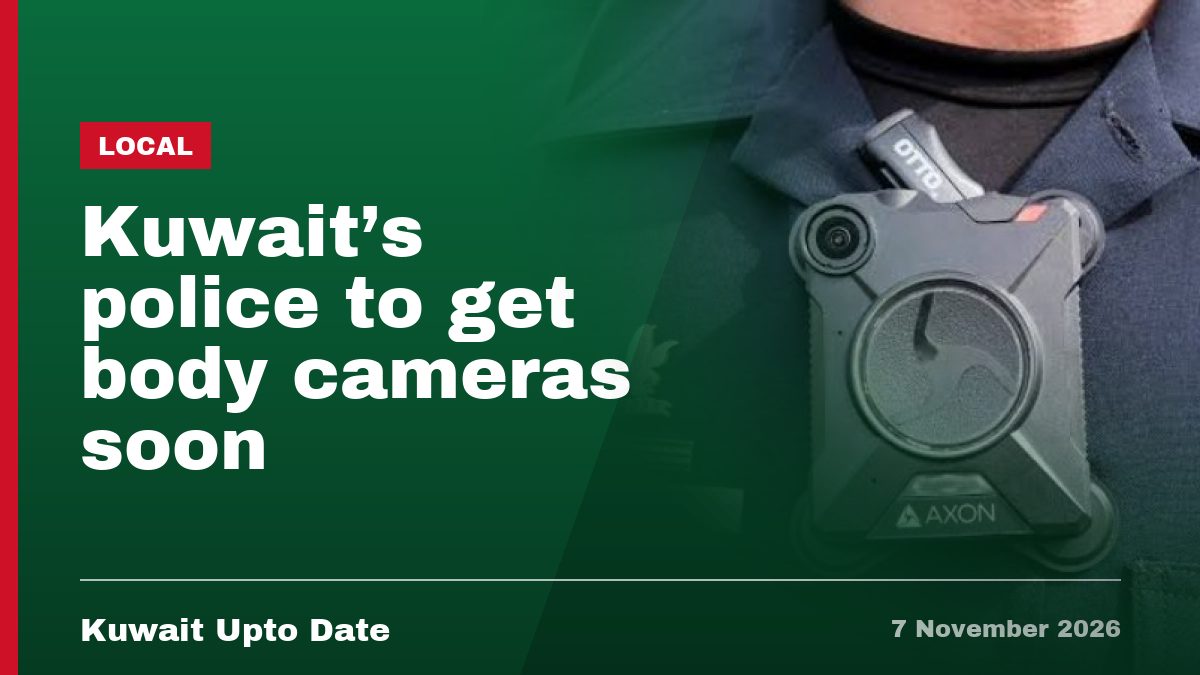
If you’ve ever called 112 or been stopped at a checkpoint by a Nejda (emergency police) patrol, the next time might look a little different. Officers will soon be wearing body cameras to record their interactions with the public, in both sound and video.
The announcement came from Brigadier Hamlan Hadheiri Al-Hamlan, Director General of the General Directorate of Nejda Police, in his first press interview since taking the role. He spoke to Al-Anbaa about a wider digital shake-up happening behind the scenes at Kuwait’s frontline police force, the one that answers emergency calls and patrols neighbourhoods around the clock.
- Nejda officers will soon get personal body cameras (Body Cam) to record field interactions with sound and video.
- The directorate is moving from paperwork to a digital system linking the operations room, patrols and the emergency reporting system in near real time.
- Patrols already use the “Rasid” system to check people’s security records and flag wanted individuals or violators.
- Kuwait’s governorates are divided into security sectors, with patrols placed according to traffic density and the type of calls each area usually gets.
Why body cameras, and why now?
Al-Hamlan said the cameras are meant to boost transparency, protect rights, and raise the standard of field work, something he said many developed countries already do. The goal isn’t just to catch wrongdoing. It’s also to protect Nejda officers themselves, and to settle disputes about what actually happened during a stop or an incident.
With footage on record, both officers and the public have something to point to if there’s disagreement later about how an interaction went. Al-Hamlan said this helps “preserve rights and determine responsibilities,” and that recordings can be reviewed whenever needed.
Patrol vehicles already carry cameras inside and outside the car, used to document events and review how officers perform. The personal body cameras are described as the next step, giving closer, officer-level footage rather than just the vehicle’s view.
What’s changing behind the scenes
Beyond the cameras, Al-Hamlan described a broader digital transformation project. The directorate is cutting down on paperwork by linking the operations room, patrol units and the emergency call system electronically, with information flowing in close to real time. The aim is faster response times and better handling of incoming reports.
Patrols also rely on the “Rasid” system, a database tool officers use in the field to check whether a person has any outstanding security requests or legal issues against them, and to identify violators. Al-Hamlan said relying on technology and security databases has become a basic part of daily field work, not an extra.
Patrol locations are tracked through a system called AVLS (an automated vehicle location system), which lets the operations room see where every patrol is at any moment and confirm officers are covering their assigned sector. If a patrol turns up outside its sector without prior instruction, the operations room follows up and checks why.
How patrols are spread across Kuwait
Each governorate is split into security sectors, and patrols are assigned to cover specific sectors based on traffic density and the kind of calls that part of the country usually generates. Al-Hamlan said this is meant to keep patrols close to likely trouble spots, so response times stay short.
Data analysis plays a role here too. The directorate studies when and where reports spike, then redistributes patrols and increases presence in those areas when needed. Checkpoints on the roads aren’t random either, Al-Hamlan said. Their locations are planned in advance by the directorate, in coordination with other departments, and chosen with an eye on not disrupting traffic flow.
You can find more Local news in Kuwait on patrol work, traffic enforcement and Ministry of Interior updates as they’re reported.
What Nejda police actually do, day to day
Al-Hamlan broke the directorate’s role into four parts. The preventive role covers crime prevention, officers patrolling main roads, side streets, residential and commercial areas to stop trouble before it starts. The rescue role is responding to calls through the emergency number 112. The humanitarian role covers helping residents and citizens in need, whether patrols come across someone during normal duty or respond to a humanitarian call directly. And the traffic role means dealing with congestion, easing traffic flow, handling violators, and backing up the General Traffic Department when asked.
Of all the calls that come in, Al-Hamlan said life-threatening cases get priority, especially crimes or attacks on people or property, because of the risk of the situation getting worse without fast intervention. Common calls to the operations room include fights between people, noise disturbances, suspicious behaviour, family disputes needing security intervention, and various traffic issues.
[EDITOR NOTE: add a line here on your own experience with a Nejda checkpoint or 112 call, if relevant, to make this section feel grounded for readers]
Training and what’s planned next
Officers go through specialised training in crisis management, shooting, public communication skills, and first aid, along with joint field exercises with other Interior Ministry sectors. Al-Hamlan said training also covers the Rasid system itself and inquiry procedures, keeping pace with the technology officers actually use on patrol.
Looking ahead, the directorate wants to bring in artificial intelligence to help direct patrols to call locations based on traffic density and the nature of each case. Officials are also working with the General Directorate of Information Systems, the General Directorate of Security Systems, and the General Directorate of Communications Engineering to modernise the operations room further and link patrols to smarter systems.
Performance isn’t judged only by the number of violations or arrests a patrol makes. Al-Hamlan said response speed, discipline, readiness, and how officers deal with the public are reviewed too, including by going back through camera footage.
What this means for people living in Kuwait
For residents and citizens alike, body cameras mean any interaction with a Nejda patrol, a traffic stop, a checkpoint, a response to a call, will likely be recorded going forward. That cuts both ways: it protects you if there’s a dispute about how you were treated, and it protects the officer too.
The push towards digital records and systems like Rasid and AVLS also points to faster response times becoming the norm, since patrols are tracked and redirected based on real data rather than guesswork. Al-Hamlan also used the interview to thank Nejda officers for their work and called on the public to cooperate with security personnel, follow instructions, and report anything that needs police attention, describing security as a shared responsibility between police and the public.
He also credited the Deputy Prime Minister and Interior Minister, Sheikh Fahad Al-Yousef, for direct support and supervision of security campaigns, Undersecretary of the Interior Ministry Lieutenant General Abdulwahab Al-Wuheib for coordinating security plans across sectors, and Brigadier Ahmad Fahad Al-Azmi, head of the Operations and Traffic Sector, for overseeing patrol deployment across the governorates.
Quick answers
When will Nejda officers start wearing body cameras?
A timeline wasn’t given. Al-Hamlan said the rollout is planned for the near future as part of ongoing upgrades to field operations.
Are patrol cars already recording?
Yes. Nejda patrol vehicles already carry cameras inside and outside the car to document incidents, separate from the new personal body cameras planned for officers.
What is the Rasid system?
Rasid is a database tool Nejda patrols use in the field to check a person’s security record and flag wanted individuals or rule violators.
How do I report something to Nejda police?
Calls go through the emergency number 112, which reaches the central operations room before being routed to the patrol covering that area.
Have you had a recent interaction with a Nejda patrol or used the 112 line? It would be good to hear how it went in the comments.
📌 Related stories
Latest News
 Local
Egyptian singer Ramy Sabry books Kuwait concert for 24 December
2 Local Video – Kuwait scam alert: fake police now add fake bank staff on video calls Read more → 3 International Hackers spread equivalent of 1.96 billion KWD theft across 10,000 wallets Read more → 4 Local Being an Expat: What Is My Future in Kuwait? Read more → 5 Local Women no longer need husband’s OK for passports Read more → 6 International Earth has a new mini-moon, but it’s leaving by early 2027 Read more → 7 Local Hiring staff you don’t need is a crime Read more → 8 Local Italy honours Sheikha Intisar with top civil award Read more → 9 International Iraq admits its soil used to attack Gulf neighbours Read more → 10 Local Video – New Salmiya waterfront Barayeh Salem place Read more → 11 International Saudi Arabia Arrests 11,587 People in One Week for Visa Breaches Read more → 12 International Trump confirms new US strikes near Qeshm Island, Iran Read more → 13 Local US Embassy Kuwait issued a security alert. Read more → 14 International US offers $20 million for one information Read more → 15 International Iran warns Saudi oil plants, Britain could be hit Read more →
Leave a Reply