

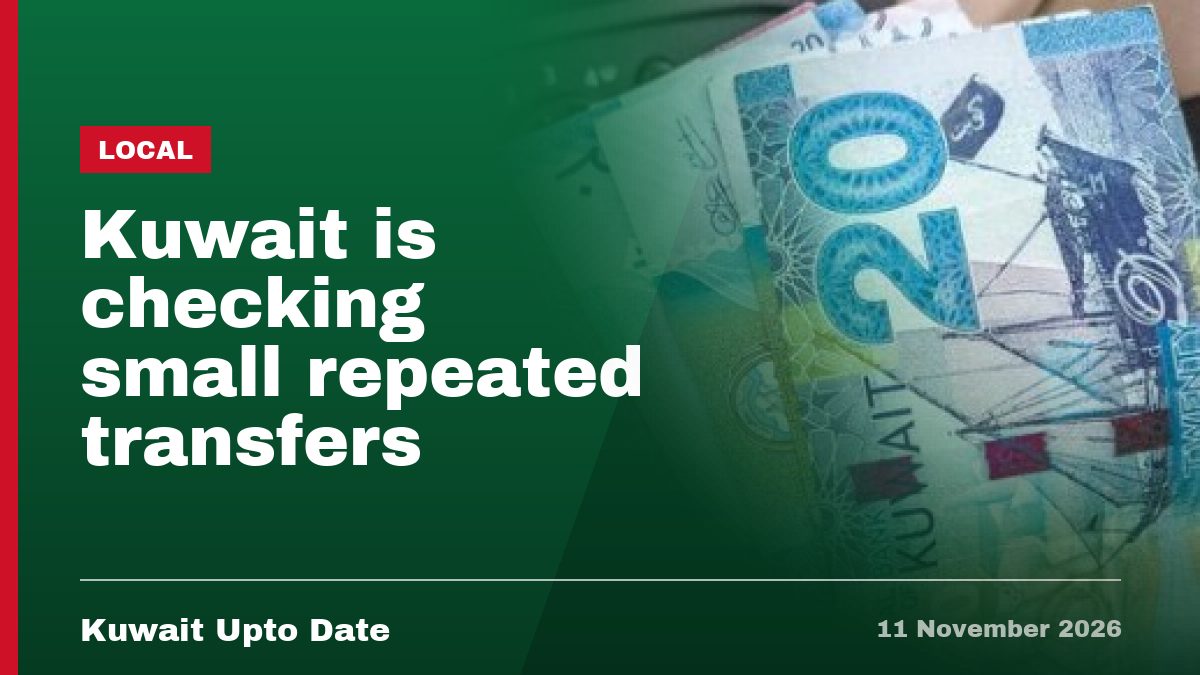
If you regularly send money home in smaller amounts, or deposit cash in a few batches instead of one, your bank may now be paying closer attention. Kuwait banks are preparing to widen their monitoring to catch repeated transfers and deposits that stay just under KD3,000.
This comes on top of other recent steps, including checks on salary accounts receiving large transfers and new rules making face recognition and OTP compulsory for some salary transfers. The common thread is simple: Kuwait wants a clearer picture of where money moves, and why.
- Banks will now track repeated deposits and transfers below KD3,000, not just single transactions at or above that amount.
- The Central Bank of Kuwait (CBK) wants banks to look at frequency, timing and total value of related transactions, not just one transfer at a time.
- The goal is to catch people who may be splitting large sums into smaller transactions to avoid reporting thresholds.
- This is part of Kuwait’s anti-money laundering and anti-terrorism financing rules under Law No. 106 of 2013.
What exactly is changing?
Until now, banks kept records mainly for cash deposits and incoming transfers of KD3,000 or more (or the same amount in foreign currency) made by one customer in a single day. That threshold still matters, but it’s no longer the whole story.
Under the new approach, a single transaction under KD3,000 can still raise a flag if it’s part of a pattern. Banks have been told to look at the combined value of related transfers or deposits over a period of time, how often they happen, and whether the timing or size looks designed to stay just under the reporting limit.
This focus on transaction splitting is the main reason for the change. If someone deposits KD2,900 today and another KD2,800 a few days later, instead of one KD5,700 deposit, banks are now expected to notice that pattern and ask questions.
Why is the Central Bank doing this now?
The CBK has directed banks to review how well their current monitoring systems catch this kind of behaviour. Banks’ anti-money laundering teams, compliance departments and internal-control specialists are reportedly working out how to share more data with regulators and build stronger tools to analyse unusual transaction behaviour.
This sits inside Kuwait’s wider push against money laundering and terrorism financing, under the framework of Law No. 106 of 2013. Officials say relying only on the value of a single transaction leaves gaps, so the broader pattern of a customer’s activity now matters more.
You can read more about related steps in our local news coverage, including CBK’s earlier call for the public to report unlicensed money transfer services.
Who should actually pay attention?
Most people sending or depositing normal amounts for salary, rent, family support or shopping have nothing to worry about. The focus is on patterns that look deliberately split to dodge the KD3,000 reporting line, not on ordinary banking habits.
That said, if you regularly move money in several smaller chunks rather than one transfer, for whatever reason, it’s worth knowing your bank may now review that pattern more closely. This applies to both citizens and expats using Kuwaiti banks for transfers abroad or local cash deposits.
It also connects to other changes already in motion. As reported on 4 November, salaries of KD300 with transfers of KD25 or more are being checked, and on 5 November, banks began linking wage data for verification, as covered in our piece on linking bank details with salary confirmation.
Could AI play a role?
Kuwait’s banks are expected to lean more on artificial intelligence to manage this. AI tools could help sort through large volumes of transaction data faster, flagging patterns that look suspicious while telling apart genuine, honest increases in activity, like people depositing more because of inflation, salary rises or higher spending, from deliberate attempts to avoid detection.
This matters because the new approach will pull in far more data than before. Instead of only flagging transactions at or above KD3,000, banks will now be reviewing a much wider range of customer activity, which means more work without better tools.
[EDITOR NOTE: a note here on how transparent banks have been with customers about why their account was flagged, or how long verification has taken in practice, would help readers know what to expect.]
Quick answers
Does this mean my bank will freeze my account?
The source does not mention account freezes. The focus is on monitoring, flagging and further verification of patterns that look suspicious, not automatic penalties for normal customers.
Is KD3,000 still the reporting threshold?
Yes. Single cash deposits or incoming transfers of KD3,000 or more still get recorded as before. What’s new is that banks now also track repeated transactions that stay below that amount.
Does this apply to transfers sent abroad too?
The report covers both cash deposits and transfers generally, without limiting it to local activity, so transfers sent out of Kuwait could fall under the same scrutiny if a pattern looks like deliberate splitting.
If you move money in several smaller amounts out of habit, it may be worth asking your bank directly how this change affects you. Have you noticed your bank asking more questions about regular transfers lately? Let us know in the comments.
Latest News
 Local
New Jira Park in Kuwait
2 Local Kuwait to fine vehicles on the spot for damaging roads Read more → 3 International Saudi coalition shoots down two Houthi drones over Mecca Read more → 4 Local Puppy found at Kuwait base reunites with US couple after 6 months Read more → 5 Local Kuwait warns of fake Interior Ministry scam on WhatsApp Read more → 6 Local Kuwait lawyers told to stop promoting on TikTok Live Read more → 7 International Saudi forces down 3 Houthi missiles aimed at Riyadh Read more → 8 International Kuwait, Pakistan PMs meet at COP31 to boost ties Read more → 9 Local What Warba Bank’s MENA award win means for Kuwait banking Read more → 10 International New Covid variant PJ.2.1 spreads worldwide Read more → 11 International Canada makes rural immigration permanent from 2027 Read more → 12 International Lahore tops pollution because of Diwali in India Read more → 13 Local Sahel app now sends you entry and exit notifications Read more → 14 International Ebola outbreak now ranks second-worst ever Read more → 15 International Student killed in flat-tyre roadside crash Read more →
Leave a Reply