

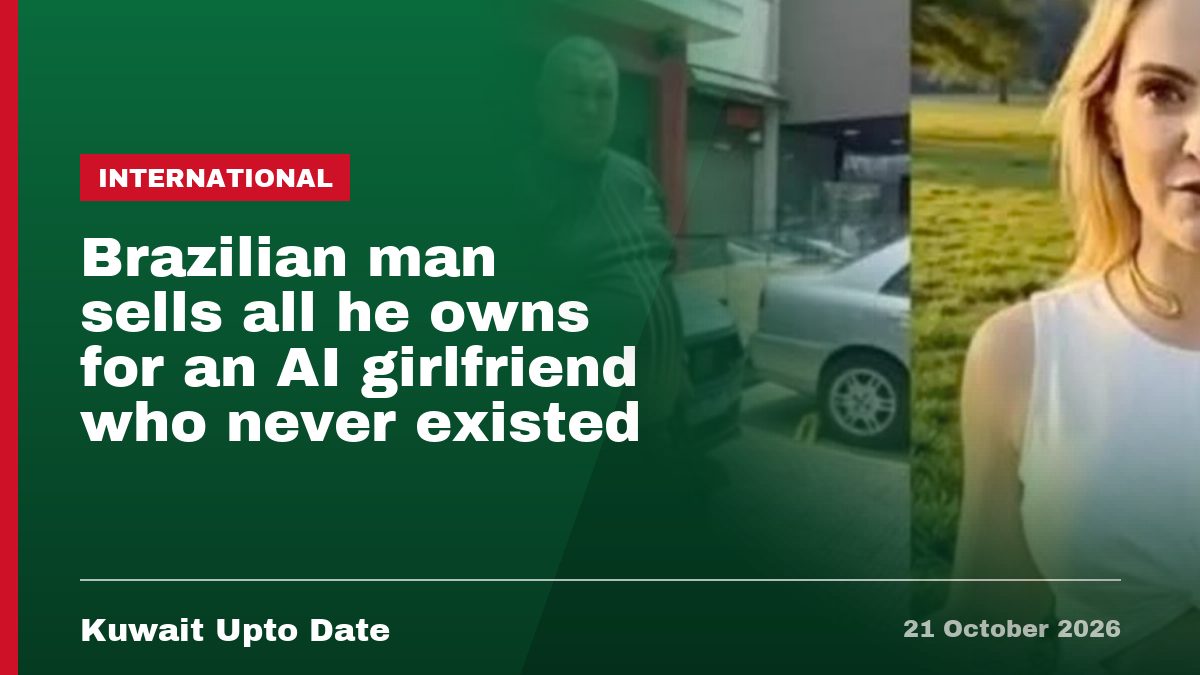
Edimar Rocha Martins is a 49-year-old bricklayer from Maranhão, Brazil. He had been chatting online with a woman he believed was his girlfriend. He trusted her enough to sell everything he owned and travel across the country to finally meet her.
She was never real.
It’s a story that sounds unbelievable, but it shows how far AI-generated content has come, and how easily it can fool people who are simply looking for connection. It’s also a good reminder for anyone in Kuwait who has ever felt unsure about someone they only know through a screen, including the kind of scams we’ve covered before, like the app approval scam that wiped out a bank balance here in Kuwait.
- Edimar Rocha Martins, 49, followed a TikTok account with more than 300,000 followers showing an AI-generated woman called “Jéssica Oliveira” (also referred to as Jessica Fazendeira)
- The account showed videos of a blonde woman who said she owned a farm and offered financial support to a future partner
- On 9 October 2026, Martins sold his belongings to pay for a bus trip of nearly 1,200 miles (1,931km) from Imperatriz to Belo Horizonte, arriving on 11 October
- He could not find her anywhere, and a local radio station confirmed the woman did not exist
How it all unfolded
Martins had been watching the TikTok account for some time. The videos showed a woman presenting herself as a farm owner, telling viewers she was looking for a partner and even offering to help them financially. For Martins, it seems the offer felt real enough, and the connection felt real enough, to act on.
On 9 October, he sold what he owned to raise money for a bus ticket. He travelled from Imperatriz all the way to Belo Horizonte, a journey of nearly 1,200 miles, arriving two days later on 11 October.
Once he got there, he had no address, no phone number, nothing solid to go on. He looked for her and could not find any trace of her. Eventually, he turned to a local radio station for help. That’s when he learned the truth: the woman he had crossed the country for did not exist. She was generated using artificial intelligence, built purely to gain views and followers online.
By that point, Martins had run out of money in a city far from home. Social workers from Belo Horizonte City Hall stepped in to help him, and he was eventually able to return home.
The person behind the TikTok account later said the persona was made with AI purely for engagement, and that no one from the account had ever actually spoken to Martins directly. In other words, the connection he believed he had built over time was entirely one-sided, with an account, not a person, on the other end.
The bigger picture
This case has drawn attention because it shows how AI-generated personas, built to look and sound like real people, can lead someone to make life-changing decisions based on a complete fiction. It’s not the same as a typical romance scam where a real scammer pretends to be someone else. Here, there wasn’t even a person replying. It was content built for views, and one viewer took it as something real enough to act on.
It raises a question a lot of us are only starting to ask seriously: how do you tell the difference between a real person online and content designed to look like one? As AI video and voice tools get better, that question gets harder to answer, not easier.
What this means for people in Kuwait
Kuwait has a large online population, and plenty of people here, citizens and expats alike, use TikTok, Instagram and other apps daily. Scams built around fake identities, fake job offers and fake financial help are already a known problem here, as we’ve seen with the online phone ad scam that cost a Kuwait shopper 200 dinars. The same caution applies to online relationships, especially ones built entirely through messages and videos, with someone you’ve never actually spoken to in real time.
If you’re following an account that seems designed to pull you into a relationship or a financial arrangement, slow down. Ask for a real video call. Ask questions that only a real person with real knowledge could answer. And never send money or make big financial decisions based only on what you’ve seen in edited videos.
Kuwait has also made it easier to flag suspicious financial requests, including through the expanded Report Me service covering requests for extra money. If something about an online relationship or offer feels off, treating it with the same caution as any other financial scam is a reasonable approach. You can read more scam and safety coverage on our international news page.
Quick answers
Was the account creator identified?
The source does not name the person or team behind the TikTok account. They only confirmed the persona was AI-generated and made for engagement.
Did Martins lose money to a direct scam, like a bank transfer?
No. The source does not describe him sending money to the account. His losses came from selling his belongings to fund the trip itself.
Is this kind of AI-generated persona common on social media?
The source doesn’t say how common this is, but it notes the account had over 300,000 followers, which shows this kind of content reaches a lot of people.
It’s worth asking yourself honestly: would you recognise an AI-generated account if you saw one today? If you’ve come across something similar online, it’s worth sharing in the comments, it might save someone else the same trip.
📌 Related stories




Latest News
 Local
Kuwait names 11 spots for 2026-2027 camping season
 2
Local Kuwait seizes 300,000 Captagon pills hidden in truck tyre
Read more →
 3
Local What we know after the Sheikh Jaber Bridge incident
Read more →
 4
Local Kuwait woman’s post on neighbours and DJ during mourning sparks debate
Read more →
 5
Local Sheikh Jaber Bridge: rescue teams recover body after fall report
Read more →
 6
International Real facts about Two Bangladeshis Executed in Makkah, avoid rumors.
Read more →
 7
International Iran claims 54th US drone shot down over Hormuz
Read more →
 8
International Schools ban photos of kids
Read more →
 9
Local US issued warning, Kuwait and 11 countries
Read more →
 10
Local 1000 KD fine for marriage without premarital course
Read more →
 11
Local Kuwait orders 10-day detention for 22 who found partial naked in women dancewear.
Read more →
 12
Local Who is Kajal Libi, the Kuwait expat now a Miss Kerala finalist?
Read more →
 13
Local Kuwait court gives death sentence to expat in heroin trafficking case
Read more →
 14
Local Best Bank for a Loan in Kuwait 2026: Every Bank Compared
Read more →
 15
Local Kuwait cuts fresh water to Hawally, Jabriya, Bayan on Wednesday
Read more →
Leave a Reply