


I have received 100s of messages from expats living across Kuwait. We talk about local news, weekend events, and visa changes. But do you know what the single most heartbreaking message I get on a weekly basis is?
Here i would talk about on following :
- How employers try to do fraud in Indemnity calculation.
- How to resolve, step by step.
It’s an expat saying, “Hey, I just left my job after seven years, and HR only gave me a fraction of what I expected. Is this right?”
It infuriates me every single time because, most of the time, the company is pulling a fast one. We move our lives to the desert, work crazy hours, and sacrifice family time. So, when it’s time to say goodbye, your indemnity in Kuwait—officially known as End-of-Service Benefits—isn’t a bonus or a gift from your boss. It’s your hard-earned money.
I’ve watched friends and community members get cheated out of thousands of Dinars simply because they didn’t know the rules. Today, I want to share the exact traps I’ve seen employers use, and show you exactly how to fight back based on how Kuwait Labor Law actually works.
3 Common Indemnity Calculation Traps Used by Employers
Under Kuwait Labor Law No. 6 of 2010, private sector employees are strictly protected. However, many HR departments rely on the fact that expats don’t read the legal clauses.
Here are the three most common issues I see:
1. The “Basic Salary” Calculation Trick
2. Forced Resignations vs. Termination
3. Illegal Deductions for Personal Days Off
1. The “Basic Salary” Calculation Trick
This is the oldest trick in the book, and I see HR departments try it constantly. You sit down for your final cancellation, and they calculate your payout using only the basic salary printed on your contract.
- The Real Law: Your Kuwait indemnity calculation must be based on your total remuneration. This means your basic salary PLUS your fixed monthly allowances. If you get a fixed monthly housing allowance, transport allowance, or a guaranteed monthly bonus, that legally counts as part of your salary.
- My Advice: Don’t let them split your salary up on paper to save themselves a buck. Look at your monthly bank statements. What actually hits your account every month as your fixed income is what your indemnity must be calculated on.
2. Forced Resignations vs. Termination
I cannot stress this enough: How you leave your job completely changes your bank account balance.
If a company terminates your contract, you get 100% of your accumulated end-of-service benefits. But if you choose to resign voluntarily, a penalty scale kicks in based on your total years of service:
- Under 3 years of service: You get 0% indemnity if you resign.
- 3 to 5 years of service: You get 50% (half) of your payout.
- 5 to 10 years of service: You get two-thirds (66.6%) of your payout.
- Over 10 years of service: You get your full 100%.
The sneaky part: I’ve seen companies that want to downsize or fire someone, but they pressure the employee into signing a resignation letter instead. They might say, “If you resign, it looks better on your record.” Don’t fall for it. They are just trying to cut your payout in half or wipe it out completely. If they want you gone, make them terminate you.
3. Illegal Deductions for Personal Days Off
Another issue I see a lot is companies looking back at a worker’s entire five- or ten-year history to deduct money for days off.
Let’s set the record straight: An employer can only deduct days from your total service period if you took unpaid leave (leave without pay). They absolutely cannot deduct your regular annual leaves, official Kuwaiti public holidays, or legal sick leaves that were backed by an official medical certificate.
Why I Built Our Kuwait Indemnity Calculator
Years ago, after seeing so many people get confused by complex formulas and legal jargon, I realized our community needed a shield. We needed an easy, foolproof way for an ordinary expat to stand up to a corporate HR director and say, “No, your math is wrong. Here is the legal breakdown.”
That is exactly why we built the authentic Kuwait Upto Date Indemnity Calculator.
I didn’t want it to be just another generic estimator. We coded it strictly to mirror the specific clauses of the Kuwait Labor Law for the private sector. It factors in your exact start date, end date, total salary with allowances, and automatically applies the correct percentages based on whether you resigned or were terminated.
Before you ever step foot into an exit interview, open up our calculator, type in your details, and print out the results. Walk into that room knowing your numbers.
How to Resolve an Indemnity Dispute (Step-by-Step)
If your employer hands you a lowball offer and refuses to fix the math, do not sign a Clearance Letter. The moment you sign that paper saying you received all your dues, your legal leverage drops to zero.
Instead, follow this exact legal path I always recommend to our readers:
- Gather Your Evidence: Print your original employment contract, your bank statements proving your regular monthly allowances, and your official termination or resignation letter.
- File a Labor Complaint with PAM: You don’t need an expensive lawyer to start. Head to the Public Authority for Manpower (PAM) portal (
manpower.gov.kw) and file an individual labor complaint. PAM will call your employer into an official conciliation meeting with a government investigator. In my experience, 80% of companies fold right here and pay up because they don’t want trouble with the ministry. - Escalate to the Kuwait Labor Court: If your employer is incredibly stubborn and refuses to settle at PAM, the investigator will officially refer the case to the Kuwait Labor Court. Don’t be afraid of this step—the law protects workers here, and filing a labor lawsuit as an employee is 100% free of court fees. Just ensure you register the court case within 30 days of the PAM meetings failing.
Final Thoughts From Me
Living the expat life is an incredible journey, but it requires us to look out for one another and stay informed. Don’t let corporate intimidation or complicated math cost you what you earned. Use the tools, know the law, and stand your ground.
Have you run into a messy indemnity calculation with an employer here in Kuwait? Let me know your story in the comments below, or share how you managed to resolve it!
📌 Related stories




Latest News
 Local
Jazeera Airways surprises passengers with mid-air orchestra show
Local
Jazeera Airways surprises passengers with mid-air orchestra show
 2
International 5 new K-dramas Kuwait is streaming now: from Make Me Tingle to Doctor X
Read more →
2
International 5 new K-dramas Kuwait is streaming now: from Make Me Tingle to Doctor X
Read more →
 3
International Trump threatens new Iran strikes
Read more →
3
International Trump threatens new Iran strikes
Read more →
 4
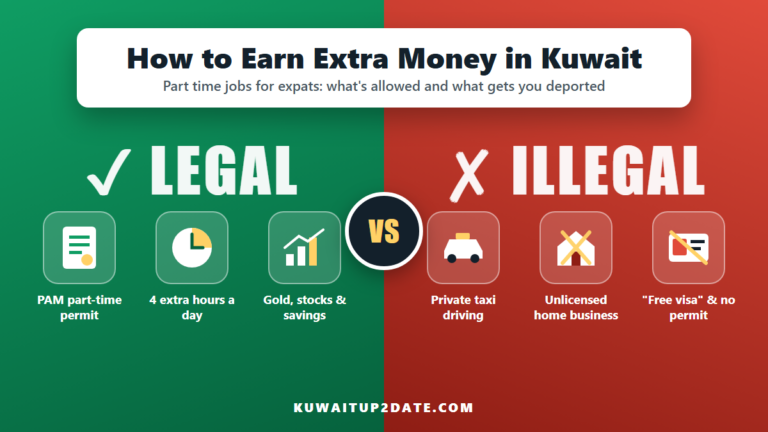
Part Time Job in Kuwait: How to Earn Extra Money Legally (2026 Expat Guide)
Read more →
4
Part Time Job in Kuwait: How to Earn Extra Money Legally (2026 Expat Guide)
Read more →
 5
Local Two Sri Lankan women found dead, the mysterious case
Read more →
5
Local Two Sri Lankan women found dead, the mysterious case
Read more →
 6
Local Life in Kuwait for the Filipino community: what to know
Read more →
6
Local Life in Kuwait for the Filipino community: what to know
Read more →
 7
International US weighs ‘Mother of All Bombs’ strike plan on Iran
Read more →
7
International US weighs ‘Mother of All Bombs’ strike plan on Iran
Read more →
 8
International Trump signals more US strikes possible against Iran
Read more →
8
International Trump signals more US strikes possible against Iran
Read more →
 9
Local Driver tries to stab another with a pen in Abu Halifa
Read more →
9
Local Driver tries to stab another with a pen in Abu Halifa
Read more →
 10
Local Kuwait Orders Airport Fees Shown Clearly on Air Tickets
Read more →
10
Local Kuwait Orders Airport Fees Shown Clearly on Air Tickets
Read more →
 11
Local The best country to live in GCC ?
Read more →
11
Local The best country to live in GCC ?
Read more →
 12
Local Kuwait suspend the license of 2,000 companies
Read more →
12
Local Kuwait suspend the license of 2,000 companies
Read more →
 13
Local Kuwait frees prisoners under Amiri pardon.
Read more →
13
Local Kuwait frees prisoners under Amiri pardon.
Read more →
 14
Local Sahel app adds lost passport service for Kuwait expats
Read more →
14
Local Sahel app adds lost passport service for Kuwait expats
Read more →
 15
Local Kuwait jails 2 Egyptians 7 years over KD 161,000 web scam
Read more →
15
Local Kuwait jails 2 Egyptians 7 years over KD 161,000 web scam
Read more →
Comments
4 responses to “My Personal Guide : Kuwait Indemnity frauds and how to resolve”
Hello sir,
I will be retiring for next year. I started working from Oct. 16,2016 and will retire or resign October 16, 2027 and my salary is fixed at 320kd. Can you help me calculate how much i will receive of my indemnity?
Dear Percy,
As per my knowledge it should be KD 3138/-
320÷26 days= KD 12.307 per day.
First 5 years x 15 days = 75 days
Last 6 years x 30 days= 180 days
Total days 180 x KD 13.307 = KD3138
Hello sir,
I will be retiring for next year. I started working from Oct. 16,2016 and will retire or resign October 16, 2027 and my salary is fixed at 320kd. Can you help me calculate how much i will receive of my indemnity?
Respected sir .. my Sponor has taken thirteen thousand five hundred Kuwaiti Dinar in cash from me and due to my release and having a new visa I was taken as granted by fraud .. how can you help me with this ? My shop was in munira complex Opp marina mall for 25 years .