

If you work in Kuwait, run a business here, or just keep an eye on petrol prices and job ads, this is worth your attention. A new global forecast suggests Kuwait’s economy could grow faster next year than almost anywhere else on Earth.

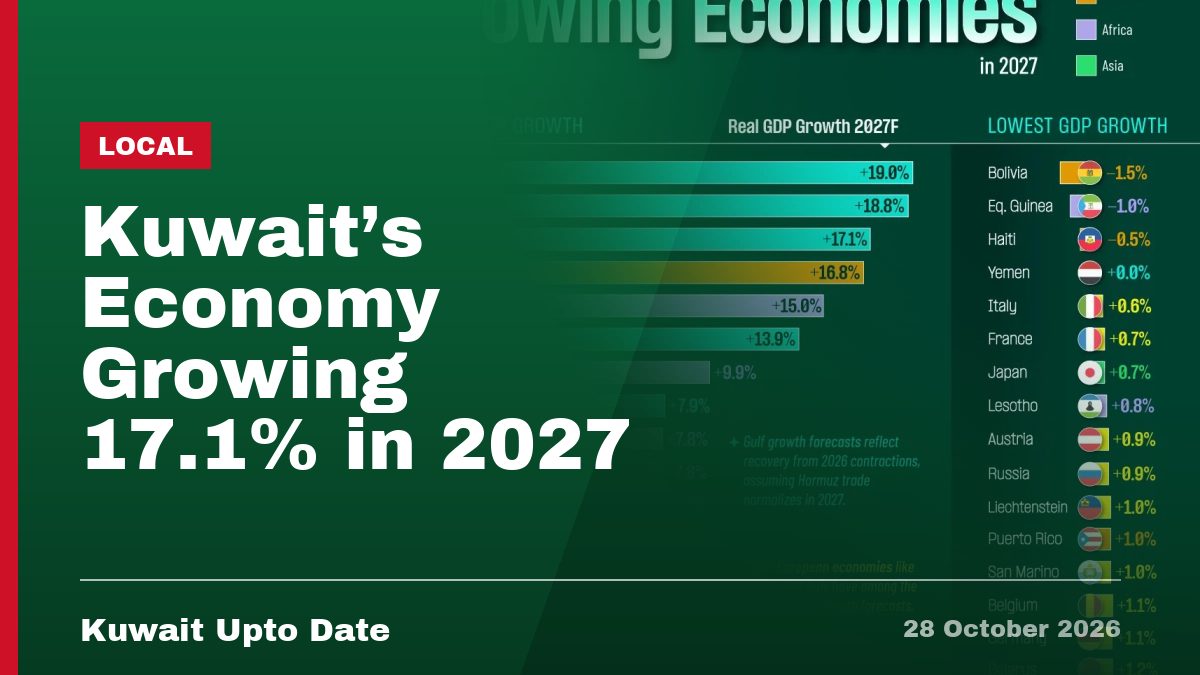
The figures come from the International Monetary Fund’s World Economic Outlook, published in October 2026, and shared through a chart by Visual Capitalist. They show real GDP growth forecasts for 2027 across the world, and Kuwait sits near the very top of the list.
This follows a run of Gulf-focused stories we’ve covered lately, including Kuwait’s climb in global innovation rankings, so it’s part of a wider picture of how Kuwait is being viewed internationally right now.
- The IMF forecasts Kuwait’s real GDP will grow 17.1% in 2027, one of the fastest rates in the world.
- Iraq (19.0%) and Qatar (18.8%) are forecast to grow even faster; Bahrain (13.9%) and Saudi Arabia (7.9%) also rank high.
- The IMF says Gulf growth forecasts assume trade through the Strait of Hormuz returns to normal in 2027, after contractions in 2026.
- Major European economies like France (0.7%) and Italy (0.6%) are forecast to have among the slowest growth in the world.
So why is Kuwait’s growth forecast so high?
A forecast of 17.1% sounds huge, and it is. But the IMF’s own note on the chart gives an important clue: these Gulf growth forecasts reflect a recovery from contractions in 2026, and they assume trade through the Strait of Hormuz normalises in 2027.
In plain terms, that means 2026 was a weak year for Gulf economies, likely linked to regional tensions affecting shipping and trade through the Strait of Hormuz. If 2027 sees that trade return to normal, economies that shrank or stalled in 2026 can look like they’re growing fast, simply because they’re bouncing back from a low point.
This matters because Kuwait isn’t the only Gulf country on this list. Iraq tops the global forecast at 19.0% growth, just ahead of Qatar at 18.8%. Kuwait follows at 17.1%, then Bahrain at 13.9%, Saudi Arabia at 7.9%, and the UAE at 7.7%. Five of the world’s fastest-growing economies for 2027, by this forecast, are in the Middle East.
Outside the Gulf, other economies also feature high on the list: Guyana (16.8%) in the Americas, Sudan (15.0%) in Africa, and Uganda (9.9%), also in Africa. Vietnam (7.5%) and India (7.0%) represent some of the stronger forecasts in Asia.
Who else is on the fast-growth list?
Beyond the Gulf and the names above, the IMF’s top-twenty list for 2027 includes Ethiopia (7.8%), Guinea (7.8%), Rwanda (7.2%), Kyrgyzstan (7.0%), Venezuela (7.0%), Bhutan (6.9%), Benin (6.8%), Tajikistan (6.8%) and Niger (6.5%).
By comparison, the United States is forecast to grow just 2.3% in 2027, shown separately on the chart below the main list. That’s a reminder of how different growth rates can be between large, developed economies and smaller or recovering ones.
And which economies are forecast to grow the slowest?
At the other end of the scale, a handful of economies are forecast to shrink in 2027. Bolivia is expected to contract by 1.5%, Equatorial Guinea by 1.0%, and Haiti by 0.5%. Yemen is forecast to show 0.0% growth, essentially flat.
Several major European economies also sit near the bottom of the global list. Italy is forecast to grow just 0.6%, and France 0.7%. Japan is also forecast at 0.7%. The IMF’s chart specifically notes that major European economies like France and Italy have among the world’s lowest growth forecasts for 2027.
Other economies forecast to grow slowly include Lesotho (0.8%), Austria (0.9%), Russia (0.9%), Liechtenstein (1.0%), Puerto Rico (1.0%), San Marino (1.0%), Belgium (1.1%), Germany (1.1%), Belarus (1.2%), Switzerland (1.2%), the UK (1.2%), Brunei (1.3%) and the Netherlands (1.3%).
What this means for people living in Kuwait
A high GDP growth forecast doesn’t directly change your salary or your rent tomorrow. But over time, strong growth in Kuwait’s economy tends to mean more government spending, more public projects, and often more hiring across sectors that depend on state budgets.
For citizens, this kind of forecast can feed into discussions about public sector wages, subsidies and development projects. For expats working in construction, retail, logistics or services tied to government contracts, a growth rebound can mean steadier demand for jobs over the next year or two.
It’s worth being cautious, though. The IMF’s own note makes clear this forecast depends on an assumption: that trade through the Strait of Hormuz returns to normal in 2027. Recent regional travel advisories and tensions involving Iran show that regional stability is still not guaranteed. If that assumption doesn’t hold, growth could look very different.
This is also a reminder that Kuwait’s economy doesn’t move in isolation. Regional events, from disruptions at Gulf airports to wider questions over Hormuz shipping, can shift these numbers quickly. For more coverage like this, you can check our latest local news from Kuwait.
Quick answers
Does a 17.1% growth forecast mean prices or salaries will change right away?
No. This is a forecast for the whole economy’s output in 2027, not a direct promise about wages or prices. Any effect on daily life would likely happen gradually, through government spending and hiring.
Why did the IMF link this forecast to the Strait of Hormuz?
The IMF says Gulf growth forecasts assume trade through the Strait of Hormuz returns to normal in 2027, after contractions in the Gulf in 2026. That means the high numbers partly reflect a recovery, not only new growth.
Is Kuwait the fastest-growing economy in the forecast?
No. Iraq is forecast highest at 19.0%, followed by Qatar at 18.8%, then Kuwait at 17.1%.
Numbers like these are easy to skim past on a chart. But they’re worth watching over the coming months, especially if you want a sense of where Kuwait’s economy, and your own plans, might be heading in 2027. What would you want to see Kuwait spend on if this growth holds up? Let us know in the comments.
📌 Related stories
Latest News
Local
Kuwait meeting: Nancy Ajram and Ahlam’s warm reunion goes viral
2 International Why Trump says the Iran war isn’t over yet Read more → 3 How to Make 100 KWD a Day on Social Media in Kuwait (Step by step Guide 2026) Read more → 4 Local Court gives 10-year term over child assault at school Read more → 5 Why Are the Houthis Attacking Saudi Arabia? Read more → 6 International US military chief gives Trump new Iran strike plans Read more → 7 International US nuclear drill end this week: what Global Thunder 27 means Read more → 8 Local Video – Kuwait police sweep Jahra areas, arrest wanted suspect Read more → 9 Local Court gives 10-year term in indian child assault case Read more → 10 Local Kuwait traffic police step up checks on delivery bikes and cycle riders. Read more → 11 International Video – She lost bracelet found after four-day search Read more → 12 Local Diwali Holiday for Indians in Kuwait Read more → 13 International Two Britons charged over Iran plot to hit RAF Fairford airbase Read more → 14 Local Kuwait finds cockroaches, crowded rooms at delivery firm housing Read more → 15 International US tells Gulf allies to brace for Iran strikes. Read more →
Leave a Reply