

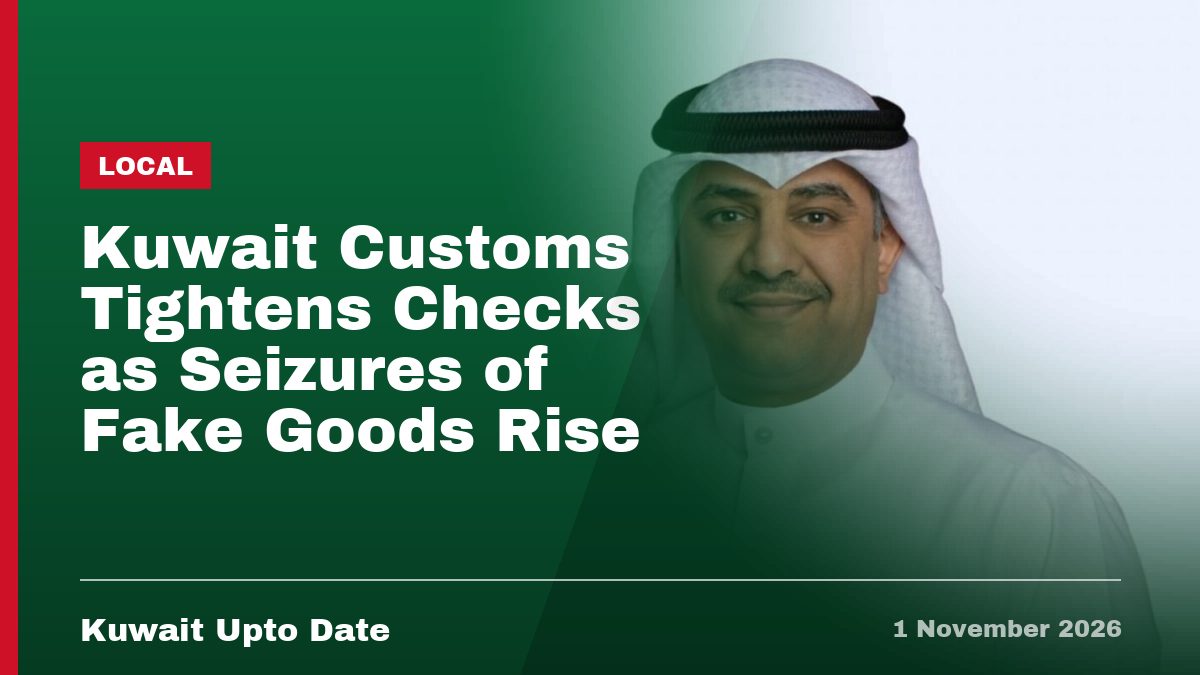
If you’ve flown out of Kuwait International Airport lately with a wad of cash in your bag, ordered a ‘branded’ handbag online, or picked up a few extra cartons of cigarettes on your last trip, you’re exactly who Kuwait Customs is talking to right now.
Saleh Al-Omar, Vice President of Customs Ports Affairs, Research and Investigation at the General Administration of Customs, has been explaining why seizures at Kuwait’s airports, seaports and land borders have been climbing. His answer might surprise you: it’s not because smuggling is getting worse. It’s because customs officers are simply getting better at catching it.
- Kuwait Customs says more seizures reflect sharper inspections and better coordination, not a rise in smuggling itself.
- Fake goods now go beyond clothes and bags – counterfeit medical supplies and cosmetics are a growing health risk.
- Travellers carrying KD 3,000 or more in cash or financial instruments must declare it through the Sahel app or website.
- Customs seized 53,000 cartons of cigarettes in one shipment at the Al-Salmi border crossing – the legal allowance per traveller is just two cartons.
So why are seizures going up?
Al-Omar put it plainly: customs is trying to strike a balance. Protect the country and the public from dangerous or illegal goods, while still letting legitimate trade and travellers move smoothly through Kuwait’s ports.
He said the counterfeit problem has grown well beyond fake designer clothes and leather goods. Officers are now finding counterfeit medical supplies and cosmetics too – products that can pose real health and safety risks if you don’t know what you’re putting on your skin or in your body.
To catch these, inspectors check shipping documents, the declared country of origin, and the declared value of goods. That’s combined with physical inspections, investigations, risk assessment, and information-sharing with local agencies and international bodies including Interpol. Al-Omar said a single suspicious case found during a routine check can often open the door to a much bigger investigation – sometimes uncovering an entire smuggling network.
If you shop online often, this is worth remembering: as we’ve covered before in our piece on an online phone scam that cost a Kuwait shopper KD 200, it pays to check who you’re buying from and what you’re buying before you pay. Al-Omar’s advice goes further – he’s urging shoppers and importers to check whether the product they want is even allowed into Kuwait, and whether it needs prior approval from a government authority, before they click ‘buy’.
What you need to know about declaring cash
This is the part that catches out a lot of travellers, especially those sending or carrying large sums of money for family back home or for business. If you’re entering or leaving Kuwait with cash or negotiable financial instruments worth KD 3,000 or more, you must declare it through the Sahel app or the Sahel website. There’s no way around it – it’s mandatory, as we explained in our earlier guide on declaring cash above KD 3,000 in Kuwait.
Al-Omar’s advice is simple: hold onto your paperwork. Bank withdrawal receipts, currency exchange records, anything that proves where the money came from and that it’s really yours. If customs has questions, that paperwork is what clears things up quickly.
He also told travellers to check the declaration rules before they even leave home, and to use the red channel at customs – the one for people declaring goods – rather than the green channel, whenever it applies to them. Not knowing the rule, he said, doesn’t protect you if you break it. Customs offices at the airport are there to help travellers through the declaration process if they’re unsure how it works.
It’s a timely reminder given how often large undeclared cash sums make headlines elsewhere – we reported in October on two travellers caught hiding $1.67 million in cash at an airport, a case that shows just how seriously customs authorities worldwide now treat undeclared money.
The 53,000 cigarette cartons
One case Al-Omar highlighted stood out. Customs officials confiscated 53,000 cartons of cigarettes in a single shipment at the Al-Salmi border crossing. That’s a scale far beyond someone simply bringing in a few extra packs for personal use.
Al-Omar said cigarette smuggling has shifted from individuals carrying small amounts to organised commercial shipments, built to exploit the price and tax differences between countries. He reminded travellers that the legal allowance is just two cartons of cigarettes per person. Anything more than that, and you’re in violation territory – no matter how it’s packed or declared.
Travellers should also remember Kuwait’s rules on luggage more generally. As we noted in our earlier piece on why you shouldn’t carry bags for other people at Kuwait Airport, you are responsible for what’s found in your own luggage, even if someone else packed it or asked you to carry it.
Al-Omar explained that each type of customs port uses equipment suited to what passes through it. Airports focus on passenger luggage, air cargo and postal parcels. Seaports focus on containers and bulk goods. Land crossings focus on travellers, trucks and vehicles. But he was clear that technology is only part of the picture – trained human inspectors remain central to catching violations that machines alone would miss.
What this means for people living in Kuwait
For residents and citizens alike, the message is straightforward. If you travel in or out of Kuwait regularly, know your declaration limits and keep your financial paperwork in order. If you shop online, especially for cosmetics, medical products or branded goods, check Kuwait’s import rules before you order, not after it arrives at customs. And if you’re bringing cigarettes back from a trip, stick to the two-carton limit – customs is actively watching for commercial-scale smuggling, not just checking the odd extra pack.
More local news from Kuwait covers how these rules play out for everyday residents, from traffic to customs to visas.
Quick answers
Do I need to declare cash under KD 3,000?
No. The mandatory declaration through Sahel applies only to cash or financial instruments worth KD 3,000 or more, whether you’re entering or leaving Kuwait.
How many cartons of cigarettes can I bring into Kuwait?
The permitted allowance is two cartons of cigarettes per traveller. Larger amounts risk seizure and possible investigation.
What should I do if I’m not sure whether my online purchase is allowed into Kuwait?
Al-Omar’s advice is to check in advance whether the product is permitted for import and whether it needs prior approval from a relevant government authority, before you buy it.
Al-Omar also credited First Deputy Prime Minister and Minister of Interior Sheikh Fahd Al-Yousef for his support of the customs administration, and praised customs staff for working around the clock, including in difficult weather, to protect the country while keeping legitimate trade and travel moving.
Have you ever had to declare cash or clear a package through Kuwait Customs? Tell us how it went in the comments – it might help the next traveller avoid a headache.
📌 Related stories
Latest News
 Local
Kuwait sends 205 people to court in September drug sweep
2 Local Smoking in Kuwait schools now means a 3-day suspension Read more → 3 Local Video – Driver with no headlights speeds on Al Salmi Road Read more → 4 International Trump says US may still strike one or two Iran sites Read more → 5 International Iran war fears grow in Gulf after US warning Read more → 6 Local KD 3.9 million allocated to widows and divorcees in Kuwait Read more → 7 Local Second viral clip shows two women fighting in Salmiya souq Read more → 8 Local Your manager can’t pay lower than agreed salary in Kuwait Read more → 9 Local Viral video shows fight between two women in Old Salmiya souq Read more → 10 International Iran’s new warning to the US and Israel Read more → 11 International Rs 10 crore reward-app scam money traced to Kuwait bank Read more → 12 Local Kuwait speeds up border checking Read more → 13 International Violation of the month Read more → 14 International Sameday visa process for Saudi Arabia Read more → 15 International Qatar’s free visa on arrival Read more →
Leave a Reply