

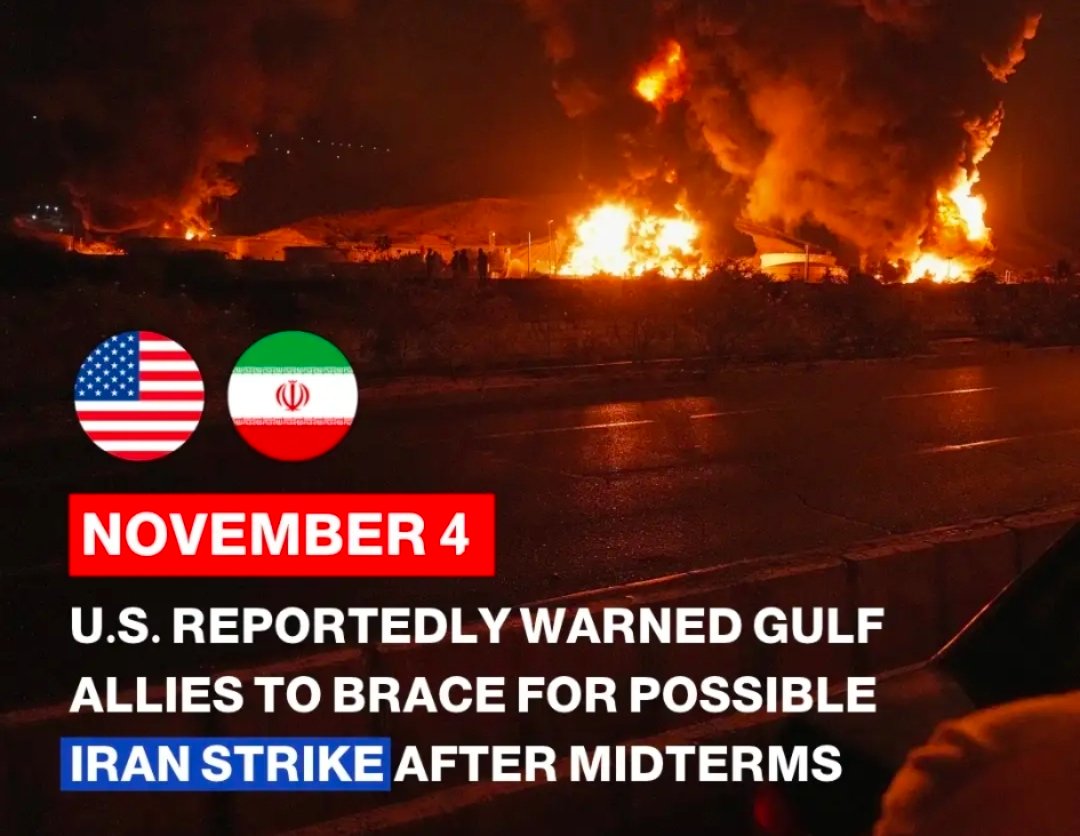
One American woman living in Saudi Arabia is packing her bags before Tuesday, just in case.
She isn’t alone. Across the Gulf, people are quietly rearranging travel plans, watching the news and wondering whether the war between the United States and Iran, paused for now, is about to start again. Why Trump says the Iran war isn’t over yet has been a question hanging over the region for weeks.
“The mood has definitely shifted,” the 36-year-old American told CNN. “People are more cautious in general, and it feels like a waiting game to see what happens.”
- US President Donald Trump has said Washington will not strike Iran before Tuesday’s US midterm elections, but hasn’t said what happens after.
- The war, which began in February when the US and Israel killed Iran’s Supreme Leader Ali Khamenei in joint strikes, is now in its eighth month with no military or diplomatic breakthrough.
- Families of US diplomats have quietly started leaving Gulf postings again, and thousands of US troops have reportedly been sent to the region.
- Quiet diplomacy is continuing, including a letter from US Vice President JD Vance to a top Iranian security official, and talks in Qatar.
Why is the fear rising now?
Trump posted online earlier this month that the US “will not be attacking Iran at any time prior to the midterm elections.” That sounds reassuring, but he never said what comes after. That gap is exactly why nerves are up.
Hasan Alhasan, a senior fellow for Middle East policy at the International Institute for Strategic Studies, told CNN the US has been “actively feeding into this regionwide sense of anxiety” by repeatedly signalling that another round of fighting might be close. “It’s becoming difficult to distinguish pressure tactics from genuine signals,” he said.
Iran has been playing its own game of signals. Military commanders have spent the past month publicly claiming Iran has built up large stockpiles of new weapons. A senior security official in Tehran told CNN that if the war resumes, Iran would target infrastructure beyond oil facilities, including artificial intelligence sites, and called it a coming “war of surprises.” On Saturday, Iran’s supreme leader, Mojtaba Khamenei, ordered a response “without geographical limitations” to any new threat.
Adding to the uncertainty, Israeli Prime Minister Benjamin Netanyahu, who partnered the US in the original strikes and has been pushing for more, is staying in office despite losing his majority in recent elections. Talks to form a new Israeli government are due to start next week, but opposition parties look unlikely to remove him quickly. Our earlier coverage on US tells Gulf allies to brace for Iran strikes and new Iran strike plans given to Trump traces how this tension built up over October.
What’s actually happening on the ground in the Gulf
Foreign workers have lived in the Gulf for decades, drawn by good jobs and a tax-free lifestyle, in a region that often feels calmer than its neighbours. That sense of safety broke this year when Iran fired unprecedented barrages of ballistic missiles and drones at Arab cities, shutting schools, disrupting travel and business, and causing casualties.
Even so, many residents stayed. Michelle, a 36-year-old American living in Abu Dhabi, told CNN she still feels safe under the protection of well-armed regional militaries, but admitted the uncertainty is wearing. “I’m actively trying not to think about that happening again because I really don’t want another winter with strikes,” she said. “I’m more concerned that our lives will have to change again.”
This month, people noticed families of US diplomats quietly leaving Gulf postings, some only realised when children began saying goodbye to classmates at school. Many of these families had only just returned after being pulled out during the worst of the fighting in March, making the exits feel like an unwelcome repeat. Reports from the Associated Press, cited by CNN, say thousands of US troops have also been sent to the region recently.
Saudi Arabia has felt the strain the most. Major events have already been cancelled, and offices there have shifted staff to remote work after Iran-allied Houthi rebels intensified strikes, a pattern we’ve also tracked with the Houthi drone attack near Madinah earlier this month. Residents worry a renewed war would pile more pressure on a country already dealing with conflict along its southern border. “My neighbours and friends are bunkering for November but starting to get concerned about flight disruptions over the holidays,” the American resident said, comparing the mood to the early days of Covid-19, with virtual offices and remote learning back in place.
Abu Dhabi, which hasn’t recorded an attack since May, is still pushing ahead with a major regional oil conference next week, expecting close to 240,000 attendees and more than 120 American exhibiting companies, according to organiser DMG. Still, two US oil firms have reportedly pulled their executives from attending, citing security concerns.
In Bahrain, one of the hardest-hit countries this year, the psychological toll remains. “There is still that traumatic effect,” 21-year-old Fawaz told CNN. “When you hear the bombings, it’s kind of like you feel it in your hearts and it’s hard to sleep at night.” He added that many people have grown used to it, “but it’s still very scary.”
Is diplomacy still alive?
Despite all the war talk, quiet diplomacy hasn’t stopped. US Vice President JD Vance sent a letter to Mohsen Rezaei, a top Iranian security official, which Iranian media say Tehran is reviewing. Trump claims the letter was about an Iranian request for medical supplies, but it has raised some hope of a breakthrough. Iranian officials are also in Qatar for talks, though a Qatari official said no US delegation was present on Saturday.
Tom Barrack, the US ambassador to Turkey and special envoy to Syria and Iraq, struck a far more hopeful tone than Trump, telling CNN’s Becky Anderson he believes there could be “dramatic steps” within two weeks. “We’re close. I think we’re very close to a place where we can finally say: Let’s just have a time out,” he said, though he added it comes down to “a matter of trust and who goes first.”
US Secretary of State Marco Rubio wouldn’t say whether recent talks had made progress, but said “if there is a diplomatic solution, we would be open to it.” Asked whether there’s a deadline before military action resumes, he said, “I don’t know if there’s a time frame… it’s up to the president.” He added that any deal “can’t be one that endangers our national security” and must address Iran’s nuclear programme.
Iran, for its part, says it’s open to talks but doesn’t trust them, pointing to past occasions when it was struck mid-negotiation. Mohammad Bagher Ghalibaf, the Iranian parliamentary speaker leading the talks, said: “Iran’s conditions have been repeatedly and clearly stated to the mediators. The carrot-and-stick approach has no effect on Iran. Progress can only be achieved once Iran’s seven conditions have been agreed upon.”
What this means if you live in Kuwait
Kuwait sits right in the middle of this picture, both geographically and in terms of risk. The country has already felt the human cost of the tension this year, as we reported when six US troops were killed at Kuwait’s Shuaiba port, including the case of Nicole Amor. Travel disruption is also not theoretical here: Kuwait Airways has already had to cancel flights to Riyadh once this year, as covered in our Riyadh flight disruptions update.
For now, nothing in this latest CNN report points to an immediate change for Kuwait residents. But the signs worth watching are the same ones people elsewhere in the Gulf are tracking: US troop movements, embassy staff departures, event cancellations and whether the Vance-Rezaei letter or the Qatar talks lead anywhere. You can follow our ongoing coverage on the International news page as this develops.
Quick answers
Will the Iran war definitely restart after the US midterms?
No one knows for sure. Trump has only promised no strikes before Tuesday’s vote. He hasn’t confirmed or ruled out action afterwards, which is exactly why the region is anxious.
Has Kuwait been directly affected by this war?
Yes. Kuwait has already seen a deadly incident at Shuaiba port this year, and flights to neighbouring Saudi Arabia have been disrupted before because of regional tension.
Is there still a chance of a peaceful solution?
Officials on both sides say talks haven’t stopped. A US letter to a senior Iranian official and ongoing talks in Qatar suggest some room for diplomacy, though trust between the two sides remains low.
If you’re in Kuwait and keeping an eye on flights, school schedules or work travel because of this, you’re not alone. What are you watching for over the next week? Let us know in the comments.
📌 Related stories
Latest News
 International
Trump says US may still strike one or two Iran sites
2 Local KD 3.9 million allocated to widows and divorcees in Kuwait Read more → 3 Local Second viral clip shows two women fighting in Salmiya souq Read more → 4 Local Your manager can’t pay lower than agreed salary in Kuwait Read more → 5 Local Viral video shows fight between two women in Old Salmiya souq Read more → 6 International Iran’s new warning to the US and Israel Read more → 7 International Rs 10 crore reward-app scam money traced to Kuwait bank Read more → 8 Local Kuwait speeds up border checking Read more → 9 International Violation of the month Read more → 10 International Sameday visa process for Saudi Arabia Read more → 11 International Qatar’s free visa on arrival Read more → 12 Local What Kuwait’s breast cancer screening numbers mean for you Read more → 13 International Congo Ebola deaths pass 5,000 as outbreak spreads further Read more → 14 International Airport for Facial Recognition Travel of passengers at checkin Read more → 15 International Binance hack: $6.3 billion crypto theft explained Read more →
Leave a Reply