


If you’ve ever hired a housemaid, driver or nanny in Kuwait, or you’re one of the hundreds of thousands of people working in someone else’s home here, this is the household the country actually looks like on paper. New figures just put real numbers behind who’s doing this work, and where they come from.
Kuwait’s Public Authority for Civil Information (PACI) has released a breakdown of the country’s domestic workforce, and it confirms something most residents already sensed: this sector runs almost entirely on workers from four countries.
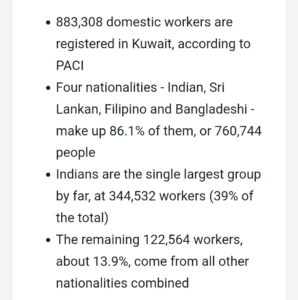
- Kuwait has 883,308 domestic workers in total, according to PACI
- Indian, Sri Lankan, Filipino and Bangladeshi nationals together make up 760,744 of them – 86.1 percent
- Indian nationals are the single largest group, at 344,532 workers (about 39 percent)
- Sri Lankans come second at 157,901 (17.9 percent), ahead of Filipinos at 151,369 (17.1 percent)
So who actually makes up this workforce?
India sits well ahead of everyone else. Indian nationals alone account for nearly four out of every ten domestic workers in Kuwait – a lead no other nationality comes close to matching.
Sri Lanka takes second place with 157,901 workers, just ahead of the Philippines on 151,369. The gap between those two is fairly narrow, which is notable given how differently the two communities are often discussed in Kuwait – Filipino domestic workers have had a higher public profile here in recent years, partly because of ongoing discussions around protections for Filipino workers in Kuwait, yet Sri Lankans actually outnumber them.
Bangladesh rounds out the top four with 106,942 workers, or 12.1 percent of the total. Beyond these four countries, the remaining 13.9 percent – roughly 122,564 people – come from a mix of other nationalities, none large enough to be broken out individually in the data PACI released.
We covered a closer look at this same dataset recently in our piece on Indians topping Kuwait’s domestic worker numbers, which set out the Indian figure in more detail. This latest release fills in the picture by showing exactly how the other three leading nationalities stack up against each other.
Why does this concentration matter?
More than eight in ten domestic workers in Kuwait come from just four countries. That’s not an accident – it reflects decades of labour migration patterns, recruitment networks, and bilateral agreements between Kuwait and these sending countries. It also means that when something changes in one of these relationships – a new labour agreement, a recruitment ban, a dispute over wages or conditions – it affects a huge slice of households across Kuwait almost overnight.
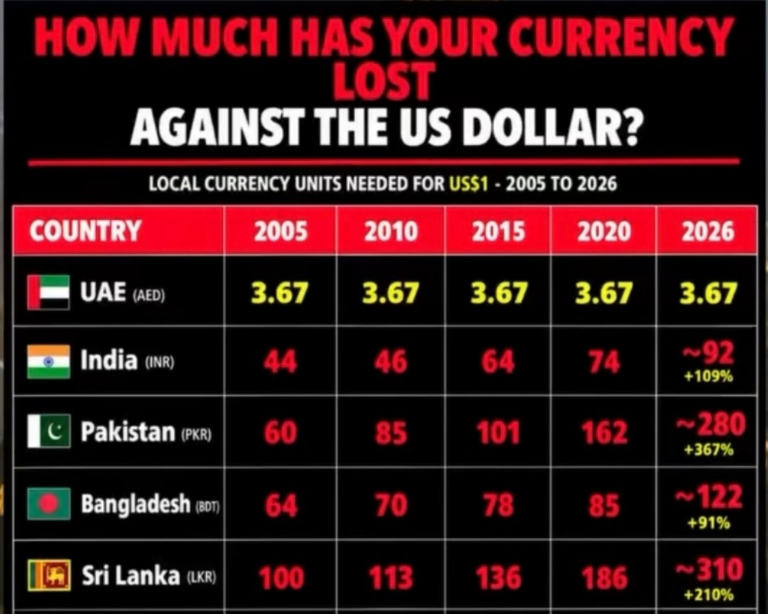
It’s also worth remembering that domestic work sits under its own legal framework in Kuwait, separate from the main private sector labour law, with its own rules on contracts, working hours, and the sponsor’s responsibilities. For many workers from these four countries, their earnings sent home are a significant part of family income back home, which is one reason exchange rate movements matter so much to this community – something we looked at in our piece on how currency depreciation affects expats sending money home.
What this means if you live in Kuwait
For Kuwaiti households and long-term expat families who employ domestic workers, these figures are a reminder of how dependent the sector is on a small number of source countries. If recruitment from any one of these four nations slows down or faces restrictions, it can tighten the market and push up costs or waiting times for hiring help.
For workers themselves, and their communities here, the numbers are a kind of validation – a sense of scale. Sri Lankan workers in particular now have clear confirmation that theirs is the second-largest community in this line of work in Kuwait, ahead of the more visible Filipino community in raw numbers, even if public conversation doesn’t always reflect that.
You can find more coverage like this on our Local news hub, where we track what these kinds of ministry and authority figures actually mean for people living here.
Quick answers
Where did these figures come from?
The data was released by Kuwait’s Public Authority for Civil Information (PACI), the government body responsible for maintaining civil records, including residency and workforce statistics.
Does this include all expat workers in Kuwait, not just domestic staff?
No. These figures specifically cover domestic workers – housemaids, drivers, cooks, nannies and similar roles – not the wider expat workforce employed in companies, government or other private sector jobs.
Which nationality has the most domestic workers in Kuwait?
Indian nationals, with 344,532 workers, making up about 39 percent of Kuwait’s total domestic workforce of 883,308.
Are Sri Lankan domestic workers really ahead of Filipino workers in Kuwait?
Yes, according to this PACI data. Sri Lankans number 157,901 compared to 151,369 Filipino domestic workers, a gap of just under 6,500 workers.
If you employ domestic help or you’re part of one of these communities, do these numbers match what you see day to day in your own building or neighbourhood? Let us know in the comments.
📌 Related stories



Latest News
 International
Fast-track family visas for Saudi Arabia for skilled professionals
International
Fast-track family visas for Saudi Arabia for skilled professionals
 2
International Canada to give high earners more immigration from 3rd November 2026
Read more →
2
International Canada to give high earners more immigration from 3rd November 2026
Read more →
 3
International Saudi Arabia launches live crowd tracker for Grand Mosque, Prophet’s Mosque
Read more →
3
International Saudi Arabia launches live crowd tracker for Grand Mosque, Prophet’s Mosque
Read more →
 4
Local Kuwait Ends Paper Car Insurance
Read more →
4
Local Kuwait Ends Paper Car Insurance
Read more →
 5
Local Expat ordered to pay KD 3,000 for insulting Kuwait doctor
Read more →
5
Local Expat ordered to pay KD 3,000 for insulting Kuwait doctor
Read more →
 6
Local Kuwait lifts bans on seven countries
Read more →
6
Local Kuwait lifts bans on seven countries
Read more →
 7
Local Kuwait Sets New Rules for Delivery Bike Riders
Read more →
7
Local Kuwait Sets New Rules for Delivery Bike Riders
Read more →
 8
Local Kuwait Police Recover KD 7,000 in Stolen Exhibition Jewellery from a woman
Read more →
8
Local Kuwait Police Recover KD 7,000 in Stolen Exhibition Jewellery from a woman
Read more →
 9
International Pakistani man’s Kuwait love story and its end
Read more →
9
International Pakistani man’s Kuwait love story and its end
Read more →
 10
International What Saudi Arabia’s Latest Visa Crackdown Means
Read more →
10
International What Saudi Arabia’s Latest Visa Crackdown Means
Read more →
 11
International Nicole Amor, killed in Kuwait
Read more →
11
International Nicole Amor, killed in Kuwait
Read more →
 12
Local Iowa soldier among six US troops killed at Kuwait’s Shuaiba port
Read more →
12
Local Iowa soldier among six US troops killed at Kuwait’s Shuaiba port
Read more →
 13
International How much has your currency lost against the US dollar?
Read more →
13
International How much has your currency lost against the US dollar?
Read more →
 14
International India: Minimum Salary Level for Employment Visas Significantly Increased
Read more →
14
International India: Minimum Salary Level for Employment Visas Significantly Increased
Read more →
 15
International Roundabout Now a Signal, Cuts Travel Time 50%
Read more →
15
International Roundabout Now a Signal, Cuts Travel Time 50%
Read more →
Leave a Reply