

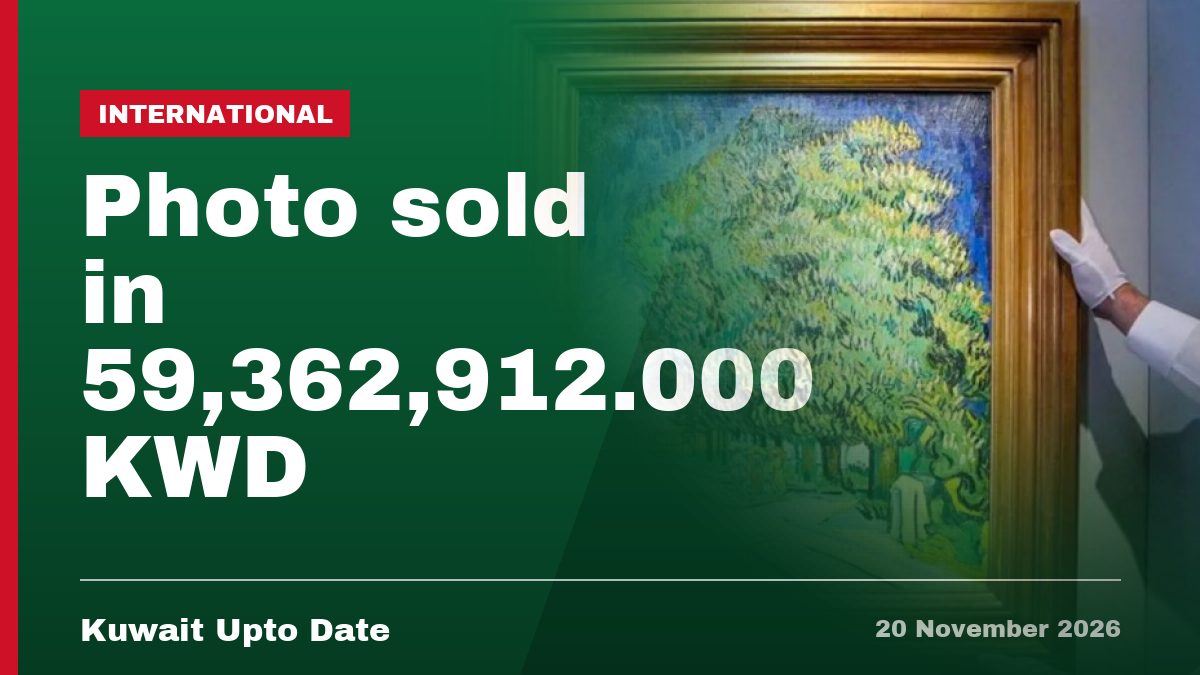
If you follow art news even a little, or you’ve ever walked past a gallery in Kuwait and wondered what a famous painting is really worth, this number will stop you: $190.4 million. That’s about KD 58.5 million, paid for a single canvas by Vincent van Gogh.
It’s not just a big number for art collectors to admire. The sale closes a long dispute over how the painting changed hands during one of the darkest periods in modern history, and it says something about where serious money is moving in the art world right now. You can follow more of this kind of international news as it develops.
- Van Gogh’s painting “Blossom Chestnuts” sold for $190.4 million (about KD 58.5 million) at Sotheby’s.
- It is now the most expensive artwork sold at auction this season and a new record for Van Gogh.
- The sale went ahead only after Sotheby’s reached a settlement with the heirs of a Jewish publisher who sold the painting in 1936, under Nazi rule.
- The family that has owned the painting since 1975 keeps it, but the deal resolves the ownership dispute for good.
What exactly sold, and for how much
The painting is called “Blossom Chestnuts,” painted by Vincent van Gogh in 1890 in the French town of Auvers-sur-Oise, where he spent his final months. Sotheby’s announced the $190.4 million sale this week, confirming it as the most expensive piece of art sold at auction so far this season.
This beats the previous record for a Van Gogh work at auction, held by “Field with Cypresses,” painted in 1888, which sold for $117.2 million (about KD 36 million) at Christie’s in New York back in 2022. In other words, this new sale isn’t just a record for one painting. It’s a record for the artist himself.

Why the sale almost didn’t happen
Here’s where the story gets more serious than just money. The painting was sold in 1936 by Samuel Fischer, a prominent German Jewish publisher. His heirs argued that he had been forced to give up the painting because of the economic and political pressure Jewish families faced under Nazi rule at the time, not because he simply wanted to sell it.
Gunnar Schnabel, a Berlin-based lawyer representing the Fischer family, publicly called on Sotheby’s to prove the painting had been sold at its real market value in 1936, and that Fischer would have sold it anyway regardless of the political situation he was living under. That’s a serious question in any Nazi-era art case: was the sale genuinely free, or forced?
The family who has actually owned the painting for decades, the Blackier-Arrieta family, bought it in 1975 and kept it in the family for more than 50 years. They were not involved in the 1936 sale and had owned the work in good faith for half a century.
How the dispute was settled
Sotheby’s announced on Tuesday that an agreement had been reached between the Blackier-Arrieta family, who still own the work, and “all legal rights holders” of Samuel Fischer. The exact terms of the settlement were not shared publicly.
Sotheby’s said it had carried out in-depth research into the painting’s full ownership history and, so far, found no evidence that it was sold under duress or for less than its true value in 1936. That’s Sotheby’s own position. The Fischer family’s lawyer had raised doubts about exactly that point, so the settlement appears to be a way to close the matter without a court deciding who was right.
This kind of dispute is not unusual. Many Jewish families lost or were forced to sell valuable property, including art, during the Nazi era. Several claims for the return of such artworks have been filed in recent years, and many have ended, like this one, in amicable settlements rather than lengthy legal battles.
What this means if you follow art or collect it
You don’t need to be a billionaire collector for this story to matter. Kuwait has its own community of art lovers, gallery visitors and collectors who follow international auctions closely, and sales like this one shape prices across the whole market, from major names down to smaller works.
A record sale also reminds buyers and sellers everywhere, including galleries and private collectors in Kuwait, why checking a painting’s full ownership history, known as provenance, matters so much before any purchase. A painting’s price isn’t only about brushstrokes. Its history of ownership can affect its value and even whether it can be legally sold at all.
For anyone newer to art collecting, this case is a useful lesson: even a world-famous auction house like Sotheby’s can face a dispute over a painting’s past, decades after it last changed hands. A clean bill of ownership is worth as much as the artwork itself.
Quick answers
Why did Sotheby’s need a settlement before selling the painting?
Because the Fischer family’s heirs objected to the sale, arguing their ancestor was forced to give up the painting under Nazi-era pressure in 1936. Without resolving that, the sale’s legal standing would have stayed in doubt.
Does the family that owned the painting since 1975 lose it?
No. The Blackier-Arrieta family, who bought the painting in 1975, remain its sellers in this deal. The settlement is with the Fischer family’s heirs, not a transfer of ownership away from the sellers.
Is this the most expensive Van Gogh ever sold?
Yes, at auction. The $190.4 million price for “Blossom Chestnuts” beats the previous Van Gogh auction record of $117.2 million, set by “Field with Cypresses” at Christie’s in 2022.
Are Nazi-era art disputes common?
Yes. Several claims have been filed in recent years by families seeking the return of art lost or sold under pressure during the Nazi era, and many end in settlements rather than court rulings.
A painting from 1890 just sold for nearly KD 60 million, partly because of an argument over what happened to it in 1936. History doesn’t stay quiet for long, even in the art world. What do you think a fair settlement looks like in cases like this one?
Latest News
International
GTA 6 sales hit $2.3 billion in just 24 hours
2 International Expats from Kuwait, Who Became Famous Around the World Read more → 3 Local Old landmine in Kuwait desert kills Bangladeshi shepherd Read more → 4 International What Dubai’s new teacher phone ban means for parents Read more → 5 International Police arrest TikTok creator over alcohol livestream Read more → 6 Local Gulf businessman says some nationalities ‘unsuited’ to Gulf jobs Read more → 7 International What TikTok’s new deepfake-detection tool means for you Read more → 8 Local Four arrested after newborn abandoned, Kuwaiti and Saudi Read more → 9 Local Rumaithiya suitcase murder case Read more → 10 International Turkey Launches New Golden Visa Without Property Investment Read more → 11 Local Video – Kuwait police seize abortion pills, arrest man in Mahboula Read more → 12 Local 494 more Jleeb buildings ordered demolished in 2 weeks Read more → 13 Local Video – Six drivers in Kuwait owe KD 162,795 in unpaid fines Read more → 14 International Study: husbands who listen to wives rarely divorce Read more → 15 Local Kuwait to seize and crush quad bikes used on public roads Read more →
Leave a Reply