

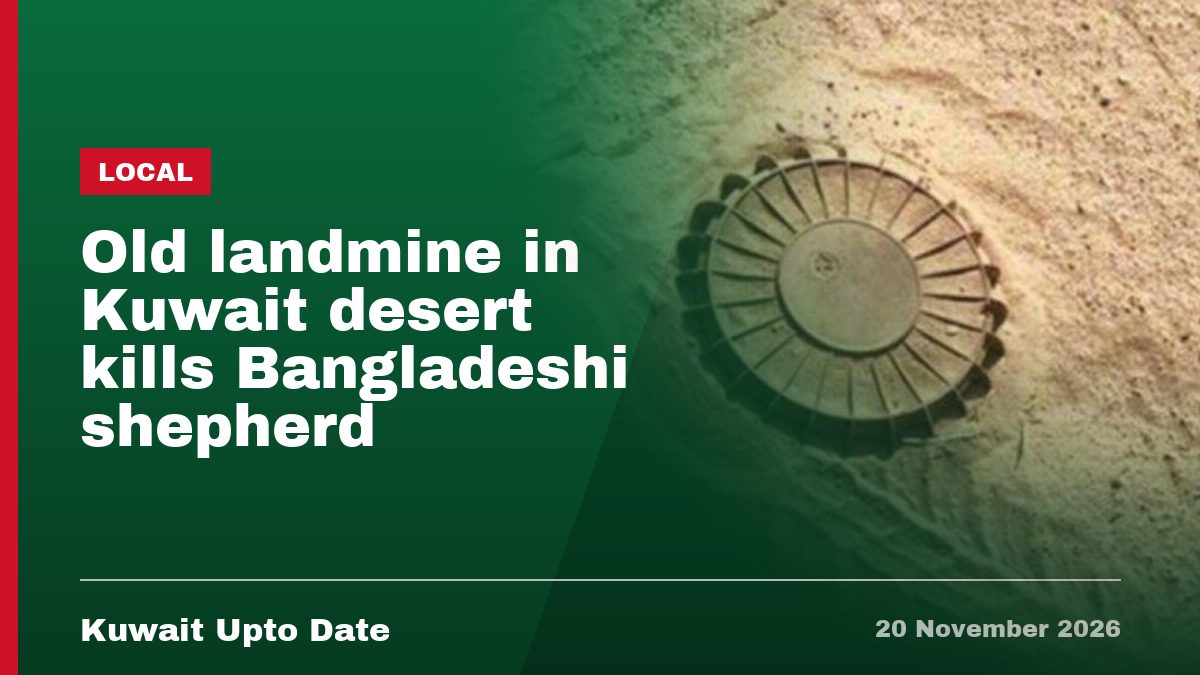
If you spend weekends out in the open desert, this story is a reminder that not every patch of sand is safe to walk on. Decades after the Gulf War, pieces of old military hardware can still be sitting under the surface, waiting.
A Bangladeshi shepherd has died after stepping on a landmine believed to date back to Iraq’s 1990 invasion of Kuwait, an occupation the country endured for roughly seven months before liberation. The explosion also injured a she-camel that was at the same spot.
It’s a quiet, grim story, but one with a direct safety message for anyone living in or visiting Kuwait: old mines and unexploded ordnance from that war have not all been cleared, more than 35 years later.
- A Bangladeshi shepherd died after stepping on a landmine left over from the 1990 Iraqi invasion of Kuwait.
- A she-camel at the same location was injured in the blast.
- The exact date, location and the shepherd’s age have not been confirmed.
- Authorities have not yet released an official statement on the incident, as far as is known.
What happened
According to the information available, the shepherd had lived and worked in Kuwait for more than 35 years. He was out with his animals, likely in one of Kuwait’s open desert or grazing areas, when he stepped on a mine left behind from the 1990-91 war.
The blast killed him and injured a she-camel nearby. No further details have been given about where exactly this happened, which authority responded, or whether an investigation is underway.
Because so little has been officially confirmed so far, it’s worth treating some details – like the precise location and date – as not yet known rather than guessing at them.
Why landmines are still a danger in Kuwait
Kuwait was occupied by Iraqi forces from August 1990 until February 1991. During that period and the war that followed, large numbers of landmines and other explosive devices were placed across the country, particularly in border and desert areas.
Kuwait has carried out extensive demining work in the decades since. But unexploded mines can still be found in remote desert areas, especially ones that are rarely disturbed or far from main roads. Shifting sand can also expose devices that were previously buried deep enough to be missed.
This is not the first time old ordnance has caused injury or death in Kuwait’s deserts, which is exactly why residents are regularly urged to be careful in areas away from marked paths and known camping grounds.
That warning matters more than it might seem, especially with desert camping season in full swing. The next section looks at who should be paying attention.
What this means for people living in Kuwait
This incident is a warning for anyone who works, herds animals, camps or drives in Kuwait’s desert areas – citizens and expats alike. Shepherds, farm workers and desert camping groups are especially exposed, since they often move through areas that are not regularly checked or marked.
If you’re planning a desert trip, stick to known, well-used tracks and camping spots rather than wandering into untouched or isolated ground. Avoid digging, lighting fires in unfamiliar soil, or letting children or animals roam too far from the group.
If you ever come across a metal object, wire or anything that looks like it could be military equipment, don’t touch it or try to move it. Leave the area and report it to the nearest police station or to Kuwait’s Ministry of Interior.
You can find general safety advice and more local news from Kuwait on our site as this story develops.
Quick answers
Are there still landmines in Kuwait’s desert?
Yes, in some remote areas. Kuwait cleared large amounts of ordnance after the 1990-91 war, but isolated mines and unexploded devices can still turn up, especially in less-travelled desert ground.
What should I do if I find something suspicious in the desert?
Don’t touch or move it. Leave the area immediately and report the location to the police or the Ministry of Interior.
Is it safe to go desert camping in Kuwait?
Popular, well-used camping areas are generally considered safe. The risk is higher in isolated or rarely visited spots, which is why sticking to known routes matters.
It’s a sobering story, but a useful one to share with anyone who heads out to the desert often. If you camp or travel in Kuwait’s open areas, it’s worth passing this warning on to your group before your next trip.
Latest News
 International
Expats from Kuwait, Who Became Famous Around the World
2 International What Dubai’s new teacher phone ban means for parents Read more → 3 International Police arrest TikTok creator over alcohol livestream Read more → 4 Local Gulf businessman says some nationalities ‘unsuited’ to Gulf jobs Read more → 5 International What TikTok’s new deepfake-detection tool means for you Read more → 6 Local Four arrested after newborn abandoned, Kuwaiti and Saudi Read more → 7 Local Rumaithiya suitcase murder case Read more → 8 International Turkey Launches New Golden Visa Without Property Investment Read more → 9 Local Video – Kuwait police seize abortion pills, arrest man in Mahboula Read more → 10 Local 494 more Jleeb buildings ordered demolished in 2 weeks Read more → 11 Local Video – Six drivers in Kuwait owe KD 162,795 in unpaid fines Read more → 12 International Study: husbands who listen to wives rarely divorce Read more → 13 Local Kuwait to seize and crush quad bikes used on public roads Read more → 14 International Trump sets 1 January as next Iran decision point Read more → 15 International 5 days off for GTA VI launch Read more →
Leave a Reply