

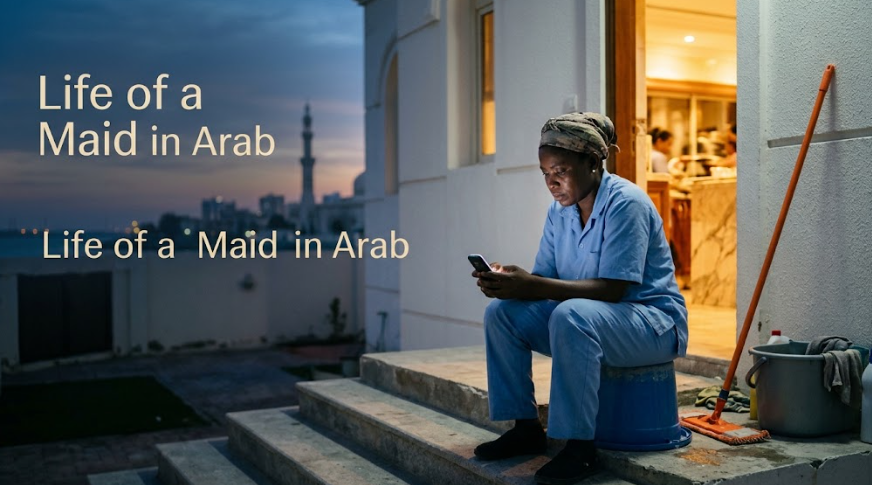
She wakes before the call to prayer. She sleeps after the last light in the house goes out. In between are eighteen hours that nobody counts but her. This is the story of the women who keep millions of homes running across the Arab Gulf, and who are, too often, invisible inside them.
Who Are the Women Behind the Doors?
Walk through any wealthy neighbourhood in Riyadh, Kuwait City, Doha, Dubai or Muscat and you will pass thousands of homes. Behind many of those walls a woman from Kenya, Uganda, Ethiopia, the Philippines, Indonesia, Sri Lanka, Nepal, India or Bangladesh is mopping a floor, rocking a baby that is not hers, or standing over a hot stove in a kitchen she is not allowed to eat in.
The ILO estimates that there are around 6.6 million domestic workers in the Arab States, roughly 8.7% of all domestic workers on Earth. Most are migrants, and most migrant women in the region work in homes. They left their own children so they could feed them. Many of them do not see those children again for two, three, sometimes five years.
The system that binds most of them has a name: kafala, or sponsorship. Under kafala, a worker’s legal right to stay in the country is tied to one employer. Leave without permission and she can be reported as “absconding”, which is a crime. Lose your sponsor and you lose everything. That one rule shapes every hour of her day.
Meet Mercy
Mercy is 34. She comes from a small town outside Mombasa. She has two children: Brian, who is 11, and Faith, who was 4 when Mercy left and is now 6. Faith calls her “Mama on the phone”.
Mercy paid an agent nearly a year of savings to get her job. She was promised a salary, a weekly day off, her own room and a phone. When she landed, the agent’s representative met her at the airport and took her passport “for processing”. She has not seen it since.
This is one day in her life.
24 Hours: A Timeline of One Day
The alarm no one else hears
Mercy sleeps on a thin mattress in a storeroom behind the kitchen, next to the water heater and a box of cleaning supplies. There is no window. She has learned to wake without an alarm because the old phone she was allowed to keep is often taken away at night.
She washes her face with cold water, ties her hair back, and moves quietly. Waking the family is the worst thing she can do.
“In Kenya the roosters wake me. Here it is fear.”
Prayers, coffee, and a house still asleep
She prepares coffee and dates for the father before the dawn prayer. She irons his white thobe, sets out the school uniforms for three children, and starts breakfast. Eggs, foul, bread, tea with milk, juice, each child wants something different, and each must be ready at once.
The school rush
She wakes the children, dresses the youngest, packs lunchboxes, finds the lost shoe, and walks the kids to the driver waiting outside. The youngest, Noor, is six, the same age as Faith. Noor hugs her goodbye. Mercy smiles. It is the kindest moment of her day, and it hurts the most.
“I brush another girl’s hair every morning. I have never brushed my daughter’s hair since she was four.”
Breakfast, but not for her
She clears the plates. She eats whatever is left standing up in the kitchen, a piece of bread and some cold egg. In some homes workers are given their own food. In others, as Amnesty heard again and again, women are given leftovers, or so little that they go hungry. Mercy has learned to eat fast.
The big clean
Five bedrooms. Six bathrooms. Two majlis sitting rooms that must be spotless in case guests come. She sweeps the sand that blows in every day, mops marble floors on her knees, washes and hangs the laundry, scrubs the outdoor courtyard in heat that will soon pass 45°C.
Her back has hurt for a year. She has not seen a doctor. She is afraid to ask.
Madam’s list
The mother of the house wakes and hands her a list: wash the car mats, clean the fridge, iron the curtains, go up and clean the grandmother’s flat on the top floor. Sometimes she is sent to clean a relative’s house too. That is extra work, never extra pay.
“I don’t say no. I don’t know how to say no in Arabic, and I don’t know what happens to me if I do.”
The lunch that feeds twelve
In the Gulf, lunch is the main meal. Today relatives are coming. Mercy cooks machboos, salad, soup, rice, and a tray of sweets. She chops onions until her eyes run, and no one can tell whether it is the onions.
Serving, standing, waiting
She serves the food, refills the tea, and stands by the kitchen door in case someone calls. When the family finishes she clears the table, washes a mountain of dishes, and eats from the pots, quickly, alone.
Ten minutes of rest, maybe
Saudi regulations now say a domestic worker should not work more than 10 hours a day and must get at least 8 straight hours of rest. Qatar’s law also caps the day at 10 hours. Kuwait’s 2015 law says 12. On paper, these are real rights. In Mercy’s house no one has ever mentioned them. She sits on an upturned bucket on the back step and checks if the phone has any messages from home.
There is one. A voice note from Brian: “Mama, school fees are due on Friday.”
Homework and the children who aren’t hers
The kids are home. Mercy gives them snacks, sits with them while they do homework, stops the fights, gives the youngest a bath. She knows these children better than she knows her own now. She knows Noor hates tomatoes. She does not know what Faith’s favourite food is anymore.
Ironing mountain
A basket of clothes taller than Faith. Thobes, abayas, school shirts, bedsheets. The iron is hot, the room is hotter. If one crease is left, it gets done again.
Guests, again
Evening visitors arrive. Arabic coffee, tea, dates, cake, fruit cut in perfect shapes. She carries trays back and forth. Some guests thank her. Most do not look at her. She is part of the house, like the curtains she ironed this morning.
“The worst thing is not the work. It is when you are in a room full of people and you are no one.”
Dinner, dishes, and the last clean
A light dinner for the family. Then dishes, again. Then the kitchen floor, again. Then the bathrooms the guests used. Then laying out the uniforms for tomorrow.
The phone call
Finally alone. She sits on her mattress and calls home. The signal is weak. Faith is already asleep. Brian answers, sleepy. She asks about school. He asks when she is coming home.
“Soon,” she says. She has said “soon” for two years.
She has not been paid for three months. Madam says the money is “being kept safe” for her. She sends what she has borrowed from another worker she met once at the supermarket. It is enough for the school fees. It is not enough for anything else.
“Mercy! Water!”
Just as her eyes close, a voice from upstairs. One of the boys wants water, or a snack, or the AC fixed. She gets up. There is no clock-out time for a live-in worker. Human Rights Watch has recorded women describing days of up to 21 hours.
Sleep, for a little while
She lies down. She does the maths she does every night: months left on her contract, money owed, debts to the agent, school fees, her mother’s medicine. She prays for her children. She prays the next family she is sent to will be kind. In four hours, she will do it all again.
There is no day off tomorrow. There was none last week. There may be none this year.
“I clean their house so my children can have a house.”— a sentiment echoed by countless domestic workers across the Gulf
Why Doesn’t She Just Leave?
It is the question everyone asks. The answer is that leaving is often not a real choice.
The invisible locks
- Her passport is gone. Confiscating passports is illegal across the Gulf, yet surveys and reports keep finding it is routine. In Amnesty’s 2025 study of Kenyan women in Saudi Arabia, nearly all said their passports were taken on arrival.
- Kafala ties her to one employer. If she runs, she can be reported as an “absconder”, arrested, detained and deported, often without the wages she is owed.
- Debt. Many women pay recruitment fees back home and arrive already owing money. Going home empty-handed can mean losing the family land or facing shame.
- Isolation. She may not speak Arabic, may not know the address of the house, and may not be allowed out alone. Amnesty found most women it interviewed could not leave the home unless accompanied, and some were locked in.
- Fear of false accusations. Workers who complain have reported being accused of theft in retaliation.
- Weak protection. Domestic workers are excluded from the main labour laws in much of the region and covered by separate, weaker rules that are rarely enforced inside private homes.
Not Every Story Is Dark, and That Matters
It would be unfair, and untrue, to paint every Arab household with one brush. Many families treat their domestic workers like family. They pay on time, give days off, pay for flights home, celebrate Eid together, and stay in touch for decades. Many workers return year after year to the same employer because they are treated well. Gulf societies themselves have voices, lawyers, journalists and activists pushing for change.
And there has been real progress:
- Kuwait passed a domestic worker law in 2015 that Human Rights Watch called a breakthrough, giving workers a weekly day off and 30 days of paid annual leave.
- Qatar passed its domestic workers law in 2017 and later introduced a minimum wage and reforms to kafala.
- Saudi Arabia has updated its domestic worker regulations, including daily rest periods, a weekly day off, and fines for employers who withhold wages.
- The UAE issued a new domestic workers law in 2022 with rest-day and leave rights.
The problem is the gap between the law on paper and life behind a locked door. A right you do not know about, cannot claim, and cannot enforce is not yet a right.
“A right you cannot claim behind a locked door is only a promise.”
What Can You Do?
If you employ a domestic worker
- Let her keep her own passport and phone. Always.
- Pay her in full, on time, ideally into her own bank account.
- Give her a real day off every week, and a fixed time when her work ends each night.
- Give her a private room with a lock, a window and proper food.
- Learn her children’s names. Ask about them.
If you are a neighbour, friend or reader
- Say hello. Ask her name. Being seen matters more than you think.
- If you suspect abuse, contact the country’s labour ministry hotline, the worker’s embassy, or a local migrant-rights organisation.
- Support groups that work on the ground, such as Migrant-Rights.org, and national domestic worker associations in workers’ home countries.
- Share stories like this one. Silence is what keeps the doors locked.
Before you scroll away…
Think about the last time someone cleaned up after you, made you tea, or cared for your child. Did you know her name?
Somewhere tonight, Mercy is lying awake doing the maths. If this story moved you, share it. Leave a comment below. Tell us: have you, or someone you love, worked as a domestic worker abroad? Your story might be the one that changes someone’s mind.
Final Thoughts
Mercy is not a statistic. She is a mother who has not hugged her daughter in two years. She is a woman with a sore back, a sharp sense of humour that no one in the house has ever heard, and a dream of opening a small shop back home. She is one of millions.
The homes of the Gulf are among the most beautiful in the world. They are beautiful partly because women like Mercy make them so, every day, from before dawn until after midnight. The least we owe them is to see them.
Sources and Further Reading
- ILO: Domestic Workers in the Arab States
- Amnesty International (2025): Saudi Arabia: Migrant domestic workers face severe exploitation, racism and exclusion from labour protections
- Amnesty International: “Locked in, left out: The hidden lives of Kenyan domestic workers in Saudi Arabia”
- Human Rights Watch: Gulf States’ slow march toward domestic workers’ rights
- Human Rights Watch: Qatar: Fix gaps in domestic worker law
- Human Rights Watch: Kuwait: New law a breakthrough for domestic workers
- Saudi Gazette: Domestic worker regulations on working hours and rest
- Amnesty International: Abuse and exploitation of domestic workers in Qatar
- Migrant-Rights.org: Statistics on low-wage workers in the Gulf
Latest News
 Local
New Jira Park in Kuwait
2 Local Kuwait is checking small repeated transfers Read more → 3 Local Kuwait to fine vehicles on the spot for damaging roads Read more → 4 International Saudi coalition shoots down two Houthi drones over Mecca Read more → 5 Local Puppy found at Kuwait base reunites with US couple after 6 months Read more → 6 Local Kuwait warns of fake Interior Ministry scam on WhatsApp Read more → 7 Local Kuwait lawyers told to stop promoting on TikTok Live Read more → 8 International Saudi forces down 3 Houthi missiles aimed at Riyadh Read more → 9 International Kuwait, Pakistan PMs meet at COP31 to boost ties Read more → 10 Local What Warba Bank’s MENA award win means for Kuwait banking Read more → 11 International New Covid variant PJ.2.1 spreads worldwide Read more → 12 International Canada makes rural immigration permanent from 2027 Read more → 13 International Lahore tops pollution because of Diwali in India Read more → 14 Local Sahel app now sends you entry and exit notifications Read more → 15 International Ebola outbreak now ranks second-worst ever Read more →
Leave a Reply