

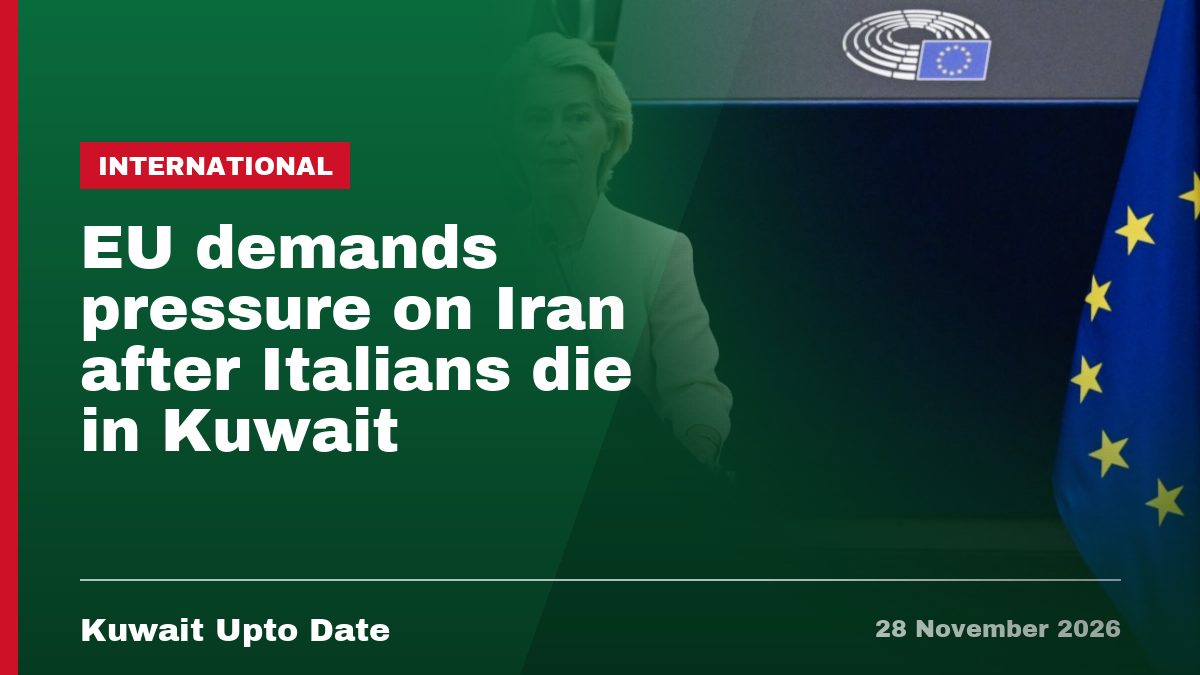
Two Italian technicians died in Kuwait this week, and they weren’t hit by a drone that got through – they were hit by pieces of one Kuwait’s own air defences had just shot down.
It’s the first time European nationals have died in this long-running Gulf conflict, and it has pushed the European Union to change its tone almost overnight. As we reported on 26 November, Kuwait confirmed the deaths the same day the drones were intercepted.
- Two Italian defence technicians working for Rheinmetall Italia died in Kuwait on Thursday, 26 November.
- They were killed by debris from Iranian drones that Kuwait’s air defences intercepted, not by drones that got through.
- EU Commission President Ursula von der Leyen called for stronger pressure on Iran, calling Gulf security “a matter of security for us all”.
- Iran denied launching the drones; Kuwait called the attack a criminal act.
Who were the two men, and what were they doing?
Italian Foreign Minister Antonio Tajani identified the two victims as technicians contracted through Rheinmetall Italia, the Italian branch of the large German defence company. They were working on technical support for Kuwait’s air defence network when they died.
They weren’t killed by a drone strike landing directly – Kuwait’s defence ministry said the casualties came from debris produced when the country’s air defences intercepted the incoming drones. Four other people were hurt by falling shrapnel in the same incident. As we reported on 26 November, that same wave of interceptions also disrupted flights and left four people injured.
Italian Prime Minister Giorgia Meloni confirmed the deaths during an EU summit in Brussels, where Gulf security quickly took over the agenda. The men were later named as Italian defence technicians, as this site reported on 27 November.
Why Brussels is raising its voice now
Speaking from the EU summit, von der Leyen said the bloc “must step up pressure on Iran” to end attacks she called unacceptable. That is noticeably sharper language than earlier EU statements on the Gulf conflict, and it reflects how much weight these two deaths carry in Brussels.
European Council President António Costa has also been in direct contact with Kuwaiti leadership, and both leaders have repeatedly condemned what they call indiscriminate Iranian strikes across the Gulf. Von der Leyen has argued before that any threat to Gulf trade routes is really an economic threat to European citizens too. With EU nationals now among the dead, it will be harder for Brussels to limit its response to statements alone.
Iran denies involvement, Kuwait calls it a criminal act
Tehran rejected the accusations and denied launching the drones. Iran’s embassy in Rome pushed back on the claims, even as it offered condolences. Despite that denial, both Kuwait and Italy pointed directly at Iran, and the EU’s condemnation left little doubt about where Brussels places the blame.
Kuwaiti authorities labelled the strike a criminal attack. The country has been absorbing a steady wave of Iranian strikes through this conflict, and officials noted that the growing risk from interception debris is a direct result of Kuwait’s increasingly active air defence operations against incoming threats. You can follow more of our international coverage on how this conflict keeps spreading across the Gulf.
Italy’s exposure in Kuwait has been building for months
This week’s deaths are the sharpest point of an escalation Rome has watched build since March. On 15 March, a drone struck Ali Al Salem Air Base, which Italian and US forces share, destroying an Italian Air Force MQ-9A Reaper aircraft inside a hardened shelter. That was Italy’s first confirmed aircraft loss in the conflict, though all personnel escaped unharmed at the time.
Since then, Tajani has said Italy remains fully committed to supporting Kuwait and is open to strengthening its defensive help. That commitment is now being tested far more seriously than before.
The story so far
- 26 November: Kuwait intercepted hostile drones, leaving four people hurt.
- 26 November: the same interceptions forced a flight diversion at Kuwait’s airspace.
- 26 November: Kuwait confirmed the deaths of two Italians hit by interception debris.
- 27 November: the victims were named as Italian defence technicians working for Rheinmetall.
- 28 November: the EU calls for tougher pressure on Iran over the deaths.
What this means for people in Kuwait
For residents here, the practical risk is the same one Kuwait’s defence ministry pointed to: debris from intercepted drones can hurt people on the ground even when the interception itself works. That’s a hazard that grows as Kuwait’s air defences stay active against incoming threats.
For the wider region, this is also a sign that the conflict is no longer only a Gulf story. With European nationals now among the casualties, pressure from Brussels on Tehran is likely to grow, which could shape how this conflict develops in the months ahead.
Quick answers
Were the men killed by a direct drone strike?
No. Kuwait’s defence ministry said they were killed by debris from drones that were intercepted, not by a drone that landed directly.
Has Iran accepted responsibility?
No. Tehran denied launching the drones, and its embassy in Rome rejected the accusations while offering condolences.
Is this the first European loss in the conflict?
These are reported as the first deaths of European nationals tied to the Gulf conflict. Italy had earlier lost an aircraft in a March strike, but with no casualties at that time.
This conflict keeps finding new ways to reach people who thought they were just doing technical work far from the front line. If you live or work near a defence site in Kuwait, it’s worth staying alert to official updates rather than assuming interceptions mean the danger has passed.
Latest News
 Local
Video – Men praying in the middle of Ring Road
2 International German city defends €25 fine for bench without a child Read more → 3 Local Kuwait sets strict new rules for desert grazing sites Read more → 4 Local Kuwait warns: report suspicious bank transactions now or face blame Read more → 5 Local Got unknown money in your bank account? Here’s what to do in Kuwait Read more → 6 International GTA 6 price in Kuwait: what each edition and platform costs Read more → 7 International Bihar wedding draws 400,000 guests despite lawmaker’s murder case Read more → 8 International My Lisaa weight-loss products banned Read more → 9 Local Two held in Kuwait, including ruling family member, over drugs Read more → 10 International Lloyds and Bank of Scotland apps down during Black Friday sales Read more → 11 International Iran lawmakers threaten US bases over Hormuz tensions Read more → 12 Local What a new survey reveals about Kuwait’s delivery habits Read more → 13 Local He married his daughter to two men without her knowledge and registered his brother as his son Read more → 14 International WhatsApp adds message scheduling: how it works in Kuwait Read more → 15 International Iran warns on Gulf military presence Read more →
Leave a Reply