

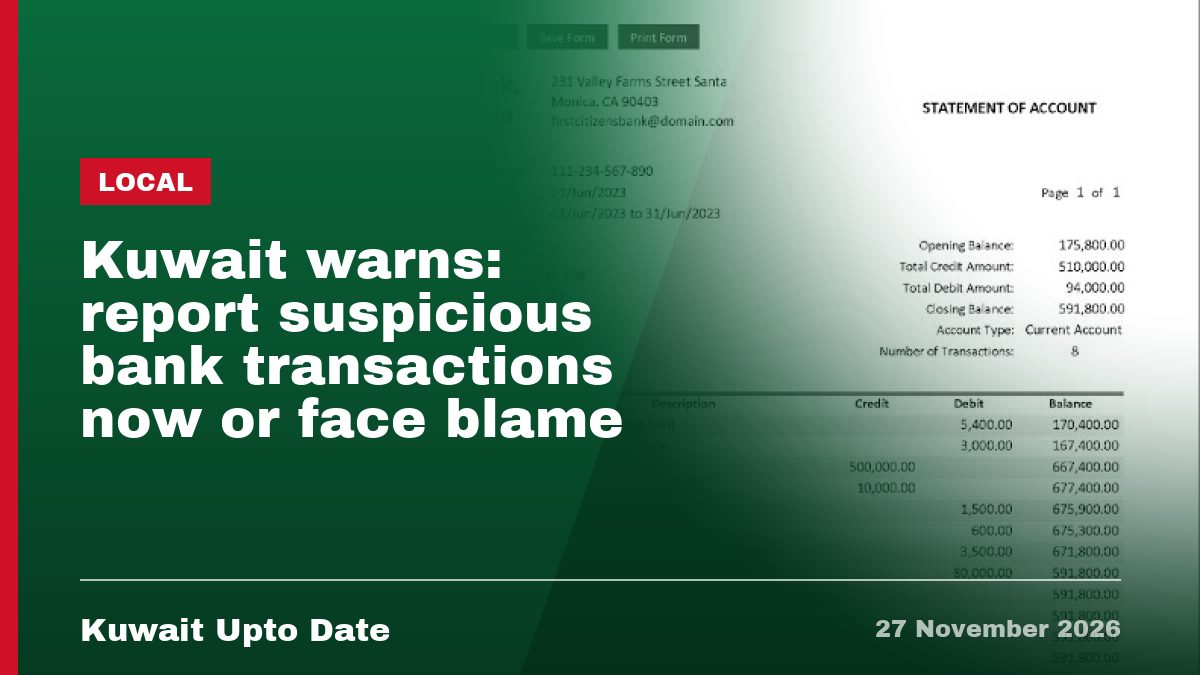
If you see money moving in or out of your bank account that you don’t recognise, don’t wait. Call your bank today, not next week. You are responsible for whatever happens in your account, even if you didn’t make the transaction yourself.
That’s the warning going around in Kuwait right now, and it’s a serious one. If your account gets used to move money for someone else, even without your knowledge, you could end up answering to the police for it. We’ve already covered what to do if you find unknown money in your account, and this takes that warning a step further.
- Account holders are responsible for all debits and credits in their name, known or not
- Someone else accessing your account without your knowledge may be using it for money laundering
- You must contact your bank immediately if you spot anything unusual
- Acting early matters – security agencies may approach you if the account is flagged before you report it
What exactly changed?
There’s no new law or fee attached to this warning. It’s a reminder, and a strong one: you carry the responsibility for every transaction in your bank account. That includes money you never asked for and transfers you never authorised.
The risk isn’t just a wrong number landing in your account by mistake. If someone else gets hold of your account details, your card, or your online banking login, they can move money through your account without you noticing for weeks. Investigators call this money laundering, where stolen or illegal funds get passed through ordinary accounts to hide where they really came from. If your account is used this way, you can be pulled into the investigation, even if you had no idea it was happening.
This fits a pattern we’ve been watching closely. Kuwait’s banking regulator has already told the public to report unlicensed money transfers, and banks are now checking small repeated transfers more closely than before. None of this is random. It comes after real cases, including one where an expat in Ahmadi lost KD 8,000 from their account.
Who does this apply to?
This applies to everyone with a bank account in Kuwait – citizens, expats, workers, students, anyone with their name on an account. It doesn’t matter if you rarely check your balance or use your account every day. If the account is in your name, you are the one responsible for it in the eyes of the bank and the authorities.
It’s worth saying clearly: this isn’t about punishing people who make an honest mistake. It’s about accounts being quietly taken over or misused, often without the owner noticing until it’s too late.
Steps to take if you spot a suspicious transaction
- Open your banking app or statement and check your recent transactions regularly, not just once a month.
- If you see a debit or credit you don’t recognise, write down the date, amount, and any reference number shown.
- Contact your bank straight away – use the customer service number on the back of your card or visit your branch in person.
- Ask the bank to freeze or flag the account if you believe someone else has access to it.
- Change your online banking password and PIN immediately, and check if your SMS alerts are still active.
- Keep any confirmation or reference number the bank gives you for your report – you may need it later.
- Do not wait for a letter or a call from a security agency. Reporting first, on your own, is always better than being approached later.
The last step matters most. The source warning is blunt about this: if you notice anything strange, contact your bank before the authorities contact you. Waiting doesn’t protect you – it only makes it look like you knew and said nothing.
Why banks are watching so closely
Kuwait has seen several cases this year that explain why banks and regulators are pushing this message so hard. A bank employee was jailed for 10 years over stolen loan fees, two men were sentenced over a KD 4 million fraud case, and investigators even traced a foreign reward-app scam back to a Kuwait bank account. These cases show how ordinary accounts can get pulled into much bigger schemes without the owner realising it.
Separately, banks are reviewing how they handle transfers and fees, including plans that could let banks deduct loan instalments directly from your account. None of that is connected to this warning directly, but it shows how closely account activity is being monitored right now. You can read more local news on Kuwait’s banking rules as these checks continue.
Checking your account takes two minutes. Dealing with an investigation takes much longer. The next section answers the questions most readers will have.
Quick answers
What if the money came into my account by mistake?
Report it to your bank anyway. Don’t spend it and don’t move it. Let the bank sort out where it came from.
Can I be blamed if I genuinely didn’t know?
The warning is clear that account holders carry responsibility for what happens in their account, so reporting anything unusual as soon as you see it is your best protection.
Who do I contact first – the bank or the police?
Start with your bank. They can flag the account and guide you on next steps, including whether a police report is needed.
Take a minute today to open your banking app and look through your last few transactions. If something doesn’t look right, don’t sit on it. Have you ever spotted a transfer you didn’t make? Tell us how you handled it in the comments.
Latest News
 Local
Kuwait sets strict new rules for desert grazing sites
2 Local Got unknown money in your bank account? Here’s what to do in Kuwait Read more → 3 International GTA 6 price in Kuwait: what each edition and platform costs Read more → 4 International Bihar wedding draws 400,000 guests despite lawmaker’s murder case Read more → 5 International My Lisaa weight-loss products banned Read more → 6 Local Two held in Kuwait, including ruling family member, over drugs Read more → 7 International Lloyds and Bank of Scotland apps down during Black Friday sales Read more → 8 International Iran lawmakers threaten US bases over Hormuz tensions Read more → 9 Local What a new survey reveals about Kuwait’s delivery habits Read more → 10 Local He married his daughter to two men without her knowledge and registered his brother as his son Read more → 11 International WhatsApp adds message scheduling: how it works in Kuwait Read more → 12 International Iran warns on Gulf military presence Read more → 13 International Etihad cancels Riyadh, Dammam flights until 31 December Read more → 14 International Flydubai extends Riyadh flight cancellations to 10 December Read more → 15 Local Kuwait attack victims named as Italian defence technicians Read more →
Leave a Reply