

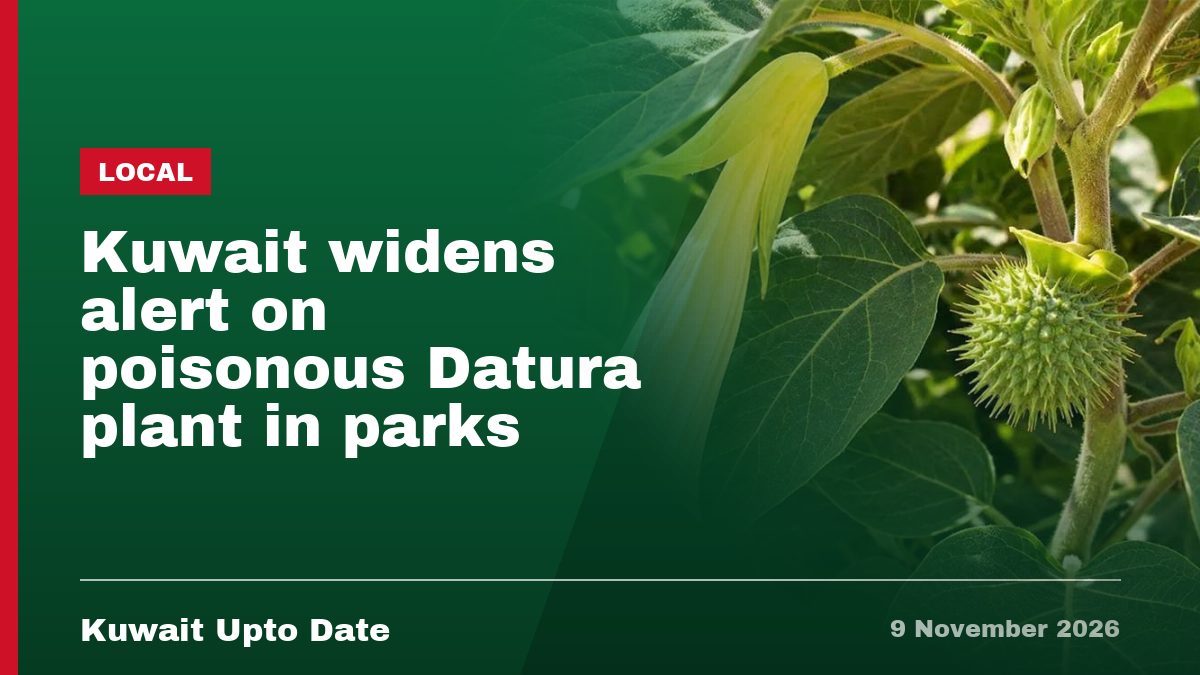
If you walk your kids through a park in Kuwait, or let them play near open ground in your neighbourhood, it’s worth knowing what a Datura plant looks like. Health and environment officials are stepping up warnings about it, and it has already sent some people to hospital.
As we reported earlier today, Kuwait has flagged Datura as a poisonous plant growing in several locations around the country. Now more details have come out from the officials involved, and they show this is bigger than one single warning notice.
- Datura is an invasive plant with trumpet-shaped white or purple flowers and spiny green fruit, found in parks and residential areas.
- Every part of the plant contains toxins that can cause poisoning, hallucinations, seizures, or worse.
- The Poison Control Center at Amiri Hospital has already treated severe cases, some needing hospitalisation.
- Three government bodies are now coordinating on a national plan to find, remove, and raise awareness about the plant.
What exactly is Datura, and why is it dangerous?
Datura belongs to the nightshade family. It usually grows in spring and summer, though flowering can stretch into early autumn depending on the weather. You can spot it by its large white or purple trumpet-shaped flowers, strong-smelling leaves, and spiky green seed pods packed with seeds.
Dr Abdulatif Al-Oumi, head of the Kuwait Poison Control Center at Amiri Hospital, told Kuwait News Agency (KUNA) that all parts of the plant carry toxic alkaloids, including atropine, hyoscyamine and scopolamine. Eating or chewing any part of it can cause dry mouth, wide pupils, a fast heartbeat, confusion, delirium, and hallucinations. In serious cases, it can lead to seizures, coma, and death.
Dr Al-Oumi explained that several plants in Kuwait carry natural toxins, including some ornamental ones grown in gardens and others that simply grow wild in open areas. How dangerous a plant is depends on the species, which part of it is involved, and how someone is exposed to it. Some cause only mild symptoms. Others need real medical treatment.
He also made a point of saying that Datura growing somewhere doesn’t mean anyone planted it on purpose. It spreads and grows on its own. The real danger comes from people, especially children, touching or eating parts of it without knowing what it is.
Has anyone actually been poisoned?
Yes. Dr Al-Oumi said the Poison Control Center has recently treated severe poisoning cases linked to toxic plants, including Datura, and some patients needed to be hospitalised. That’s part of why he’s pushing for more public awareness, especially among families with young children who might pick up or chew on unfamiliar plants outdoors.
Reports of Datura turning up in residential neighbourhoods and public spaces pushed health officials to start working with other authorities to find where it’s growing, warn the public, and arrange for it to be removed.
What are officials actually doing about it?
A coordination meeting was held between the Poison Control Center and the Environment Public Authority (EPA) to talk specifically about poisonous plants. They agreed on steps for reporting sightings, identifying plants, checking how risky they are, and deciding what action to take.
Sharifa Al-Salem, head of the EPA’s Wildlife Monitoring Section, told KUNA that Datura can cause poisoning, hallucinations, nervous system problems, and irregular heartbeats that can be fatal. She said the meeting also covered other risks found in Kuwait’s outdoors, including scorpions, snakes, jellyfish, and venomous fish such as stonefish. The goal, she said, is better coordination between agencies, faster information sharing, and quicker responses that protect both public health and the environment.
She asked residents not to touch, collect, or eat poisonous plants, and not to handle dangerous wildlife either. If you spot one, she said, report the location to the right authorities instead of dealing with it yourself.
The Public Authority for Agriculture Affairs and Fish Resources (PAAAFR) is also involved. Nouf Al-Hashash, acting director of the authority’s Environment Rehabilitation Department, said Datura adapts easily to different conditions and grows well in open or disturbed ground. It produces huge numbers of seeds that can sit dormant in the soil for a long time, then sprout once there’s enough moisture. That’s exactly what makes it hard to control long-term.
Al-Hashash said PAAAFR’s role is technical: identifying the plant species involved, assessing the risks, and recommending how to manage it safely, working alongside the other authorities.
What’s the bigger plan here?
PAAAFR has now proposed a joint meeting with the Poison Control Center and EPA to build an integrated national programme to contain Datura’s spread. The plan on the table includes:
- Field surveys to map out where the plant is growing and how dense it is, with schools, public facilities, parks and areas children visit often getting priority.
- Scientific risk assessments for each location found.
- A technical plan for safely removing, collecting, and disposing of the toxic plant waste, so seeds don’t spread further and workers and the public stay protected.
- Ongoing monitoring, since Datura seeds can stay dormant for years before conditions favour new growth.
- Public awareness materials explaining what the plant looks like, the health risks, and how to handle it safely, developed together with health, education, and environment authorities.
Al-Hashash said tackling invasive poisonous plants needs this kind of joined-up approach: science, field checks, and public awareness all working together, to protect both public health and Kuwait’s environment.
What this means for you
If you live in Kuwait with children, or spend time in parks and open areas, it’s worth teaching kids not to touch or chew unfamiliar plants, flowers, or seed pods. This applies whether you’re a citizen or an expat living anywhere from Salmiya to Jahra.
Dr Al-Oumi had specific advice if you think someone has eaten a poisonous plant: get medical help straight away. Don’t try to make the person vomit, and don’t rely on home remedies. If you can, take a clear photo of the plant itself, since that helps doctors identify exactly what they’re dealing with.
The Kuwait Poison Control Center runs a 24-hour hotline on 1804774 for any poisoning or exposure questions. Dr Al-Oumi also urged people not to use unidentified wild plants in drinks, traditional recipes, or home remedies, something worth remembering if you’ve grown up with family recipes that use foraged herbs.
This warning comes in the same stretch of news where Kuwait has been active on public health fronts, from our coverage of breast cancer screening numbers to a first case reported at Kuwait Zoo. For more on what’s happening locally, check our local news coverage.
Quick answers
How do I know if a plant is Datura?
Look for large trumpet-shaped white or purple flowers, leaves with a strong, pungent smell, and spiny green seed pods. If you’re not sure, don’t touch it, and report the location instead.
What should I do if someone eats part of it?
Get medical help immediately. Don’t induce vomiting or use home remedies. Taking a photo of the plant can help doctors identify it faster. You can also call the Poison Control Center hotline on 1804774 at any time.
Does finding Datura in a park mean someone planted it?
Not necessarily. Officials say it grows and spreads naturally and its presence doesn’t mean it was deliberately cultivated.
Have you spotted anything that looked like this in a park or near your building? It’s worth reporting it rather than walking past, and worth a word with your kids before the next trip to the playground.
📌 Related stories
Latest News
 Local
Enjoy six days Eid Break
2 International Robot waitresses bring a new dining experience Read more → 3 International Philippines in talks for $800m BrahMos missile deal with India Read more → 4 Local Kuwait tells users to turn on 2FA and fingerprint login Read more → 5 International US pauses Iran strike plans, gives talks a few more days Read more → 6 International Kuwait backs Saudi Arabia after missiles hit Riyadh, Read more → 7 Local PACI set to restart Civil ID home delivery after 4 years Read more → 8 Local Five drivers jailed after sports cars seized for highway racing Read more → 9 International 149 Filipino workers from Kuwait, Saudi fly home amid unrest Read more → 10 Local 13 Asians held in Farwaniya gambling and tobacco raid Read more → 11 Local PACI gives 30 days to fix address or pay KD 100 fine Read more → 12 Steps – How to make money from TikTok in Kuwait. Read more → 13 International TikTok Shop gets its own new app Read more → 14 Local Video – Kuwait police seize warehouse in Salmiya Read more → 15 International Stepmother arrested after death of girl, 4. Read more →
Leave a Reply