

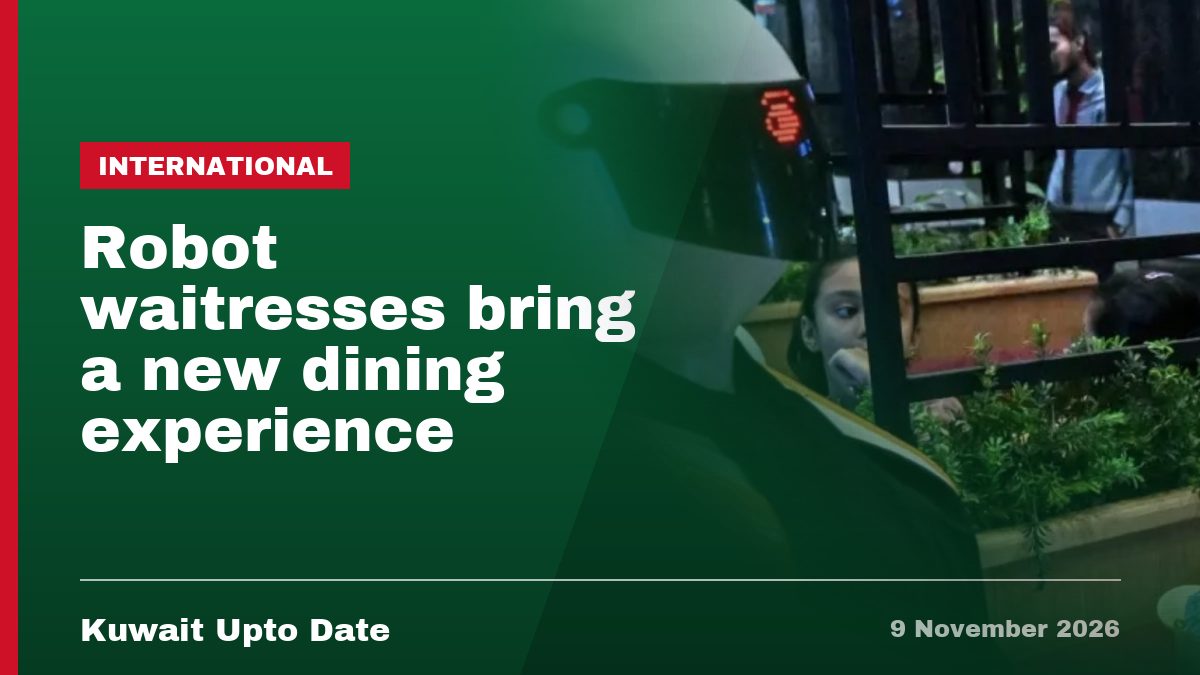
If you’ve got family or friends back in Karachi who love eating out, you may already be hearing about this one. A restaurant there has started using robot waitresses to bring food to the table, and people are travelling across the city just to watch them work.
The robots, named Robia and Jojo, roll between the booths at The Sicilian, a restaurant in Karachi lit up with neon signs. They have round white heads, dark visors that look a bit like motorcycle helmets, and black shawls around their necks styled like a dupatta. When they reach a table, Robia introduces herself in an electronic voice: “Welcome to Sicilian. My name is Robia.”
- A Pakistani engineer built two robot waitresses for a Karachi restaurant, mostly from locally made parts
- The robots, Robia and Jojo, carry food to tables but customers still have to lift the plates off the tray themselves
- Families are travelling from across Karachi to see them, and staff say business has grown because of it
- The engineer plans to add cameras so the robots can recognise returning customers and suggest orders
Who built them, and how
The robots are the work of Syed Osama Aziz, a Pakistani engineer who also set up The Sicilian restaurant. He built Robia and Jojo through his robotics company, Cobot, with help from friends.
Aziz designed the circuit boards and wrote the programming himself, in his own lab. His workshop, where the robots are actually manufactured, is in Multan. Most parts are made locally in Pakistan, though he had to bring in some electronic components from abroad.
“The equipment, the things needed to make robots, are not so easily available here, so we had to arrange them,” Aziz told AFP.
Robots like this are common in restaurants across China and other East Asian countries, where they already carry food to tables, greet hotel guests and even handle cleaning jobs. Humanoid robots from the US and China are also getting a lot of attention worldwide right now. In Pakistan, though, a robot waitress is still a rare sight, which is exactly why Aziz’s creations are drawing so much interest.
What happens when you visit the restaurant
When Robia or Jojo arrive at a table carrying food, there’s no human hand-off waiting to serve it for you. Customers either lift the dish off the serving tray themselves, or wait for a member of staff to help.
That hasn’t put families off. Children reach out to touch the robots, while parents take photos and selfies as the machines roll past.
Customer Ahmer Zameer told AFP the best part is that the robot introduces itself and “tells you what things you can order.” Another customer, Sonia Dilosker, said she liked the robots’ look and their style of service, saying she preferred it “because it is a machine and without any emotions.”
Staff member Hellen said the novelty has clearly paid off for the business. “Our business has grown. People are coming from far away for this. They have seen a robot for the first time here,” she told AFP. “People are excited to see this.”
What’s next for Robia and Jojo
Aziz isn’t stopping at food delivery. He wants to add camera-based processing so the robots can recognise diners by sight.
“That means the robot will also recognise you by looking at you, and it will remember what you ordered last time, and accordingly it will be able to give you better suggestions,” he explained.
If that works as planned, returning customers could get a more personal experience each visit, with the robot remembering their usual order.
Why this matters beyond one restaurant
This isn’t a story about Kuwait, but it’s one many readers here will relate to. Pakistan has a huge community living and working in Kuwait, and stories like this from home often travel fast through family group chats. It’s also a small sign of how local engineers in Pakistan are building tech themselves, rather than waiting for it to arrive from abroad, something that fits into the broader international news we follow on this site.
It also says something about how novelty can shift a small business overnight. A restaurant that built two robots in-house is now pulling in customers from across one of the world’s biggest cities, simply because people want to see something new.
Quick answers
Can the robots serve food on their own, start to finish?
Not fully yet. They carry the tray to the table, but a customer has to take the food off themselves, or a staff member helps.
Are robot waiters common in Pakistan?
No. They’re still rare. Robots serving food are far more common in countries like China, but this is new for Karachi and for Pakistan generally.
Where are the robots actually made?
Engineer Syed Osama Aziz builds them in his workshop in Multan, using mostly parts made in Pakistan, with some electronic components imported from abroad.
Would you want to see a robot server at a restaurant here in Kuwait, or does it feel like something you’d rather skip? Tell us what you think in the comments.
📌 Related stories
Latest News
 Local
Enjoy six days Eid Break
2 Local Alert – Kuwait warns of poisonous plant found in parks Read more → 3 International Philippines in talks for $800m BrahMos missile deal with India Read more → 4 Local Kuwait tells users to turn on 2FA and fingerprint login Read more → 5 International US pauses Iran strike plans, gives talks a few more days Read more → 6 International Kuwait backs Saudi Arabia after missiles hit Riyadh, Read more → 7 Local PACI set to restart Civil ID home delivery after 4 years Read more → 8 Local Five drivers jailed after sports cars seized for highway racing Read more → 9 International 149 Filipino workers from Kuwait, Saudi fly home amid unrest Read more → 10 Local 13 Asians held in Farwaniya gambling and tobacco raid Read more → 11 Local PACI gives 30 days to fix address or pay KD 100 fine Read more → 12 Steps – How to make money from TikTok in Kuwait. Read more → 13 International TikTok Shop gets its own new app Read more → 14 Local Video – Kuwait police seize warehouse in Salmiya Read more → 15 International Stepmother arrested after death of girl, 4. Read more →
Leave a Reply