

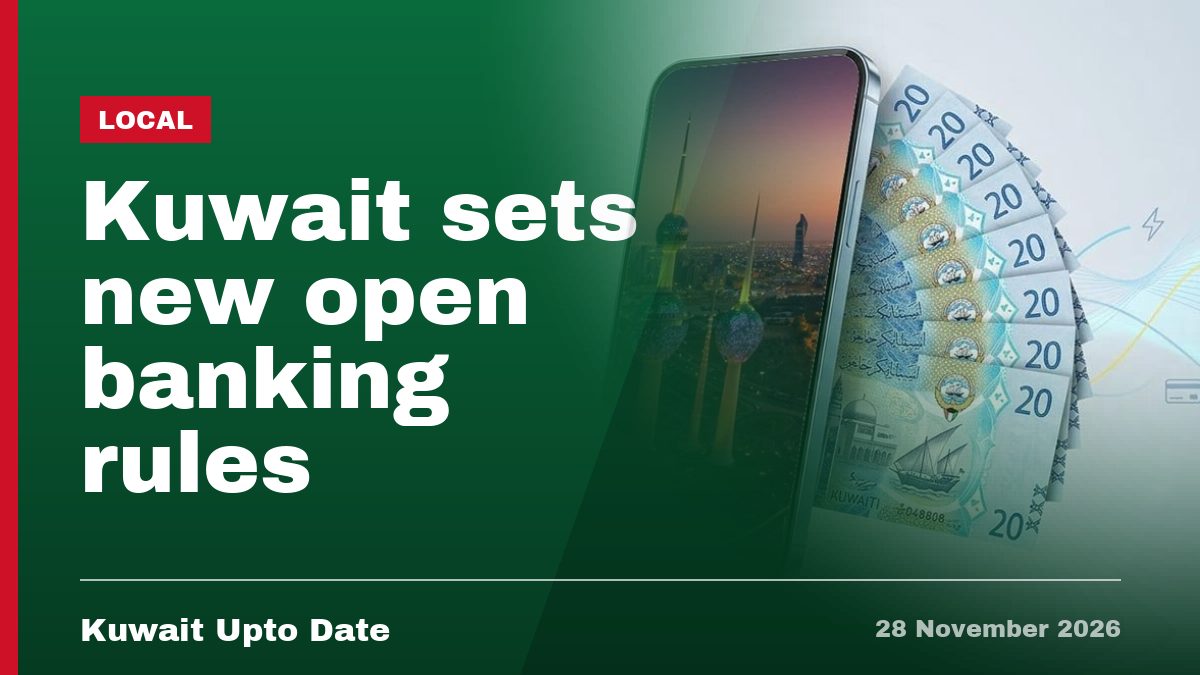
Checking five different bank apps just to see where your money went could soon be a thing of the past. Kuwait has just opened the door for approved apps to pull all your account information into one screen, or even pay a bill for you, without you logging into your bank at all.
This comes from the Central Bank of Kuwait (CBK), which has rolled out a full set of rules for what’s called open banking. It’s part of the same wave of financial reform we’ve seen with the new housing finance law and tighter checks on how money moves through local accounts.
- CBK issued Resolution No. 87/500/2026 on 11 November 2026, published in the Official Gazette on 22 November 2026.
- It lets approved companies view your bank data or make payments for you, but only with your clear consent.
- Two new licence types are created, with minimum capital of KD 100,000 and KD 500,000.
- Existing payment providers must register for the new rules within 180 days.
So what exactly is open banking?
In plain terms, approved companies can now access your bank information or pay bills for you, but only through secure channels and only if you say yes.
Article 1 of the updated Instructions splits this into two services. Account Information Services (AIS) let you see and combine data from different bank accounts in one app, so you can track spending without logging into each bank separately. These services cannot move your money, they only show it to you.
Payment Initiation Services (PIS) go a step further. They let you pay directly from your bank account through a third-party app, skipping your bank’s own payment screen entirely.
Neither service means tech companies get automatic access to your account. A provider still needs CBK registration, approval, and successful testing before it can touch any customer’s banking information.
Your consent now matters more than ever
The rules put a heavy focus on consent, and this is the part that protects you directly. Consent has to be clear, specific, given in advance, and tied to a defined purpose and time period. You must also be able to cancel it at any time, with no conditions attached.
Article 39 requires banks and providers to have proper systems for creating, checking and cancelling this consent, plus renewing authentication. A simple tick-box buried in long terms and conditions won’t be enough anymore. Companies will need to show exactly what data they can access, why, for how long, and how you can withdraw permission.
This focus on consent fits a pattern we’ve seen all year, from the CBK’s push for face recognition and OTP checks on salary transfers to its link between wage protection details and your bank account. The regulator clearly wants fewer silent transactions and more checks that you actually agreed to what’s happening with your money.
New licence categories, and who can get one
Before this update, Kuwait had five categories of electronic payment service providers. The new rules add two more, bringing the total to seven. Both new categories must be set up as joint stock companies.
- Account Information Service Providers need at least KD 100,000 in capital and can only offer account viewing services.
- Payment Initiation Service Providers need at least KD 500,000 and can offer payment initiation, account information, or both.
Small electronic payment providers are shut out of both new categories, so this is aimed at serious, well-capitalised players rather than small startups.
Applicants also have real homework to do. Under Articles 15 and 16, they must submit a five-year business strategy, describe exactly how the service will work, and detail the data they plan to access. Before going live, every provider must also complete pilot testing approved by the CBK.
The paperwork doesn’t stop there. The last section covers settlement, ownership and record-keeping rules that affect how these companies actually operate day to day.
Old rules still apply, plus new paperwork for companies
Open banking doesn’t replace Kuwait’s existing payment rules, it sits alongside them. Articles 24 and 26 of the 2023 Instructions still require providers to credit collected funds to the payee’s account by the end of the next business day, get the CBK’s written approval before charging any fee, and disclose charges before a payment happens.
Rules on keeping customer funds separate from company funds, and on buy-now-pay-later services, also remain in force. This matters if you’ve used instalment-style payment apps, because those protections haven’t gone away.
For companies, there’s more to track. Settlement must run through local bank accounts, and swapping a settlement bank needs CBK approval first. Applicants must disclose any shareholder holding more than 5%, anyone with real control over the company, and the true beneficial owners, plus a recent certificate from the Criminal Enforcement Prosecution on any final judgments against partners.
Records must be kept for at least five years after a customer relationship ends, longer if a law, regulator, dispute or investigation requires it. And existing limited-purpose electronic money providers have 180 days from when the Instructions were issued to apply for CBK approval under Article 12, so that clock is already running for some companies.
What this means for people in Kuwait
For ordinary customers, the upside is convenience: one app that shows every account, or a faster way to pay without juggling banking logins. But it also means more companies, not just banks, will be asking to handle your financial data. Reading what you’re agreeing to before tapping
Latest News
 International
Trump warns Iran: no nuclear weapons.
2 International Iraq boosts troops in Kirkuk to stop oil smuggling Read more → 3 Local Video – Men praying in the middle of Ring Road Read more → 4 International EU demands pressure on Iran after Italians die in Kuwait Read more → 5 International German city defends €25 fine for bench without a child Read more → 6 Local Kuwait sets strict new rules for desert grazing sites Read more → 7 Local Kuwait warns: report suspicious bank transactions now or face blame Read more → 8 Local Got unknown money in your bank account? Here’s what to do in Kuwait Read more → 9 International GTA 6 price in Kuwait: what each edition and platform costs Read more → 10 International Bihar wedding draws 400,000 guests despite lawmaker’s murder case Read more → 11 International My Lisaa weight-loss products banned Read more → 12 Local Two held in Kuwait, including ruling family member, over drugs Read more → 13 International Lloyds and Bank of Scotland apps down during Black Friday sales Read more → 14 International Iran lawmakers threaten US bases over Hormuz tensions Read more → 15 Local What a new survey reveals about Kuwait’s delivery habits Read more →
Leave a Reply