

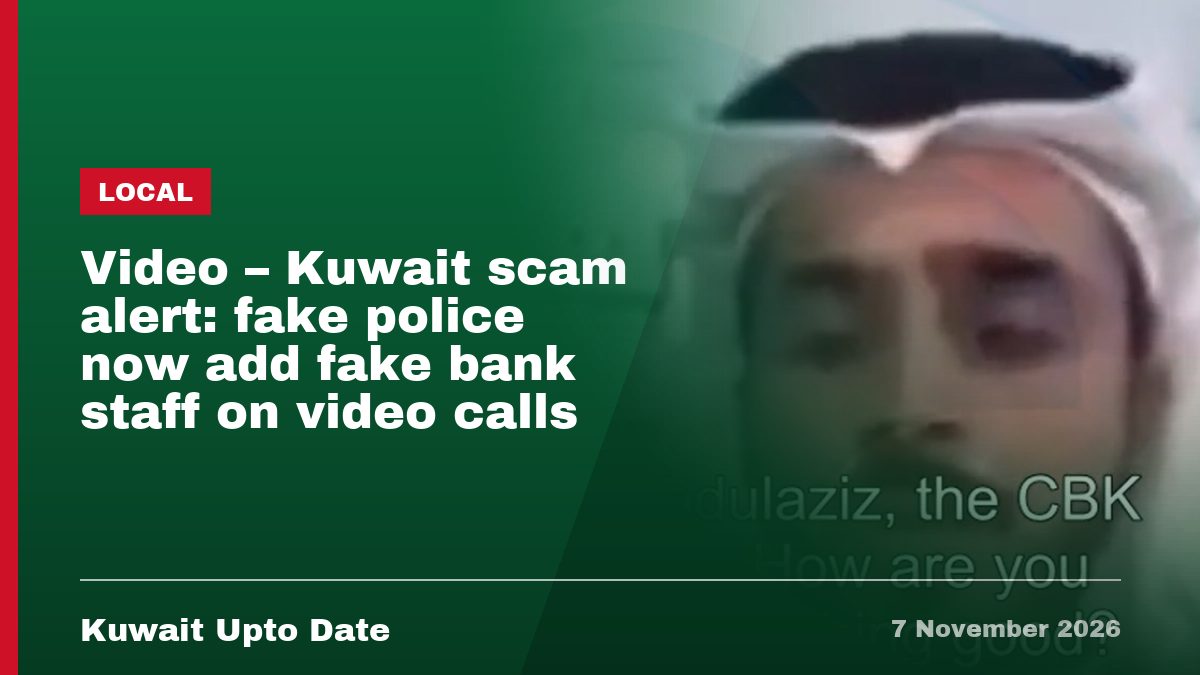
If you ever get a video call from someone in a police uniform asking about your bank details, hang up. It’s not the police. It’s a scam, and now it’s got a second act.
Fraud networks operating in Kuwait have been running a video-call trick for a while now, and they’ve just added a new character to the show. The old routine was simple: someone appears on a video call dressed to look like a Kuwaiti police officer, throws scary accusations at you, then asks for personal information. Now there’s a twist. After the fake officer does the scaring, the call gets handed over to a second fraudster posing as a bank employee.
https://twitter.com/arabtimeskuwait/status/2119165672022257914
It’s the same pressure tactic with an extra layer. First comes the uniform, then comes the supposed banker, both working together to push you into handing over details you’d never normally share. This comes amid wider attention on banking fraud in Kuwait, including warnings from the Central Bank about unlicensed money transfers.
- Scammers are adding a second fake character, a bank employee, to their existing fake police video-call trick.
- The caller first poses as a police officer, makes threatening claims, then transfers the victim to someone pretending to work at a bank.
- The goal, as before, is to get victims to hand over banking details, passwords, OTPs (one-time passcodes) or other personal information.
- Residents are urged to end suspicious calls immediately and only contact banks or police through official channels.
How the new version of the scam plays out
The call usually starts the same way it always has. Someone appears on screen wearing what looks like a Kuwait police uniform. They throw out fabricated accusations, maybe about a legal case, a traffic issue or something more alarming, designed purely to scare you into reacting without thinking.
Once the victim is rattled, the call gets passed to a second person, this one claiming to be a bank employee. That handover is the new part. It adds a sense of official back-and-forth, as if the police and the bank are genuinely working together on your case. In reality, both people are part of the same scam.
At this point, the goal is to get the victim to share banking information, a password, an OTP, or other personal details that can be used to access their account or move their money. Nothing about this process is legitimate. Kuwaiti banks and police do not operate this way over random video calls.
Who scammers are targeting
These calls don’t appear to target one specific group. Anyone with a phone and a bank account in Kuwait could get one, whether you’re a citizen or an expat, and whether you’ve lived here for years or just arrived. What matters to the scammers is reaching someone who panics first and questions later.
This fits a pattern we’ve been seeing more of recently. Kuwait’s banking sector has been under closer watch this year, with the Central Bank pushing new layers of protection such as compulsory face recognition and OTP checks for low salary transfers and tighter links between Shoun (the government’s labour and wage system) and bank accounts to confirm salaries and transfers. Scammers often try to exploit exactly this kind of confusion around new banking rules, hoping victims assume the call is somehow part of an official check.
Residents have also lost real money to other online scams this year. One Kuwait shopper lost 200 dinars to a fake phone ad, and authorities traced scam money from a reward-app fraud to a Kuwait bank account. None of these cases are connected to this specific video-call scam, but they show the same pattern: scammers using fear, urgency or fake officialdom to get people to act fast.
What to do if you get one of these calls
- Do not answer questions about your bank account, password, or OTP on a video call, no matter who the caller claims to be.
- End the call as soon as it feels off, especially if it involves threats, legal accusations, or urgent demands.
- Do not let a
📌 Related stories
 Local Kuwait opens bank loans under new law 114/2026 Local Face recognition and OTP is compulsory for low salary transfers Local Your detail in shoun being linked with your bank for confirmation of salary and transfers. Local If your salary is 300 KD and transfers 25 KD or more that salary, you will be checked..
Latest News
Local
Egyptian singer Ramy Sabry books Kuwait concert for 24 December
2 International Hackers spread equivalent of 1.96 billion KWD theft across 10,000 wallets Read more → 3 Local Being an Expat: What Is My Future in Kuwait? Read more → 4 Local Kuwait’s police to get body cameras soon Read more → 5 Local Women no longer need husband’s OK for passports Read more → 6 International Earth has a new mini-moon, but it’s leaving by early 2027 Read more → 7 Local Hiring staff you don’t need is a crime Read more → 8 Local Italy honours Sheikha Intisar with top civil award Read more → 9 International Iraq admits its soil used to attack Gulf neighbours Read more → 10 Local Video – New Salmiya waterfront Barayeh Salem place Read more → 11 International Saudi Arabia Arrests 11,587 People in One Week for Visa Breaches Read more → 12 International Trump confirms new US strikes near Qeshm Island, Iran Read more → 13 Local US Embassy Kuwait issued a security alert. Read more → 14 International US offers $20 million for one information Read more → 15 International Iran warns Saudi oil plants, Britain could be hit Read more →
Leave a Reply