

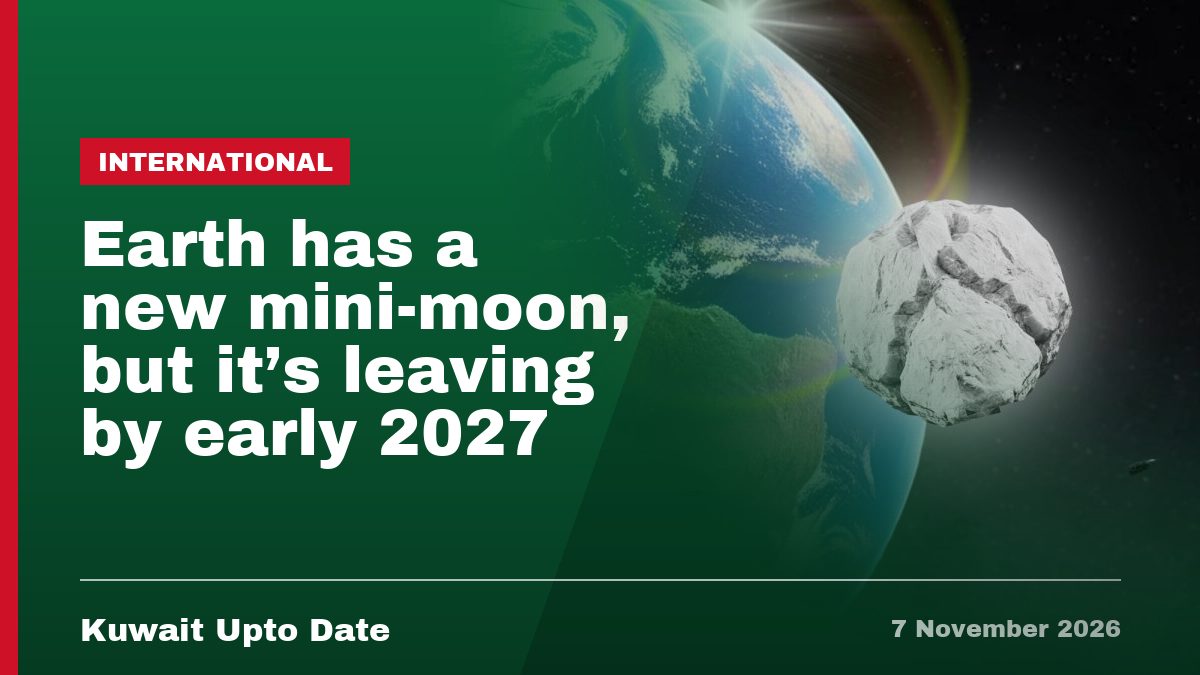
If you like looking up at Kuwait’s clear winter sky, here’s something small but fun happening above us right now. Earth has quietly picked up a new, tiny companion – and it’s not sticking around for long.
Scientists call it a mini-moon, and this one has the name 2026 QQ8. It won’t be visible to the naked eye, but it’s a good reason to pay a little more attention to the night sky this season, especially with several sky events happening over Kuwait this November.
- Earth has temporarily captured a small space rock called 2026 QQ8, first spotted in August 2026.
- It actually entered orbit around Earth back in April 2026, but nobody noticed until months later.
- It will stay under Earth’s gravity until around December 2026 or January 2027, then drift away again.
- At only about 2 metres across, it poses no danger to Earth even if it ever came close.
So what exactly is a mini-moon?
A mini-moon, more correctly called a temporary satellite, is a small object from space that gets caught by Earth’s gravity for a while. It’s not a real moon like the one we see every night. It’s a passing visitor that Earth’s pull grabs for a short time before it moves on.
The International Astronomical Union’s Minor Planet Center, the body that tracks and names these objects, reported the discovery of 2026 QQ8 on 29 October 2026. Researchers then worked backwards and found that the rock had already been orbiting Earth since April 2026, months before anyone spotted it.
Where did 2026 QQ8 come from, and where is it going?
2026 QQ8 normally travels around the sun on its own path, taking about 359 days to complete one loop. That’s close to one Earth year. Around once every ten years, it passes close to our planet. This time, it came close enough that Earth’s gravity managed to hold onto it for a while.
According to the Minor Planet Center, the closest 2026 QQ8 will get to Earth during this visit is about 353,000 miles (568,000 kilometres). That’s roughly 110,000 miles (177,000 kilometres) further away than the Moon usually is from Earth. So even at its closest, it stays well clear of us.
Scientists expect the rock to break free from Earth’s gravity sometime around December 2026, based on the orbit data, though separate modelling on typical mini-moon behaviour suggests it could linger slightly longer, into January 2027.
Is this dangerous, and how big is it really?
No, it isn’t dangerous. 2026 QQ8 is only about 6 feet, or 2 metres, across. Even in the unlikely case that it ever got pulled towards Earth, it would almost certainly burn up completely in the atmosphere long before reaching the ground.
It’s actually bigger than most mini-moons. Earlier modelling this year found that the average temporary satellite is only about 75 centimetres (30 inches) wide, roughly the size of a large suitcase. That same research suggested these objects usually stay captured for around nine months on average, which roughly matches the April-to-January timeline expected for 2026 QQ8.
Some past studies have suggested Earth may have up to six mini-moons orbiting it at any given time, many of them likely small fragments broken off from our actual Moon over the years.
If a bigger rock, around 10 feet (3 metres) wide, were ever captured the same way, researchers say it could stay in Earth’s orbit for 10 to 20 years instead of just months. That hasn’t happened with 2026 QQ8, but it shows how much size affects how long these visitors stick around.
What this means if you’re watching the sky from Kuwait
For most of us in Kuwait, this won’t change anything we can see with our own eyes. 2026 QQ8 is too small and too far to spot without a professional telescope, so don’t expect to catch it during an evening walk along the Gulf Road.
But if you’ve been following our coverage of local stargazing, this fits nicely alongside other things worth watching this month, including the recent alignment of the Moon, Jupiter and Mars over Kuwait in early November. For more science and world stories like this, check our latest international news.
Quick answers
Can I see 2026 QQ8 from Kuwait without a telescope?
No. It’s far too small and faint for the naked eye or regular binoculars. Only professional telescopes tracking it closely can detect it.
Will it ever come close enough to hit Earth?
No sign of that. Its closest approach during this stay is about 353,000 miles away, further than the Moon. Even if that changed, its tiny size means it would burn up in the atmosphere.
When will it leave Earth’s orbit?
Scientists expect it to break away sometime between December 2026 and January 2027, based on current orbital calculations.
It’s a small story in the grand scheme of things, but it’s a nice reminder that there’s always more happening above Kuwait than meets the eye. Have you ever tried mini-moon or meteor watching from here? Share what worked for you in the comments.
📌 Related stories
Latest News
 Local
Egyptian singer Ramy Sabry books Kuwait concert for 24 December
2 Local Video – Kuwait scam alert: fake police now add fake bank staff on video calls Read more → 3 International Hackers spread equivalent of 1.96 billion KWD theft across 10,000 wallets Read more → 4 Local Being an Expat: What Is My Future in Kuwait? Read more → 5 Local Kuwait’s police to get body cameras soon Read more → 6 Local Women no longer need husband’s OK for passports Read more → 7 Local Hiring staff you don’t need is a crime Read more → 8 Local Italy honours Sheikha Intisar with top civil award Read more → 9 Local Video – New Salmiya waterfront Barayeh Salem place Read more → 10 International Saudi Arabia Arrests 11,587 People in One Week for Visa Breaches Read more → 11 International Trump confirms new US strikes near Qeshm Island, Iran Read more → 12 Local US Embassy Kuwait issued a security alert. Read more → 13 International US offers $20 million for one information Read more → 14 International Iran warns Saudi oil plants, Britain could be hit Read more → 15 International Bahrain revokes citizenship of 69 people Read more →
Leave a Reply