

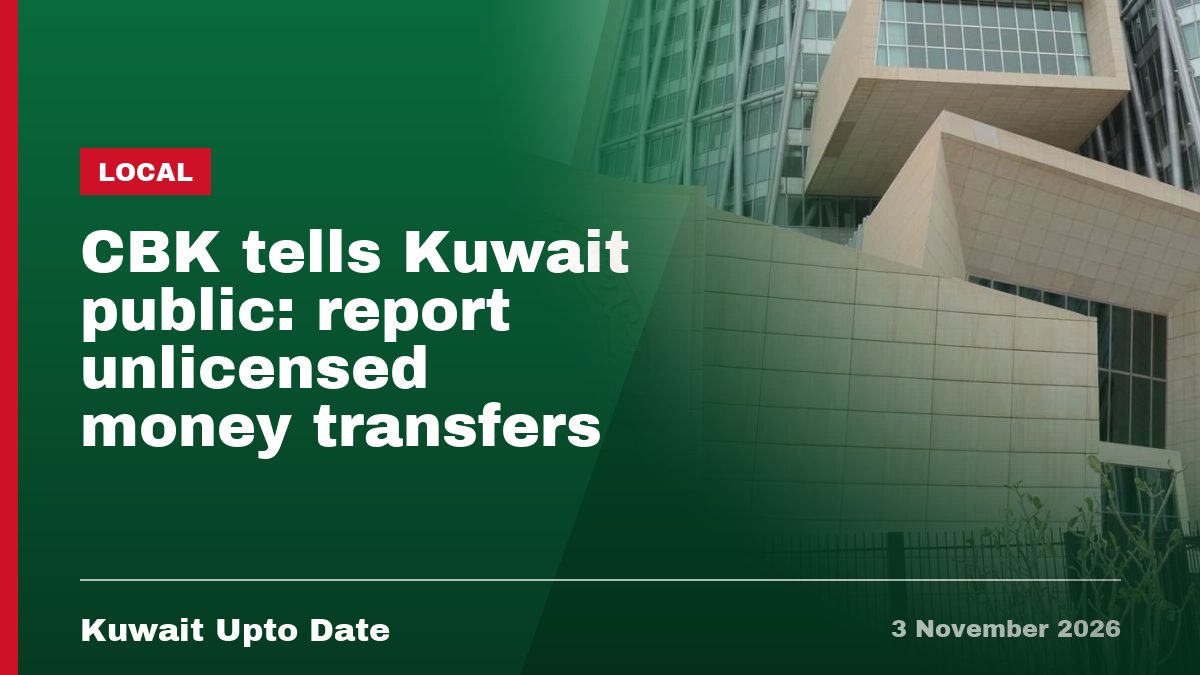
If you’ve ever sent money through someone who ‘does transfers on the side’, or used a payment link from a business you’d never heard of, the Central Bank of Kuwait (CBK) has a message for you: tell them about it.
The CBK posted a notice on its official account on X this week, asking ordinary people and businesses in Kuwait to report anyone carrying out financial activities without its approval. The bank said these unlicensed activities put customers’ money at risk and could weaken the stability of the country’s wider economy.
It’s the kind of warning that’s easy to scroll past. But if you look at what’s been happening in Kuwait’s banking world lately, from app-approval scams that wipe out bank balances to a bank worker jailed for stealing customer loan fees, this notice fits into a bigger pattern worth paying attention to.
- The CBK wants the public to report people or firms doing financial work without a licence.
- This includes money transfers, financing and running electronic payment links without approval.
- You can report by phone on 22972999 or by email at Unlicensed@cbk.gov.kw.
- The CBK says this cooperation protects customers and helps keep Kuwait’s financial system safe.
What exactly did the CBK say?
In its post, the CBK named three specific activities that need a licence: money transfers, providing financing, and operating electronic payment links. If someone is doing any of these without CBK authorisation, the bank considers it a reportable offence.
The bank didn’t name any specific case or person in its statement. This was a general public notice, not a reaction to one single incident. But the timing matters. Kuwait has seen a string of money-related scams and frauds reported in recent weeks, and regulators appear to be trying to get ahead of the problem rather than just reacting to it.
Why would someone run an unlicensed money service?
Unlicensed transfer agents and payment links usually promise something official banks don’t: speed, lower fees, or no paperwork. For a resident sending money home or paying a small business, that can sound appealing.
The problem is simple. Without CBK licensing, there’s no official body checking that the person holding your money is trustworthy, properly capitalised, or even real. If something goes wrong, you have far less protection than you would with a licensed bank or exchange company.
We’ve already covered cases where this exact gap caused real damage. One reader’s story, where a link worth just 1 Kuwaiti Dinar emptied an entire bank account, shows how a single unverified payment link can cause serious loss. More recently, we reported on stolen money from a reward-app scam traced to a Kuwait bank, and on CBK-adjacent warnings about cash-for-SIM schemes that criminals use to move stolen funds.
None of these were necessarily tied to this specific CBK notice. But they explain why the bank is asking the public to be its eyes on the ground.
So who does this affect?
This notice is aimed at everyone living in Kuwait, citizens and expats alike. Anyone who sends money, pays bills, or uses a payment link is a potential customer of either a licensed service or an unlicensed one, whether they realise it or not.
Expat workers who send remittances abroad through informal channels should take particular note. So should small business owners who might unknowingly use an unlicensed payment gateway to collect customer payments online.
[EDITOR NOTE: a short line here on how common informal money-transfer arrangements are among certain expat communities in Kuwait, and whether readers have come across unlicensed payment links themselves, would fit well.]
What should you actually do?
- Check that any money transfer company or payment service you use is licensed by the CBK before sending funds through it.
- If you suspect a person or business is running transfers, financing, or payment links without a licence, call the CBK on 22972999.
- You can also email details to Unlicensed@cbk.gov.kw.
- Avoid sending money through informal agents, even if they are recommended by friends or family, unless you can confirm they are licensed.
The CBK was clear that public cooperation is
📌 Related stories
Latest News
 International
Iran media shares nuclear attack guidance: what it means here
2 International US strikes Iranian targets near Hormuz as talks continue Read more → 3 International Iran says Washington holds key to avoiding new war Read more → 4 International Oman coast ship strike kills Indian crew member, 13 safe Read more → 5 International Trump renews Iran strike threat as Tehran warns of longer war Read more → 6 International US-Iran tension rises after Qeshm Island missile strike Read more → 7 International Moroccan girl jumped from 7th floor of hotel Read more → 8 International Vance says : we have made good progress with Iran Read more → 9 Local Luna Park returns to Al-Muruj with KD 5 all-day ticket Read more → 10 Local Kuwait schools ban cash, gifts and unapproved events now Read more → 11 Local 2:00am to 5:00am on 3rd November 2026. Moon, Jupiter and Mars lined up over Kuwait. Read more → 12 International Helping Visa Violators Now Means Jail , KSA. Read more → 13 International Consultations with Qatar and Pakistan are extremely intensive Read more → 14 Local Trolley’s 2026 results of KD 15.4 million in first nine months. Read more → 15 Local Kuwait-Riyadh Rail Link Now Out in next stage Read more →
Leave a Reply