

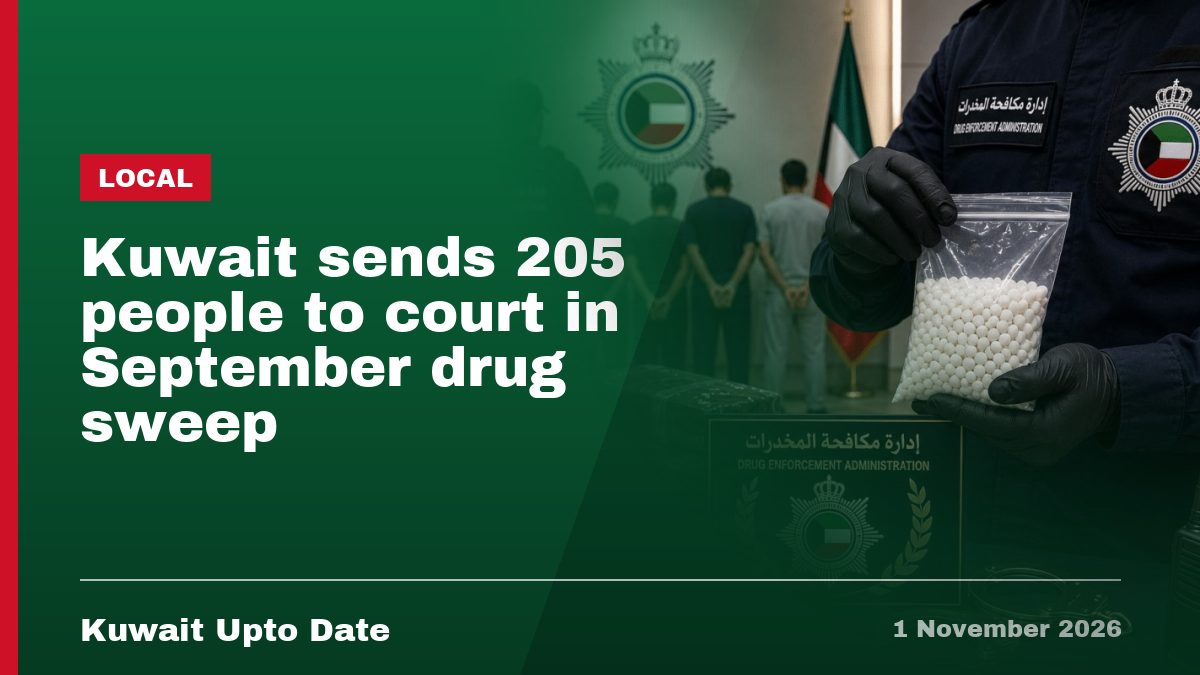
By the end of September, 194 people had already left Kuwait for good, deported after being caught up in drug-related cases. That’s where this story ends. To understand how it got there, you have to go back to the start of the month, when Kuwait’s drug control officers began a wave of raids, tip-offs and arrests that would stretch across the whole country.
Over 30 days, the Directorate-General for Drug Control (DGDC), the Ministry of Interior unit in charge of fighting narcotics, built 160 separate cases. Each one started the same way: a report, a search, sometimes a long investigation into suspicious movements. By the time September ended, 205 people had been arrested and referred to the Public Prosecution, Kuwait’s body that decides whether a case goes to trial.
- 160 drug cases referred to the Public Prosecution in September, involving 205 arrested people
- Seizures included 724,946 narcotic pills, over 62kg of crystal meth, 14.5kg of hashish and 5.159kg of heroin
- 194 expatriates of various nationalities were deported over the month
- 52 people came forward with addiction-related complaints, 43 men and 9 women
How the month’s cases broke down
Not every case was the same kind of offence. Of the 160 cases sent to the Public Prosecution, 104 were drug consumption cases, meaning people found to have used narcotics themselves. Another 29 were trafficking cases, 15 were drug-related misdemeanours, eight involved smuggling, and four involved perpetrators who have not yet been identified.
The 205 people arrested split out this way too: 131 were linked to consumption cases, 47 to trafficking, 16 to misdemeanours and 11 to smuggling. That split matters, because it shows most of the month’s arrests were users rather than traffickers, even though the trafficking and smuggling cases involved the larger seizures.
This isn’t an isolated month. September’s deportation figures follow a similar pattern reported earlier, and cases like the 300,000 Captagon pills found hidden in a truck tyre near Kabd show how smuggling attempts keep testing Kuwait’s border checks.
What was actually seized
The quantities recovered during September give a sense of the scale of the operation. Officers seized 724,946 narcotic pills, more than 62 kilograms of crystal methamphetamine, and about 14.5 kilograms of hashish. Alongside these were 5.159 kilograms of heroin, 4.308 kilograms of marijuana, 305 grams of cocaine, nine grams of Lyrica powder (a prescription medicine sometimes misused), and one gram of wax, a cannabis concentrate.
Authorities also confiscated six grams and five litres of synthetic cannabinoids, often called chemical drugs locally, along with two bottles of liquor. On top of the narcotics, the raids turned up eight firearms and weapons: one Kalashnikov rifle, four pistols, three shotguns and an air rifle. Weapons showing up alongside drug seizures is something Kuwait’s security forces have flagged before as a sign of how trafficking networks operate.
Other recent cases show the same pattern of drugs moving through unexpected channels. A woman in Jleeb Al-Shuyoukh was accused of using children to hide drug drops, while a driver in Ardiya was arrested for dealing drugs while on family duty. These individual cases sit inside the same monthly statistics the DGDC now publishes.
Why 194 people were deported
Deportation is a separate step from the court referrals. The 194 expatriates removed from Kuwait in September came from various nationalities and were deported as part of the DGDC’s broader effort against drug-related activity, not necessarily all convicted through the courts first. Kuwait has repeatedly used deportation as a tool against non-citizens involved in drugs, alongside prosecution.
Earlier coverage on this site has tracked similar waves, including a case where an expat received a death sentence for heroin trafficking, showing how seriously Kuwait’s courts treat trafficking compared with consumption cases.
The human side: addiction complaints
Not every number in this report is about arrests. The DGDC also recorded 52 complaints related to addiction during September, 43 from men and nine from women. This points to a side of the drug issue that doesn’t always get attention: families and individuals reaching out for help rather than facing prosecution. The department has said its approach combines security measures with treatment-related support for people struggling with addiction.
Who is leading these operations
The General Directorate for Drug Control is headed by Brigadier General Mohammed Qabazard, with Brigadier Sheikh Hamad Al-Yousef as his assistant. A security source quoted in the original report said the results reflect the continued effort of Ministry of Interior personnel, particularly the DGDC, to protect society from narcotics through field operations, intensive investigations and monitoring of suspicious activity. These efforts, the source said, have helped identify and arrest people involved in drug-related activities and refer their cases to the judicial authorities.
What this means if you live in Kuwait
For most residents, these numbers won’t change daily life. But they’re a reminder that drug laws in Kuwait are enforced strictly, for citizens and expats alike. Consumption charges made up the largest share of September’s cases, which shows that even personal use is treated as a serious offence here, not just trafficking or smuggling.
For expats on work or family visas, a drug-related conviction, or even an arrest in some cases, can lead to deportation and a ban on returning. If you employ domestic workers or drivers, or if your household includes younger family members, cases like the ones referred this month are a reminder to stay aware of what’s happening around you. You can find more local news from Kuwait on how these enforcement efforts are unfolding month by month.
Quick answers
What happens after a case is referred to the Public Prosecution?
The Public Prosecution reviews the evidence and decides whether to send the case to trial. A referral is not the same as a conviction.
Are all 194 deported people connected to the 160 court cases?
The source does not say this directly. The deportations and the court referrals are both DGDC actions from September, but it isn’t confirmed whether every deported person was part of a referred case.
Does Kuwait treat drug users differently from traffickers?
The case breakdown shows consumption, trafficking, smuggling and misdemeanour cases are tracked and referred separately, though all fall under the same drug laws.
Numbers like these can feel abstract until a case appears close to home, in a neighbourhood, a workplace or a family you know. Have you noticed more awareness campaigns or checks in your area recently? It’s worth watching how next month’s figures compare.
📌 Related stories
Latest News
 International
Biggest hack of the history, equivalent 1.96 billion Kuwaiti Dinars
2 Local Kuwait Customs Tightens Checks as Seizures of Fake Goods Rise Read more → 3 Local Smoking in Kuwait schools now means a 3-day suspension Read more → 4 Local Video – Driver with no headlights speeds on Al Salmi Road Read more → 5 International Trump says US may still strike one or two Iran sites Read more → 6 International Iran war fears grow in Gulf after US warning Read more → 7 Local KD 3.9 million allocated to widows and divorcees in Kuwait Read more → 8 Local Second viral clip shows two women fighting in Salmiya souq Read more → 9 Local Your manager can’t pay lower than agreed salary in Kuwait Read more → 10 Local Viral video shows fight between two women in Old Salmiya souq Read more → 11 International Iran’s new warning to the US and Israel Read more → 12 International Rs 10 crore reward-app scam money traced to Kuwait bank Read more → 13 International Violation of the month Read more → 14 International Sameday visa process for Saudi Arabia Read more → 15 International Qatar’s free visa on arrival Read more →
Leave a Reply