

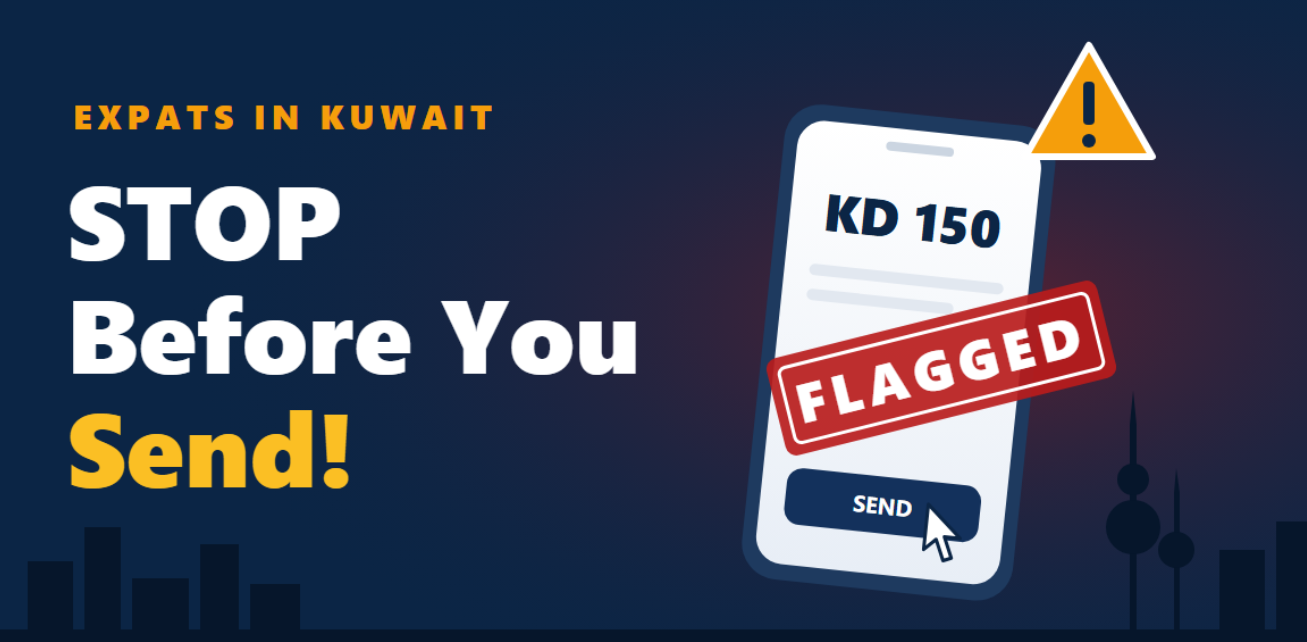
Banks and authorities are watching transfers more closely than ever. Here is what’s safe, what’s risky, and how to protect yourself.
You’ve probably seen it on WhatsApp groups: someone sells home-cooked food, offers a ride to the airport, fixes ACs at the weekend, or resells phones on Instagram. The customer sends money by bank transfer or WAMD and everyone thinks it’s harmless.
It isn’t. In Kuwait, running any commercial activity without a licence is against the law. The Central Bank of Kuwait has also told banks to watch transactions closely and report any that look like unlicensed business. One transfer with the wrong description, or a pattern of regular incoming payments, can start an inquiry.
🔍 Why This Matters More Than Ever
Kuwait has stepped up its fight against money laundering, visa trading, and illegal commercial activity. Banks now use automated systems to flag unusual activity, such as:
- Frequent incoming transfers from many different people
- Payments with notes like “order,” “delivery,” “service charge,” or “product”
- Account activity that doesn’t match your declared salary or job
- Money arriving and quickly being sent on to others
Once an account is flagged, the bank may report it to the authorities. For an expat, the results can be serious: frozen accounts, investigation, fines, legal cases, and in some cases cancellation of residency and deportation.
🚫 What You Should NOT Do Without a Licence
If you are on a work or family visa and do not hold a commercial licence, avoid receiving or making payments for:
- ❌ Selling food, sweets, cakes or catering from home
- ❌ Reselling phones, electronics, perfumes, clothes or any goods
- ❌ Private taxi, delivery or “driver” services
- ❌ Freelance repairs: AC, plumbing, electrical, car work
- ❌ Private tuition, beauty services or salon work at home
- ❌ Collecting money on behalf of a business or “a friend’s shop”
- ❌ Lending your bank account to others to receive payments
- ❌ Any arrangement involving visa or “sponsorship” money
Remember: paying someone for an unlicensed service can put you at risk as well, not just the seller. Both sides of the transaction can be questioned.
✅ What Is Perfectly Normal and Acceptable
Don’t panic. Everyday personal payments are normal and acceptable:
- ✔️ Paying your house rent to your landlord
- ✔️ Paying utility bills, internet, mobile and school fees
- ✔️ Sending money to family back home through licensed exchange companies or banks
- ✔️ Lending to or paying back a friend as a personal favour
- ✔️ Splitting a dinner bill or shared expenses with friends
- ✔️ Paying licensed shops, companies and service providers
🛡️ 7 Smart Tips to Protect Yourself
- Write clear transfer descriptions. Use honest notes like “Rent – March,” “Loan return,” “Family support.” Avoid vague or business-sounding words.
- Never lend your bank account or card to anyone, even a close friend.
- Don’t accept money from strangers and pass it on. This is a common money-mule trap.
- Buy only from licensed businesses. Ask for an invoice or receipt.
- Keep records of rent agreements, loan arrangements and family transfers in case your bank asks.
- Answer your bank honestly if it asks about a transaction. Ignoring it makes things worse.
- Want to start a side business? Do it the legal way. Check the requirements with the Ministry of Commerce and Industry and get the right licence first.
💬 Real-Life Scenarios: Safe or Risky?
| Situation | Verdict |
|---|---|
| You transfer KD 250 rent to your landlord every month | ✅ Safe |
| Your friend lent you KD 100 and you pay it back | ✅ Safe |
| You receive KD 5–10 from dozens of people for home-made biryani orders | ❌ Risky |
| You pay an unlicensed person by WAMD to repair your AC | ❌ Risky |
| A colleague asks to “use your account” to receive customer payments | ❌ Very risky |
| You send money to your parents through a licensed exchange company | ✅ Safe |
🎯 The Bottom Line
Kuwait is a great place to live and work, but the rules on commercial activity are strict and are now enforced through banking systems. The rule of thumb is simple:
“If it’s business, you need a licence. If it’s personal, keep it clean and clearly described.”
A small side income is never worth risking your job, your residency and your family’s future in Kuwait. Stay informed, stay careful, and share this with your friends who may not know.
📢 Found this useful?
Share it with your colleagues, friends and expat community groups. It could save someone from serious trouble.
Disclaimer: This article is for general awareness only and is not legal advice. Rules and procedures may change. For your specific situation, check with your bank, the Ministry of Commerce and Industry, or a qualified legal advisor in Kuwait.
📌 Related stories
Latest News
 International
Video – CD Tenerife striker dies after chest collision with goalkeeper
2 International 350+ Kenyan workers turned back from Saudi over Ebola rules Read more → 3 International Iran media shares nuclear attack guidance: what it means here Read more → 4 International US strikes Iranian targets near Hormuz as talks continue Read more → 5 International Iran says Washington holds key to avoiding new war Read more → 6 International Oman coast ship strike kills Indian crew member, 13 safe Read more → 7 International Trump renews Iran strike threat as Tehran warns of longer war Read more → 8 International US-Iran tension rises after Qeshm Island missile strike Read more → 9 International Moroccan girl jumped from 7th floor of hotel Read more → 10 International Vance says : we have made good progress with Iran Read more → 11 Local Kuwait schools ban cash, gifts and unapproved events now Read more → 12 Local 2:00am to 5:00am on 3rd November 2026. Moon, Jupiter and Mars lined up over Kuwait. Read more → 13 International Helping Visa Violators Now Means Jail , KSA. Read more → 14 International Consultations with Qatar and Pakistan are extremely intensive Read more → 15 Local Trolley’s 2026 results of KD 15.4 million in first nine months. Read more →
Leave a Reply