

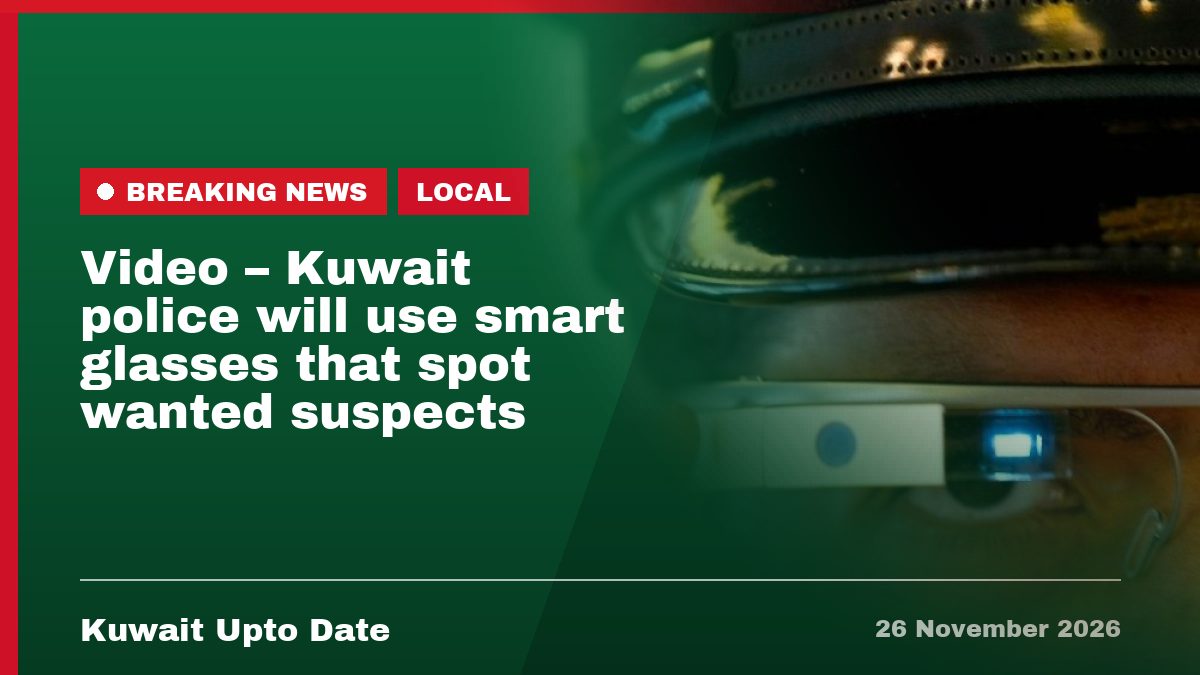
Imagine walking past a police officer in Kuwait and, without a word exchanged, the officer already knows if you’re wanted for anything. That’s the idea behind a new tool the Ministry of Interior is reportedly using: smart glasses that scan the faces of people nearby and check them against security records.
https://twitter.com/Mnw3_news_q8/status/2125985994230890647
It sounds like something from a film, but it fits a pattern we’ve seen building in Kuwait this year. The ministry has already been expanding how it tracks wanted people, including efforts to link deportee fingerprint data across the GCC.
- The Ministry of Interior is reportedly using smart glasses, described as a tool for officers in the field.
- The glasses collect data on anyone who passes in front of them.
- They reveal whether that person is wanted by security services in Kuwait.
- No official details have been released yet on where, when or how widely they’re being used.
What are these smart glasses, exactly?
Based on what’s been shared so far, these are wearable glasses fitted with some form of scanning or recognition technology. When someone walks in front of an officer wearing them, the glasses collect data on that person and check it against security records.
If the system finds a match, it reveals whether the person is wanted by the authorities. That’s the full extent of what has been described publicly. We don’t yet know if this means facial recognition specifically, whether it also reads ID cards or civil ID chips, or if it works through some other method entirely.
We also don’t know which department within the ministry is running this, when it started being used, or whether it’s a pilot programme or already active across Kuwait. These are details worth watching for in any official statement.
So why does this matter to people living here?
For citizens and expats going about daily life, a tool like this changes very little if you’ve done nothing wrong. But it does raise fair questions about privacy, since it appears to scan people simply for passing by, not because of any specific suspicion.
Kuwait has stepped up efforts against wanted individuals in recent months. Police reportedly arrested 3,461 wanted people over 10 months, and a separate sweep at the ports reportedly led to 67 arrests of wanted people in October. Local campaigns, like one reported in Jahra, have also picked up wanted suspects during area sweeps. Smart glasses, if confirmed and rolled out more widely, would give officers a faster way to check people on the spot, rather than needing a manual ID check.
That speed is the real story here. But speed also means these checks could happen more often, on more people, without them realising it. That’s the part worth watching as more details come out.
Quick answers
Is this confirmed by the Ministry of Interior?
The ministry has not released a detailed public statement explaining the technology, its legal basis, or its scope. Readers should treat this as an early report until more is confirmed.
Does this mean police are scanning everyone in public?
That’s not clear. The available information says the glasses collect data on anyone who passes in front of them, but we don’t know if this is limited to checkpoints, specific operations, or wider public use.
What happens if the glasses flag someone as wanted?
This hasn’t been detailed yet. Presumably it would lead to the same process as any other wanted-person check, but no official procedure has been described.
For more coverage like this, visit our latest local news in Kuwait.
We’ll update this story as soon as the Ministry of Interior shares more about how the smart glasses work, where they’re being used, and what safeguards exist. Until then, if you’ve seen these in use anywhere in Kuwait, we’d like to hear about it in the comments.
Latest News
 International
Saudi Arabia: A worker died and others are injured in a projectile attack
2 International Rhenium gold scam Read more → 3 Local Kuwait confirms deaths of two Italians after Iranian strike Read more → 4 Local Holiday shopping in Kuwait? 7 scams to watch for online Read more → 5 Local Flight diverted as Kuwait intercepts Iranian drones, four hurt. Read more → 6 Local Four hurt in attack in Kuwait, intercepts hostile drones. Read more → 7 International Congo Ebola cases pass 12,000 as violence hits response Read more → 8 International Netflix show sparks India-Pakistan row: what’s happening Read more → 9 Local Kuwait widen age-60 retirement rule to middle managers Read more → 10 International No visa requirement for Georgia’s tourits for one year Read more → 11 International Emirati businesswoman loses $1m haul in 10-second London robbery by a selfie Read more → 12 Local What Kuwait’s new antibiotic resistance warning means for you Read more → 13 International Video – Woman married to two brothers says the choice was hers Read more → 14 Local Kuwait culture council: watch for a comet near the sun on 27 November Read more → 15 International Indian travellers need visa from January 2027 Read more →
Leave a Reply