

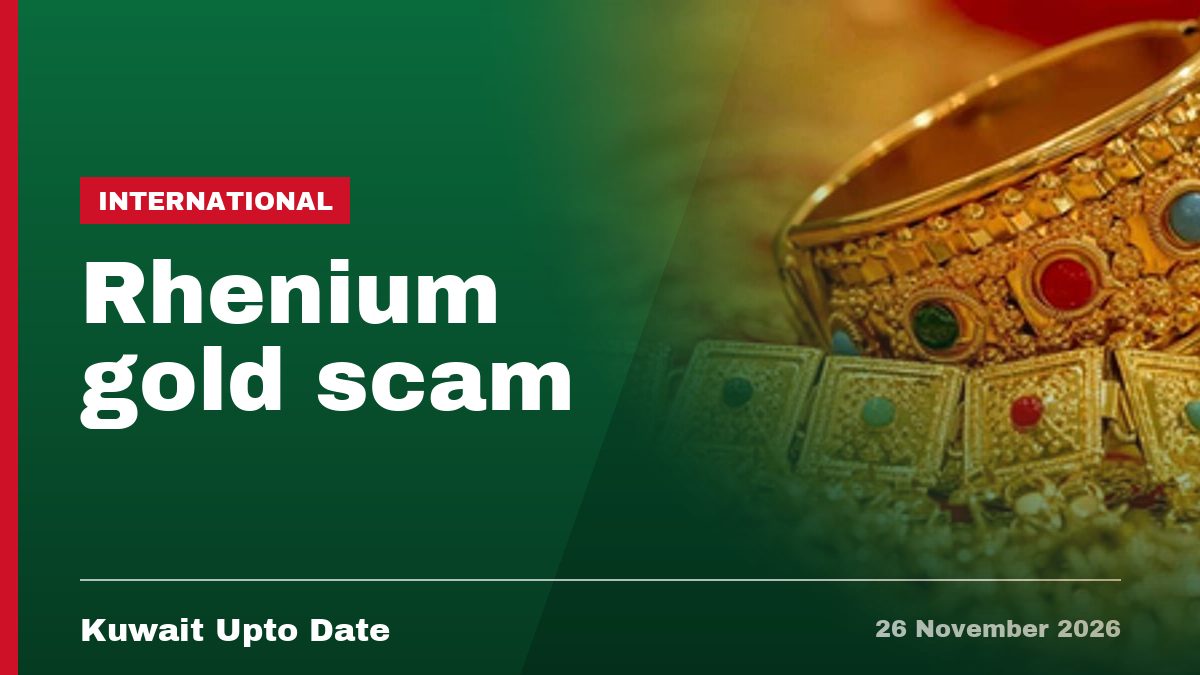
A one-gram pinch of a rare metal could be hiding inside a hallmarked gold ornament, and the testing machine at the counter might not catch it.
That’s the worry raised by a newspaper investigation in Rajasthan, India, which found that rhenium, a dense industrial metal, can be mixed into gold jewellery without most routine tests noticing. For Kuwait’s large Indian community – many of whom buy gold here or carry it home, or send money for family gold purchases – this is worth knowing about before the next trip or the next wedding season. If you’ve read our piece on gold prices dropping in Kuwait, this is the other side of that buying rush.
- A Rajasthan investigation by Dainik Bhaskar found rhenium powder mixed into gold passed as 24-karat and later as 22-karat hallmarked jewellery.
- The finished piece reportedly contained only about 81.73% actual gold – closer to 20-karat purity – despite its 22-karat hallmark.
- Common testing machines, acid tests and touchstone tests all have limits, and a government audit found most Indian jewellers go uninspected each year.
- Buyers can protect themselves by checking the BIS hallmark, the HUID number, and using the BIS Care app.
What did the investigation actually find?
Reporters from Dainik Bhaskar ran an experiment with a jeweller in Jodhpur. They say they contacted an agent linked to a company in Shenzhen, China, who claimed his firm made rhenium powder and supplied it through dealers in several Indian cities. The agent allegedly said up to 25% of a gold mix could be rhenium without detection – a claim that has not been independently verified.
The investigators got a one-gram sample through a dealer in Mumbai and mixed it with 7.83 grams of 24-karat gold, making a combined weight of 8.83 grams. That mixture reportedly still tested as 24-karat gold. A jeweller then added another metal to bring it down to 22-karat, producing a 9.58-gram ornament. This piece reportedly received an official 22-karat hallmark and kept testing as 22-karat gold at several showrooms afterwards.
But the investigation’s own estimate put the actual gold content at around 81.73%, closer to 20-karat purity. One showroom’s machine read 93.70% gold alongside silver and copper, with no sign of rhenium at all. It’s important to note this was one sample in one experiment – it doesn’t prove adulteration is widespread, or that every testing machine in India can be fooled this way.
Why would anyone use rhenium?
Rhenium is a rare, heavy metal normally used in industrial parts that need to survive very high temperatures. It’s denser than gold – about 21 grams per cubic centimetre compared with 19.3 for pure gold – so mixing it in adds weight without adding much visible change. That’s exactly what makes it attractive to anyone trying to pad out a gold item’s weight while keeping its appearance and surface readings close to normal.
The real issue isn’t the metal itself. It’s whether common testing tools can see past the surface and tell you what’s actually inside.
Why do some testing machines miss it?
Most jewellery shops use X-ray fluorescence (XRF) machines, often called karatmeters, to check gold. These only read material near the surface, and results depend on the machine, its calibration and how the test is done. Acid tests and touchstone tests have similar limits – they tell you about the surface, not what’s mixed in deeper.
Properly set up XRF machines can in fact detect rhenium. The problem is consistency: not every shop’s machine is calibrated the same way. For anyone with real doubts, a fire assay or specialised lab test is the more reliable way to confirm gold content.
Could buyers actually lose money?
Yes, if the purity is lower than what’s hallmarked. A genuine 22-karat item should be 91.6% pure gold – so a 10-gram piece should hold about 9.16 grams of actual gold. If part of that is swapped for another metal, you’re paying 22-karat prices for something worth less.
Dainik Bhaskar’s investigation estimated a possible loss of around ₹14,700 per tola (about 11.66 grams), based on an assumed gold price of ₹1.5 lakh. The exact loss depends on the real purity, the price paid, and the weight bought.
Rhenium isn’t the only name being mentioned. An earlier report by Mint flagged concerns among traders in Indore’s Sarafa market about heavy metals like ruthenium, iridium and osmium being used the same way, plus a substance some traders call
Latest News
 Local
Video – Kuwait police will use smart glasses that spot wanted suspects
2 Local Kuwait confirms deaths of two Italians after Iranian strike Read more → 3 Local Holiday shopping in Kuwait? 7 scams to watch for online Read more → 4 Local Flight diverted as Kuwait intercepts Iranian drones, four hurt. Read more → 5 Local Four hurt in attack in Kuwait, intercepts hostile drones. Read more → 6 International Congo Ebola cases pass 12,000 as violence hits response Read more → 7 International Netflix show sparks India-Pakistan row: what’s happening Read more → 8 Local Kuwait widen age-60 retirement rule to middle managers Read more → 9 International No visa requirement for Georgia’s tourits for one year Read more → 10 International Emirati businesswoman loses $1m haul in 10-second London robbery by a selfie Read more → 11 Local What Kuwait’s new antibiotic resistance warning means for you Read more → 12 International Video – Woman married to two brothers says the choice was hers Read more → 13 Local Kuwait culture council: watch for a comet near the sun on 27 November Read more → 14 International Indian travellers need visa from January 2027 Read more → 15 International Trump unveils fresh tariffs of up to 20% on 14 countries including India Read more →
Leave a Reply