

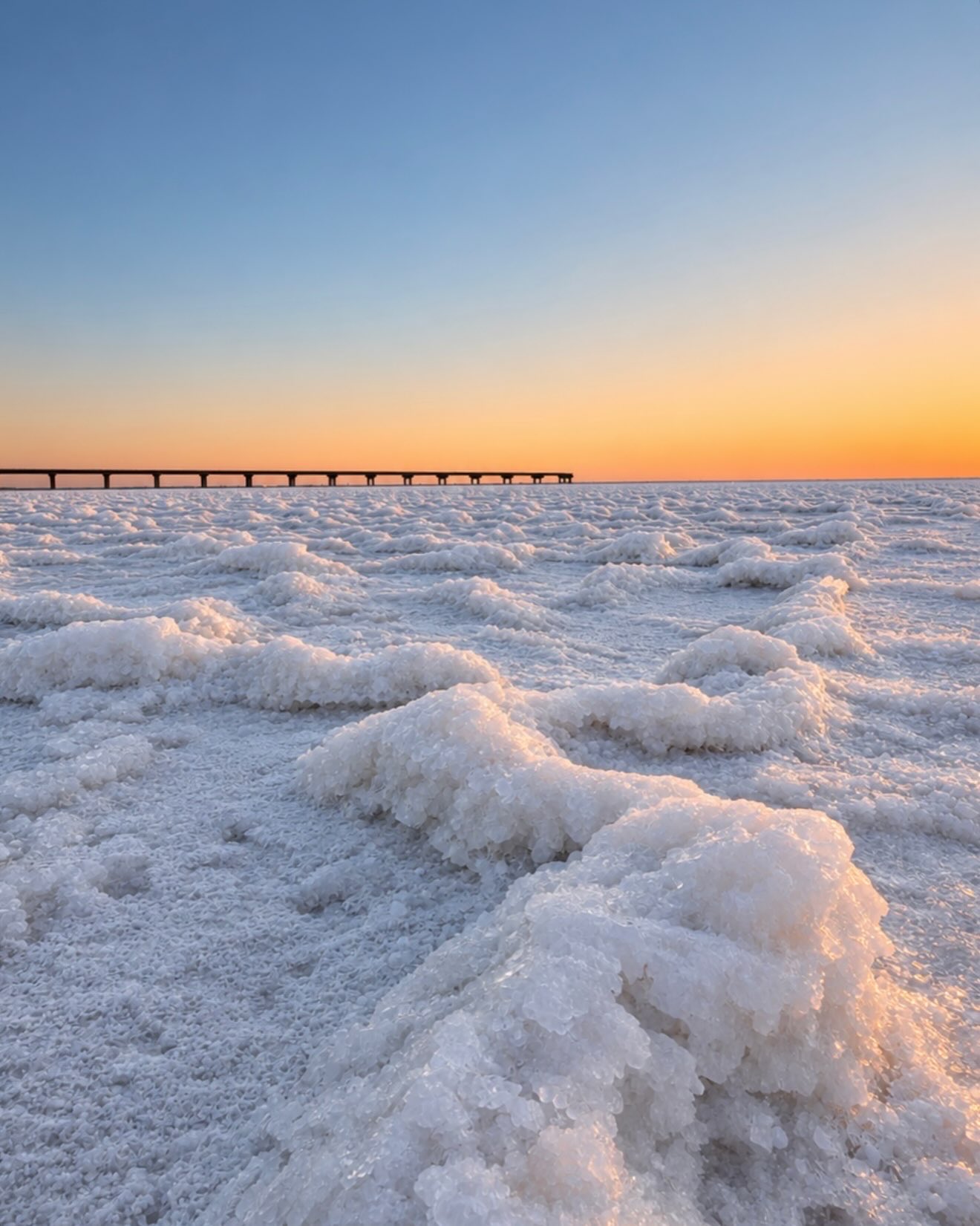
If you ever drive out towards Khor Al-Subiyah in northern Kuwait, you might notice patches of ground that look crusted in white, almost like frost in the desert heat. That’s not frost. It’s salt, and it’s forming a rare geological feature called a sabkha.

These flat, salty patches have been building up quietly for a very long time. They’re a reminder that the ground beneath Kuwait has a history written in layers of sand, sediment and salt.
- Sabkhas are salt flats that have formed in Khor Al-Subiyah, in the north of Kuwait.
- They formed after Gulf seawater pulled back and mixed marine sediment with windblown sand.
- As the area dried out, salts, gypsum and carbonates built up on the surface.
- The salts are natural but may be contaminated, so they are not safe to eat or touch casually.
So what exactly is a sabkha?
A sabkha is a flat area of land covered in a crust of salt and other minerals. You find them in low-lying coastal areas, and Khor Al-Subiyah in northern Kuwait is one such spot.
What makes this one worth talking about is how clearly you can see the process that made it. The surface shows salts, gypsum and carbonates built up together, which tells a story about how this part of Kuwait’s coastline has changed over a very long time.
How did it actually form?
It started with water. Long ago, the Arabian Gulf’s waters reached further inland than they do today. Over time, that seawater receded from the Khor Al-Subiyah area.
As the water pulled back, marine sediment left behind by the sea mixed with sand blown in by the wind. The ground that was left behind held a mix of both.
Then came the dry, hot climate Kuwait is known for. As the area dried out and evaporation increased, the water trapped in the ground evaporated and left its minerals behind. Over time, those minerals, salts, gypsum and carbonates, built up on the surface to form the crust you can see today.
This process didn’t happen overnight. It’s the kind of slow geological change that takes shape over long stretches of time, which is part of why it’s considered rare to see so clearly.
Why you shouldn’t touch or eat the salt
It’s natural, so it might look harmless, almost like something you’d want to collect or taste out of curiosity. Don’t.
The salts forming in these sabkhas may be contaminated. They are not safe for consumption. If you’re out exploring the area with family or taking photos, it’s worth keeping children and pets from handling or tasting the crust directly.
What this means if you live in Kuwait
For most residents, this isn’t a safety alert that changes your daily routine. It’s a genuinely interesting natural feature in your own backyard, in the northern reaches of the country near Khor Al-Subiyah.
If you enjoy weekend drives, desert walks or photography, this is worth knowing about before you go, mainly so you know to look and not touch. Nature lovers and anyone interested in Kuwait’s geology will find this a rare chance to see how land, sea and climate shape a landscape over time. You can find more coverage like this under local news from Kuwait.
[EDITOR NOTE: add a note here on visiting Khor Al-Subiyah responsibly, or any personal familiarity with the area, if relevant.]
Quick answers
Is it safe to walk on the sabkhas?
The ground itself isn’t flagged as dangerous to walk on, but the salt crust may be contaminated, so avoid touching it directly or letting children put it in their mouths.
Can I collect the salt as a souvenir?
It’s best not to. The salts are natural, but they may be contaminated and are not safe for consumption or casual handling.
Where exactly is Khor Al-Subiyah?
It’s an inlet area in the north of Kuwait, known for its coastal and marshy terrain, where this salt flat formation has been noticed.
Have you seen the sabkhas in Khor Al-Subiyah yourself? Share what you noticed in the comments; it helps other readers know what to expect before they go.
Latest News
Local
Ahmadi police probe KD 8,000 theft from expat’s bank account
2 Local Shoplifter caught on camera in Kuwait cosmetics theft hunt Read more → 3 Local Kuwait arrest suspect in scam network Read more → 4 Local Kuwait court jails lawyer 3 years Read more → 5 Local Farwaniya cuts power to 10 properties over violations Read more → 6 Local Kuwait court hands down two death sentences in one day Read more → 7 Local Mother and daughter acquitted over Kuwait cat sale row Read more → 8 International Video – Run Challenge 2026: robots race alongside thousands Read more → 9 Local 516 residents must update address in 30 days or pay KD 100 Read more → 10 Local Kuwait set for warm days up to 33°C this week Read more → 11 International Iranian attack on Bahrain injures two, one Pakistani in critical condition Read more → 12 Local PAM warns Kuwait employers over salary transfer rules Read more → 13 Local Gold prices drop in Kuwait, sparking a buying rush Read more → 14 International Mecca region under emergency alert amid Gulf tensions Read more → 15 Local Kuwait may set new fees and fines Read more →
Leave a Reply