

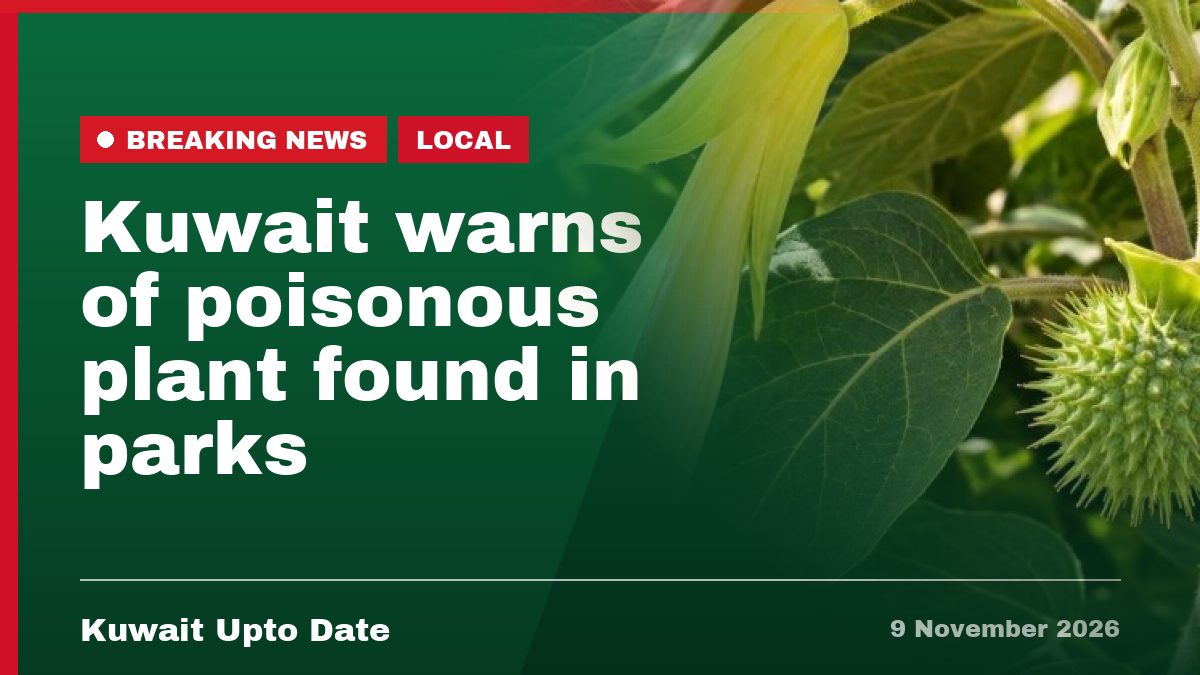
Next time you’re walking through a park or sitting in a garden in Kuwait, take a closer look at any tall plant with big white or purple trumpet-shaped flowers that open at night. It might look pretty. It could also be dangerous enough to send someone to hospital.
Health and environment officials in Kuwait are now raising the alarm about a plant called Datura, which has been spotted in several residential areas and public places across the country. It’s not native to Kuwait, but it has settled in, and officials say every part of it is toxic.
This isn’t a one-off warning. The Ministry of Health, the Public Authority for Environment (PAE) and the Public Authority for Agriculture and Fish Resources (PAAFR) have all been meeting over this plant, and they’re now building a national plan to deal with it. You can find more Local news from Kuwait on how these efforts are developing.
- Datura is a seasonal, invasive plant that has been found growing in parks, gardens and residential areas in Kuwait.
- Every part of it – leaves, stems, flowers, fruit and seeds – contains toxic compounds called tropane alkaloids.
- Kuwait’s Poison Control Center has treated severe poisoning cases linked to the plant, some needing hospital care.
- Three government bodies are now working on a national programme to map, monitor and safely remove it, with a strong focus on schools and places children visit.
What exactly is Datura, and why is it risky?
Datura belongs to the nightshade family (Solanaceae), the same plant family as tomatoes and potatoes – though Datura itself is nothing like them in terms of safety. It usually grows in spring and summer, and depending on heat and humidity, it can keep growing and flowering into early autumn.
You’d recognise it by its large white or purple trumpet-shaped flowers, which open at night, and its big leaves with a strong, sharp smell. It also produces round, spiky green fruit packed with seeds.
Dr Abdullatif Al-Awadhi, head of Kuwait’s Poison Control Center (part of the Ministry of Health, based at Amiri Hospital), explained that the danger comes from tropane alkaloids in the plant – compounds like atropine, hyoscyamine and scopolamine. If someone eats or ingests any part of the plant, it can cause acute poisoning.
Symptoms include a dry mouth, widened pupils, a fast heartbeat, confusion, delirium and severe hallucinations. In serious cases, it can cause seizures or coma, and it can be fatal.
So does this mean the plant is dangerous just to have nearby?
Not exactly, and this is the part worth understanding. Dr Al-Awadhi said Datura can grow and spread on its own – its presence somewhere doesn’t mean anyone planted it deliberately. He also stressed that simply having a poisonous plant in the environment doesn’t mean there’s an immediate danger to people nearby.
The real risk comes when someone eats it, touches it carelessly, or uses it in an unsafe way – which is exactly why health officials are pushing for public awareness rather than panic.
That said, the Poison Control Center has recently dealt with severe poisoning cases in Kuwait linked to plants like Datura, serious enough to require hospital treatment. Officials are especially concerned about children, who may be drawn to the plant’s flowers or fruit without understanding the risk.
What’s being done about it?
The Poison Control Center has received reports of Datura sightings in some residential areas and public places. In response, it has coordinated with the PAE on two fronts: public awareness, and actively locating and removing the plant.
The Center also held a coordination meeting with the PAE to set up a clear system for reporting sightings, identifying the plant, assessing its risks, and deciding who does what. Dr Al-Awadhi described this as part of a wider effort to strengthen cooperation between health and environmental bodies in Kuwait, to reduce exposure to toxic substances and protect both citizens and residents.
Sharifa Al-Salem, head of the Wildlife Monitoring Department at the PAE, confirmed that Datura is an invasive, seasonal, poisonous plant that can cause poisoning, hallucinations, and disruption to the nervous system, heart rhythm and other body functions, up to and including death.
The same coordination meeting also covered how to handle reports about other dangerous wildlife, not just plants. This includes the black-tailed scorpion (the most common type in Kuwait), the black desert snake, sea snakes, jellyfish, and fish with poisonous spines such as the stonefish. Officials discussed how to share information faster between agencies and set clear contact points so response times improve.
Our latest local updates will follow how this reporting system develops. Al-Salem urged the public not to touch, collect or eat these plants, and not to handle the animals listed above – and to report sightings to the right authorities to help protect public health and Kuwait’s biodiversity.
Why is this plant so hard to get rid of?
Nouf Al-Hashash, acting director of the Environmental Rehabilitation Department at PAAFR, explained what makes Datura particularly stubborn. It adapts well to different environmental conditions and grows easily in open or disturbed land.
It also produces huge numbers of seeds, which can stay dormant in the soil for long periods and then germinate once conditions are right – especially when there’s enough moisture or water. That means even after a site is cleared, the plant can come back.
Al-Hashash said this is exactly why a scientific, organised approach matters for invasive poisonous plants that spread and reproduce this easily.
On the legal side, she pointed to the GCC Seeds, Propagation Materials and Seedlings Law as one of the frameworks already in place to help regulate and monitor seed trade, supporting efforts to limit the spread of unwanted plant species. PAAFR’s role is mainly technical: identifying plant species, assessing their environmental traits and spread risks, and recommending how to manage and control them, working within its legal mandate and coordinating with other bodies.
What’s next: a national plan
PAAFR has proposed a joint coordination meeting with the Poison Control Center and the PAE to build a complete national programme for dealing with Datura and limiting its spread, with each body handling its own area of responsibility.
According to Al-Hashash, the plan will include a full field survey to map where the plant is growing, how dense it is, and what stage of growth it’s at – with priority given to sensitive locations like schools, public facilities, parks and places children often visit.
Officials will also carry out a scientific risk assessment covering both health and environmental impacts, before putting together a technical plan for safe control and removal when needed. That includes figuring out the best way to handle existing plants, fruit and seeds, and how to safely collect, transport and dispose of the toxic plant waste without spreading seeds further or putting workers and the public at risk.
Because Datura seeds can sit in the soil and sprout again later, the plan will also include ongoing monitoring of treated sites, to check whether control measures actually worked and to catch any new growth early.
Community awareness is described as the most important part of the whole plan. That means preparing guidance and educational materials about Datura and other poisonous plants found in Kuwait – covering what they look like, their health risks, and how to handle them safely – in partnership with health, education and environment authorities.
What this means for you
If you live in Kuwait, this mostly affects how you treat unfamiliar wild plants, especially if you have young children or walk through parks and open land regularly. You don’t need to worry about every plant you pass, but you should avoid touching, picking or tasting anything you can’t identify.
If you garden, grow ornamental plants, or let your kids play in open areas near your home, it’s worth taking a moment to check what’s growing there. The same goes for compounds, schools and public parks – these are exactly the sites officials say they’ll prioritise in the coming survey.
Quick answers
What should I do if someone eats part of this plant?
Go to the emergency room immediately and ask for medical advice early. Don’t try to make the person vomit, and don’t use home remedies. If possible, keep a clear photo of the plant or a sample to help doctors identify it.
You can also call Kuwait’s Poison Control Center on 1804774. It offers specialist advice around the clock for poisoning and exposure cases, and helps determine the right medical steps based on the type of exposure and the patient’s condition.
Can I use wild plants for home remedies or drinks?
Officials advise against using wild plants to prepare drinks, traditional recipes or home remedies unless you’re certain of the plant’s type and safety. Don’t touch or eat unidentified plants, keep children away from them, and leave identification and removal to the relevant authorities.
Does finding this plant near my home mean I’m in danger?
Not necessarily. Officials say a poisonous plant simply existing nearby doesn’t mean there’s a direct risk to residents. The danger mainly comes from eating it or using it unsafely, which is why awareness matters more than alarm.
Have you noticed any unusual flowering plants around your neighbourhood lately? It’s worth a second look before letting kids or pets near anything you can’t name.
📌 Related stories
Latest News
 International
Robot waitresses bring a new dining experience
2 International Philippines in talks for $800m BrahMos missile deal with India Read more → 3 International US pauses Iran strike plans, gives talks a few more days Read more → 4 International Kuwait backs Saudi Arabia after missiles hit Riyadh, Read more → 5 International 149 Filipino workers from Kuwait, Saudi fly home amid unrest Read more → 6 Local PACI gives 30 days to fix address or pay KD 100 fine Read more → 7 Steps – How to make money from TikTok in Kuwait. Read more → 8 International TikTok Shop gets its own new app Read more → 9 Local Video – Kuwait police seize warehouse in Salmiya Read more → 10 International Stepmother arrested after death of girl, 4. Read more → 11 Local Housemaid Beaten With Stick, Doused With Chlorine and Left Without Help Dies; Saudi Woman Gets 10 Years Read more → 12 Local Woman 10 years jail maid death Read more → 13 Local Kuwait jails 6 for protein supplements, fines KD 45,000 each Read more → 14 International Gulf states ink deal to link region by rail Read more → 15 Local Kuwait tells subscribers in 5 areas to switch to fiber-optic Read more →
Leave a Reply