

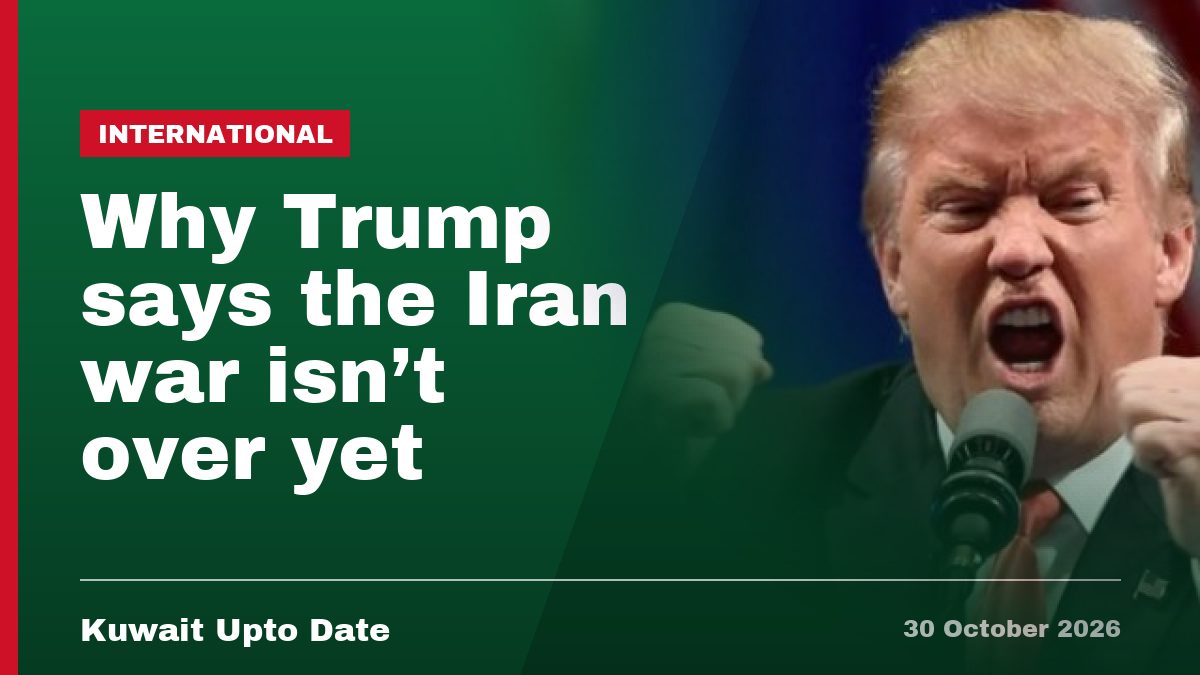
Families in Gaza, soldiers along Israel’s northern border, and now people across the Gulf watching naval movements near Hormuz – these are the groups who keep ending up on the sharp end of wars that never seem to finish cleanly. That’s the pattern Iran International laid out in a detailed look back at how Israel’s wars have actually ended, and it’s the pattern US President Donald Trump is now up against with Iran.
Trump has said the war with Iran will not end until the nuclear threat is resolved. That sounds simple. But if you look at how Israel’s previous wars played out, from 1948 right up to the fighting with Hezbollah and Hamas, almost none of them ended with a clear winner, a signed surrender and a settled peace. Some of our earlier coverage of Trump’s no-talks stance already flagged how open-ended this is turning out to be.
For people living in Kuwait, this isn’t just history. The Gulf has already felt the knock-on effects, including the loss of six US troops at Shuaiba port, which we reported on 17 October. So it’s worth understanding what ‘ending’ this war could actually mean.
- Trump says the Iran war will not end until the nuclear threat is resolved, but history shows Israel’s wars rarely end with a clear victory or a clean finish.
- Past wars with Egypt, Syria, Lebanon and Hamas ended through ceasefires, armistices or negotiated withdrawals, not surrender.
- The June 2025 war saw US strikes hit Iran’s Fordow, Natanz and Isfahan nuclear sites, followed by a ceasefire Israel accepted on 24 June.
- By October 2026, a US naval blockade and the standoff over the Strait of Hormuz were still unresolved.
How Israel’s past wars actually ended
In 1948, Israel fought off neighbouring Arab armies after declaring independence, then signed separate armistice agreements with Egypt, Lebanon, Jordan and Syria in 1949. These were lines on a map, not peace deals. The territorial dispute and the displacement of Palestinians were never resolved.
In 1956, Israel advanced fast across Sinai during the Suez crisis, but pressure from the US, the Soviet Union and the United Nations forced a full withdrawal by March 1957. Israel still gained something: access to the Straits of Tiran and a UN force deployed in Sinai. Military success and political outcome were two different things.
The 1967 war is the clearest example of a quick, total battlefield win. In six days, Israel captured Sinai, Gaza, the West Bank, East Jerusalem and the Golan Heights. But there was no formal surrender, and UN Security Council Resolution 242 set up a framework linking withdrawal to recognised, secure borders – a framework still argued over decades later.
The 1973 war began with a surprise attack by Egypt and Syria, and ended through US-Soviet diplomacy and UN ceasefire resolutions. It opened the door to Henry Kissinger’s shuttle diplomacy and eventually the 1979 Egypt-Israel peace treaty. Israel withdrew from most of Sinai by 1982, and handed back the disputed Taba area in 1989 after arbitration. That’s one of the few wars on this list that genuinely ended with a lasting peace.
Lebanon and Gaza: wars that keep coming back
Israel’s 1982 invasion of Lebanon pushed into Beirut and led to the departure of PLO leaders and fighters, but that wasn’t the end of armed groups in Lebanon. Israeli troops stayed in a southern security zone until they finally withdrew in May 2000, after years of fighting Hezbollah – without a peace treaty or surrender on either side.
The 2006 war with Hezbollah ended through UN Security Council Resolution 1701, with a cessation of hostilities on 14 August that year. Hezbollah was never disarmed. Even so, UNIFIL says the arrangement helped keep almost 17 years of relative calm before fighting flared up again in 2023.
Gaza has followed a similar loop. The wars of 2008-09, 2012, 2014 and 2021 all ended without Hamas surrendering or losing all its military ability. Researchers Efraim Inbar and Eitan Shamir called this pattern
📌 Related stories
Latest News
 Local
Kuwait meeting: Nancy Ajram and Ahlam’s warm reunion goes viral
2 Local Step by Step Guide – Renewing car registration in Kuwait online Read more → 3 How to Make 100 KWD a Day on Social Media in Kuwait (Step by step Guide 2026) Read more → 4 Local Kuwait traffic department: skip the paper registration booklet Read more → 5 Local Body found in Mahboula ground, two stab wounds reported Read more → 6 Local Court gives 10-year term over child assault at school Read more → 7 Why Are the Houthis Attacking Saudi Arabia? Read more → 8 International US nuclear drill end this week: what Global Thunder 27 means Read more → 9 Local Video – Kuwait police sweep Jahra areas, arrest wanted suspect Read more → 10 Local Court gives 10-year term in indian child assault case Read more → 11 Local Kuwait traffic police step up checks on delivery bikes and cycle riders. Read more → 12 International Video – She lost bracelet found after four-day search Read more → 13 Local Diwali Holiday for Indians in Kuwait Read more → 14 International Two Britons charged over Iran plot to hit RAF Fairford airbase Read more → 15 Local Kuwait finds cockroaches, crowded rooms at delivery firm housing Read more →
Leave a Reply