

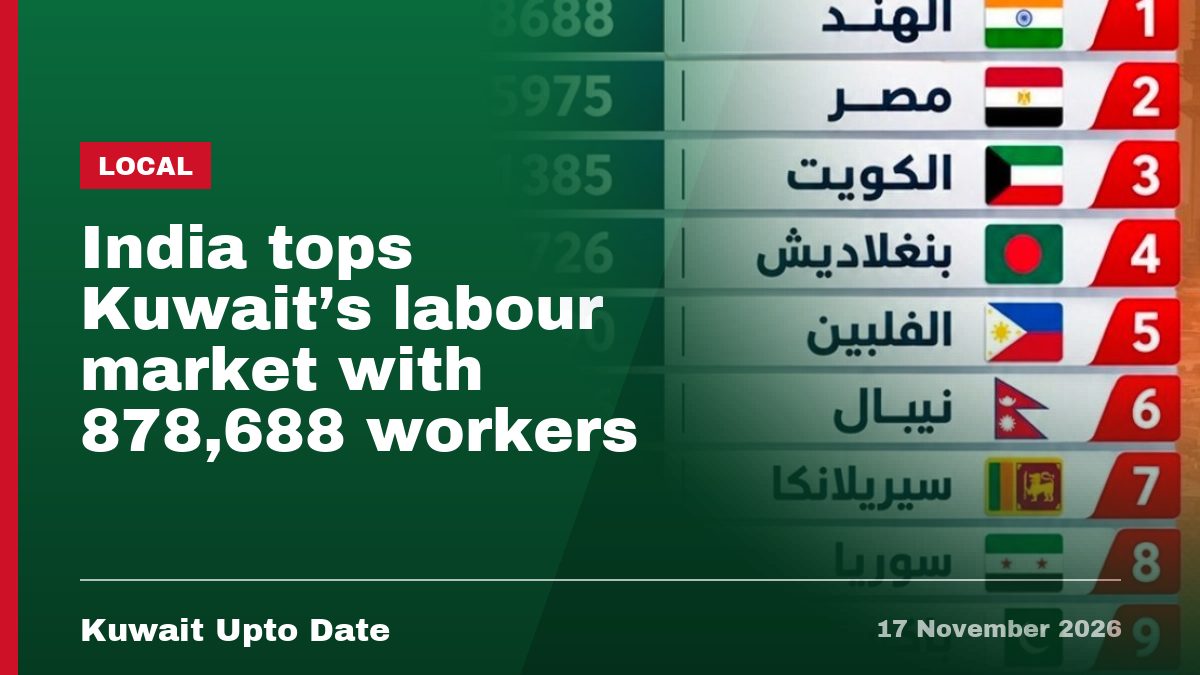
If you’re one of the hundreds of thousands of Indian, Egyptian or Bangladeshi workers living in Kuwait, you’re part of the biggest groups shaping the country’s workforce. New figures on Kuwait’s labour market show exactly how the numbers stack up, nationality by nationality, and the picture says a lot about who really keeps Kuwait running.

The data covers the whole labour market, including the household sector – so maids, drivers and other domestic workers are counted alongside office staff, construction workers and everyone else on a work visa. It also shows how many Kuwaiti citizens are part of the workforce, so you can see the local-to-expat balance in one glance.
- India has the largest number of workers in Kuwait, at 878,688 people.
- Egypt comes second with 465,975, and Kuwaiti citizens make up the third-largest group at 431,385.
- Bangladesh, the Philippines and Nepal round out the top six.
- Jordan sits at number 10 with 30,818 workers.
So who are the top 10, exactly?
Here’s the full ranking by nationality, based on the latest numbers:
- India — 878,688
- Egypt — 465,975
- Kuwait — 431,385
- Bangladesh — 301,726
- Philippines — 195,190
- Nepal — 172,646
- Sri Lanka — 165,871
- Syria — 75,698
- Pakistan — 74,234
- Jordan — 30,818
Add these up and you’re looking at well over 2.7 million people across just these 10 nationalities, out of Kuwait’s total population. That’s a reminder of how international Kuwait’s workforce really is, long before you count the dozens of smaller nationality groups not shown here.
Why is India so far ahead?
India’s lead isn’t close. At 878,688, it has nearly double Egypt’s total, the next biggest group. Indian workers have long been a major part of Kuwait’s construction, healthcare, retail and domestic sectors, and these figures confirm India remains the single biggest source of labour in the country by a wide margin.
Egypt’s 465,975 workers keep it firmly in second place, just ahead of Kuwaiti citizens themselves at 431,385. That means citizens are outnumbered by both India and Egypt individually within the wider labour market – a detail that says more about how reliant Kuwait’s economy is on foreign labour than any single policy statement could.
What about the smaller groups in the top 10?
Bangladesh holds fourth place with 301,726 workers, followed by the Philippines at 195,190 and Nepal at 172,646. These three nationalities together make up a huge share of Kuwait’s domestic and service sectors.
Sri Lanka comes in seventh with 165,871 workers. As we reported earlier, Sri Lanka is now Kuwait’s second biggest domestic worker group, so its strong showing here fits with that trend of rising numbers in household work specifically.
Syria (75,698) and Pakistan (74,234) are close to each other in eighth and ninth place, while Jordan closes out the top 10 with 30,818 workers.
The numbers above only tell part of the story. What they mean for daily life in Kuwait is where it gets interesting.
What this means if you live in Kuwait
For expats, these figures confirm what many already sense day to day: you’re surrounded by a genuinely international workforce, with Indian and Egyptian communities forming the largest groups by far. If your workplace, building or neighbourhood feels dominated by certain nationalities, the national figures back that up.
For citizens, the data is a useful reality check on how the labour market is shaped, especially as discussions continue around Kuwaitisation (replacing expat workers with citizens in certain jobs) and labour market reform. With citizens making up only the third-largest group overall, any policy shift affecting expat numbers has wide knock-on effects across households, businesses and services.
It’s also worth remembering that this list only covers the top 10. Dozens of other nationalities work in Kuwait in smaller numbers, and together they add even more to the total labour force beyond what’s shown here. You can find more local news like this on our Local news page.
Quick answers
Does this list include domestic workers?
Yes. The figures cover the whole labour market, including the household sector, so maids, drivers and other domestic staff are counted within each nationality’s total.
Where does this data come from?
The source and exact date of this breakdown are not specified in the material available, so the agency or ministry behind these numbers isn’t yet confirmed.
Why isn’t Kuwait’s population the same as the citizen figure here?
This list only counts people in the labour market. Kuwait’s total citizen population includes children, retirees and others not counted in workforce figures.
These numbers are a snapshot, not a forecast. If you work in Kuwait, where does your own nationality rank, and does it match what you see around you day to day? Tell us in the comments.
Latest News
Local
Kuwait power cuts hit 4 areas on Wednesday, 18 November
2 Local Kuwaiti’s salary 1,603 KD a month on average, expats get 356 KD Read more → 3 Local Kuwait jobs data: 83% of citizens work for government and 17% in private firms Read more → 4 Local What a cyber expert says, Kuwait must do about bank impersonation scams Read more → 5 Local Kuwait’s cold wave ends as temperatures start to rise Read more → 6 Local Kuwait set for Leonid meteor shower this week: dates and viewing tips Read more → 7 Local Kuwait police to track and summon drivers who film while driving Read more → 8 Local Kuwait gets 7 Brew’s first store outside the US Read more → 9 Local Alshaya, the firm behind Starbucks and H&M in Kuwait, makes global top 25 Read more → 10 Local Egyptian arrested in Dubai by interpol and sent to Kuwait for 7-year term. Read more → 11 Local Kuwait police warn: stay in your lane or pay fine Read more → 12 International ULA rocket failure wipes out 40 Amazon Leo satellites Read more → 13 Local Kuwait court confirms 7 years for accountant in invoice fraud Read more → 14 Local Turning from the wrong lane now flagged by Kuwait police Read more → 15 International Countries plan Rwanda hub to speed up deportations Read more →
Leave a Reply