

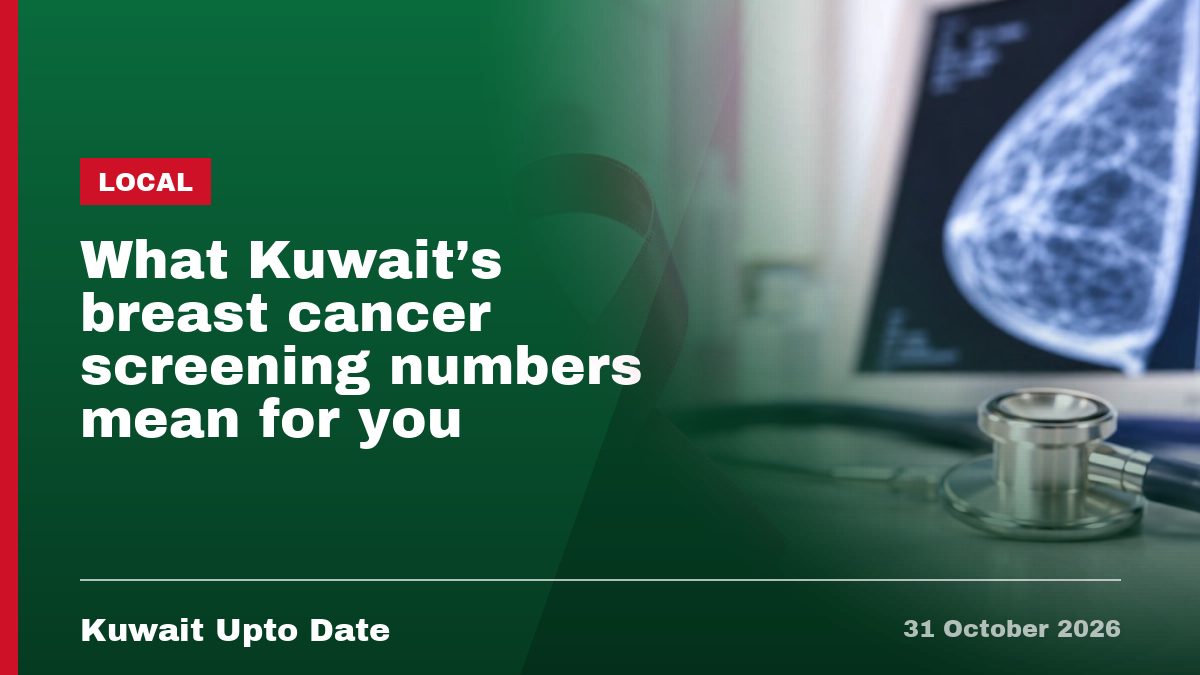
If you’re a Kuwaiti woman over 40, there’s a free check-up sitting in your phone right now, inside the Sahl and Salem apps. Most people never open that booking page. New numbers show why they should.
Kuwait’s National Program for Early Detection of Breast Cancer has carried out 46,225 examinations so far. Doctors found 418 cancer cases through those scans. Every single one of those 418 women had no symptoms at all. No lump, no pain, nothing they would have noticed on their own.
That detail is the whole point of the programme, and it came up repeatedly during a recent awareness workshop organised by Kuwait’s National Cancer Awareness Campaign, known as CAN, now in its 15th year of breast cancer awareness work. For more on how Kuwait is doing on health and wellbeing measures generally, see Kuwait’s ranking on the 2026 progress index.
- Kuwait’s free screening programme ran 46,225 examinations and found 418 cancer cases, all in women with no symptoms.
- The programme targets Kuwaiti women aged 40 to 69. Appointments are booked through the Sahl or Salem apps.
- Doctors say avoiding four major risk factors could cut cancer cases by 37%, and catching breast cancer early can mean a 100% recovery rate in some stage-one cases.
- In the Gulf, about half of breast cancer patients are only diagnosed once the disease has already advanced.
Why doctors are pushing this so hard
Dr Khaled Al Saleh, Chairman of the Cancer Control Society, told the workshop that avoiding known risk factors can prevent a third of all cancer cases. He said avoiding four major risk factors specifically could cut cancer cases by 37%.
Some examples he gave are stark. Smoking causes 80% of lung cancer cases. The HPV vaccine, which protects against the human papillomavirus, can cut cervical cancer rates by about 90%, according to international studies he cited.
On breast cancer specifically, Dr Al Saleh said recovery rates can reach 100% in some stage-one cases, where the cancer is caught right at the start. In advanced stages, that figure drops to between 33% and 37%. That gap, between catching it early and catching it late, is why the whole workshop existed.
He urged women over 40 not to delay mammograms, especially if breast cancer runs in their family. Kuwait’s current guidance recommends a screening mammogram every two years for this age group.
So who exactly does this affect?
The national screening programme is aimed at Kuwaiti women aged 40 to 69 who don’t have any symptoms. The goal is to catch the disease before a lump is even big enough to feel. You book through the Sahl or Salem apps, Kuwait’s official government service apps.
Dr Latifa Al Kandari, Head of the Diagnostic Radiology Department at Al Adan Hospital, shared the full screening figures. All 418 cases confirmed through this programme were found in women who showed no outward signs of illness at all. That’s the entire argument for going for a scan even when you feel completely fine.
Dr Maha Al Sindi, a Consultant Oncologist at the Bahrain Oncology Center, added some regional context that’s worth sitting with. About half of breast cancer patients across the Gulf are only diagnosed once the disease has reached an advanced stage, even though recovery rates exceed 95% when it’s caught early. She also noted that the average age of breast cancer diagnosis in the region is around 45, at least 10 years younger than in Western countries.
That age gap is one reason Kuwait’s screening age starts at 40 rather than later, as is common in some other countries. You can browse more local news in Kuwait for other health and residency updates relevant to daily life here.
What about the fear that comes with a diagnosis?
Psychological consultant Nadia Al Obaidi spoke about the emotional side of a cancer diagnosis, which she said goes well beyond the illness itself. Women worry about whether they’ll recover, how treatment will change their appearance, and how it will affect their work and relationships.
She said clear, reliable information and hearing from survivors directly both help reduce that anxiety, and help break the stigma that still surrounds cancer in many communities.
Dr Hessa Al Shaheen, who moderated the workshop and sits on CAN’s Board of Directors, said the high number of cases found through the national screening programme shows exactly why early detection matters so much. She also pointed to family support and psychological help as factors that aid recovery. Survivors, she said, have increasingly become awareness ambassadors themselves, sharing their own stories to help others. She credited the Makin Center with preparing survivors to take on that role.
What this means if you live in Kuwait
For Kuwaiti women between 40 and 69, this is about as direct as public health messaging gets: book the free scan, don’t wait for symptoms, and repeat it every two years as recommended. The 418 cases found in this round were all caught before anything was physically noticeable, which is the entire reason the programme exists.
For expat residents, the national screening programme as described here is aimed at Kuwaiti nationals, so it’s worth checking with your own insurer or private clinic about mammogram coverage and recommended screening ages, since guidance can differ by provider.
For families more broadly, the message from Dr Al Obaidi and Dr Al Shaheen is just as relevant: how you talk about a diagnosis, and the support you offer afterwards, genuinely affects how someone copes with treatment.
Quick answers
Who can get the free breast cancer screening in Kuwait?
The national programme targets Kuwaiti women aged 40 to 69 who have no symptoms of breast cancer.
How do I book a mammogram appointment?
Appointments are available through the Sahl and Salem apps, Kuwait’s official government service platforms.
How often should I get screened?
Kuwait’s current recommendation is a mammogram every two years for women in the target age group, more often if advised by a doctor based on family history.
Why do doctors push screening even without symptoms?
Because every one of the 418 cases found in this latest round had no symptoms at all. Catching it before a lump is even felt gives far better recovery odds, up to 100% in some stage-one cases compared with 33-37% in advanced stages.
If you’ve booked a mammogram through Sahl or Salem recently, or you’re putting it off, it’s worth sharing how the process actually went in the comments below. It might push someone else to finally make the appointment.
📌 Related stories
Latest News
 International
Qatar’s free visa on arrival
2 International Congo Ebola deaths pass 5,000 as outbreak spreads further Read more → 3 International Airport for Facial Recognition Travel of passengers at checkin Read more → 4 International Binance hack: $6.3 billion crypto theft explained Read more → 5 International Saudi coalition shoots down Houthi drone near Madinah Read more → 6 International High Alert – US renews Saudi Arabia alert over airport attack risk Read more → 7 International Kenya Travel Ban: Saudi Arabia’s New Ebola Rules Explained Read more → 8 International Scotland invites Karan Johar back for 2028 film anniversary Read more → 9 Kuwaiti Dinar Savings: Keep It in Kuwait, Buy Gold, or Send to India? Read more → 10 International Why Trump says the Iran war isn’t over yet Read more → 11 Local Step by Step Guide – Renewing car registration in Kuwait online Read more → 12 How to Make 100 KWD a Day on Social Media in Kuwait (Step by step Guide 2026) Read more → 13 Local Body found in Mahboula ground, two stab wounds reported Read more → 14 Local Court gives 10-year term over child assault at school Read more → 15 Why Are the Houthis Attacking Saudi Arabia? Read more →
Leave a Reply