

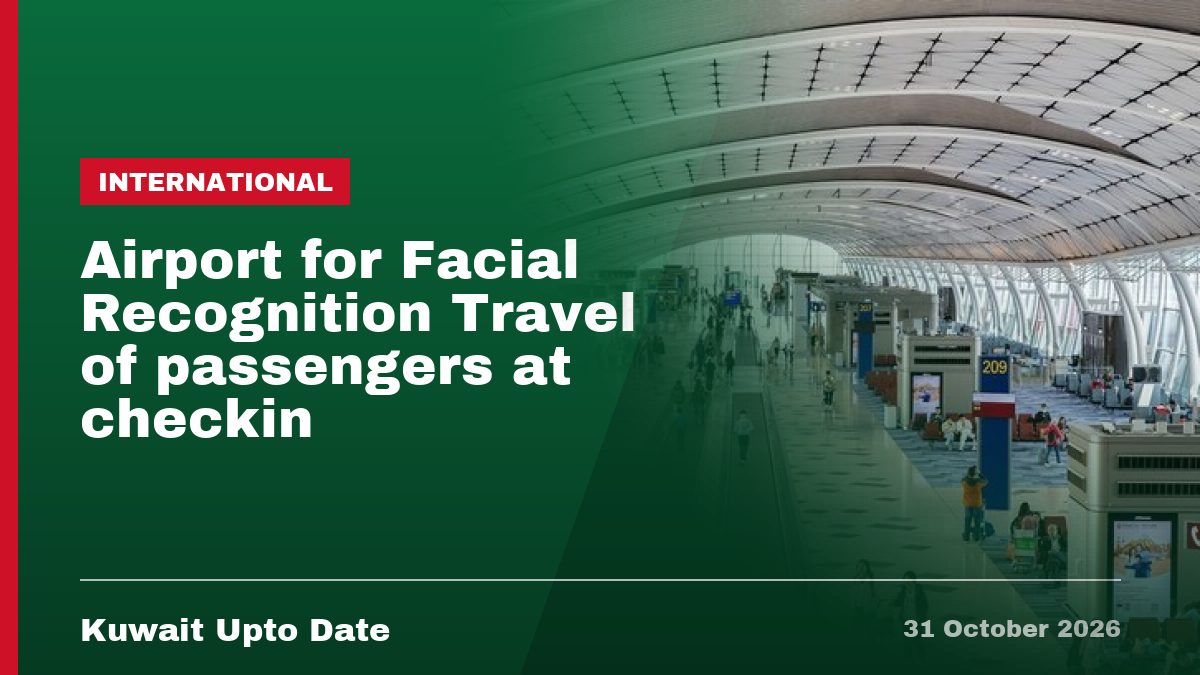
If you’ve ever stood in a slow-moving queue at an airport, digging out your passport and boarding pass for the fourth time in an hour, you’ll understand why this news matters. Hong Kong International Airport has just become the first airport in the world to get a special certification for letting passengers use their face instead of paper documents at almost every checkpoint.
It’s a small story on the surface, but it points to where air travel is heading. Kuwait has already made some of its own changes at the airport, including clearer airport fees shown on tickets, and other countries in the region are moving fast on travel technology too, as we’ve seen with Saudi Arabia’s new digital entry app for GCC residents.
- Hong Kong International Airport received IATA’s One ID certification on Wednesday, a world first.
- The certification confirms the airport meets international standards for digital identity, biometric technology and passenger privacy.
- Its Flight Token facial recognition system, running since 2021, has been used by more than 93 million passengers.
- Over 80% of departing passengers can now use facial recognition through their entire departure process, according to IATA.
What exactly did Hong Kong airport get certified for?
The certification came from the International Air Transport Association (IATA), the global body that represents airlines and sets many of the rules airports and carriers follow. It confirms that Hong Kong International Airport’s digital identity system, called Flight Token, meets strict international standards.
Those standards cover three things: how the airport handles digital identity, how it uses biometric technology (like facial scans), and how it protects passenger privacy. This is the first time any airport in the world has earned this specific One ID certification from IATA.
In plain terms, it means instead of pulling out your passport and boarding pass at every checkpoint, a traveller’s face becomes their ticket. One scan at the start of the journey, and cameras recognise the same person at security, immigration and boarding.
How many people are already using this?
Flight Token has been running at Hong Kong airport since 2021, so this isn’t brand new technology, it’s a system that’s already been tested at scale. IATA says more than 93 million passengers have used it since launch.
Right now, over 80% of departing passengers at the airport are eligible to use facial recognition throughout their whole departure process, from check-in to boarding. That’s a huge share of travellers skipping repeated document checks.
Vivian Cheung, the CEO of Airport Authority Hong Kong, said the certification would support the airport’s efforts to expand the technology beyond Hong Kong itself, through working with airlines, other airports and government authorities. The idea seems to be making this kind of facial recognition travel work across borders, not just inside one airport.
Do travellers actually want this?
According to IATA’s 2026 Global Passenger Survey, 78% of travellers said they would be willing to share their biometric information if it meant they didn’t have to keep showing physical travel documents at airport checkpoints. That’s a strong majority, and it tells you why airports and airlines are investing in this kind of system.
Hong Kong International Airport has also picked up other recognition recently. It was named Best Airport in the World at the 2026 Global Travel Awards back in April, and it won the World’s Best Airport Security Processing award at the Skytrax awards, which are widely followed in the aviation industry.
What else is changing at the airport?
Beyond facial recognition, the airport is upgrading its security screening with CT scanners. These produce detailed 3D images of what’s inside your baggage, which generally means faster and more accurate checks, and in many airports abroad it has meant passengers no longer need to take laptops and liquids out of their bags.
This fits a wider pattern.
Other airports in the region and beyond are also modernising checkpoints, from Pakistan ordering smart scanners to cut baggage delays to India installing full-body scanners that Kuwait-bound travellers should know about.
What does this mean if you fly through Kuwait or to Hong Kong?
For now, this certification is specific to Hong Kong International Airport. It doesn’t change anything at Kuwait International Airport directly. But it’s a sign of where global aviation is heading, and Kuwait travellers connecting through Hong Kong, or through other major hubs adopting similar systems, will likely see shorter queues and less document handling in the coming years.
Kuwait has already made moves in the direction of smoother airport processes, including the rollout of passport-free e-gates at some airports. If more airports follow Hong Kong’s lead and get certified for digital identity systems, expats and citizens travelling for work, study or holidays could eventually spend far less time standing in line with their passports out.
It’s also worth remembering which airports in the Gulf are already competing on passenger experience. Earlier this year, two Gulf airports were named among the world’s most beautiful terminals, a reminder that the region is paying close attention to how airports look and function. You can find more of our coverage on international travel and airport news as these changes keep rolling out.
Quick answers
Is facial recognition now required at Hong Kong airport?
No. The source doesn’t say it’s compulsory. It says over 80% of departing passengers are eligible to use it, which suggests it remains an option passengers can choose.
Will this come to Kuwait International Airport?
There’s no confirmation of that in the source. Kuwait has made separate changes, like clearer fee display on tickets and some passport-free e-gates, but nothing tying it directly to Hong Kong’s system.
Is my personal data safe with this kind of system?
The certification specifically checks that the airport meets international standards for passenger privacy, alongside digital identity and biometric technology standards. Full details of how data is stored or shared weren’t given in the source.
Would you be comfortable letting your face replace your passport at the gate? It’s a question more of us travelling through Gulf and Asian airports will be asked in the next few years, so it’s worth thinking about before it becomes the norm.
📌 Related stories
Latest News
 International
Congo Ebola deaths pass 5,000 as outbreak spreads further
2 Local Mutlaa killing: Bangladeshi walks into Sharq police station and confesses Read more → 3 International Binance hack: $6.3 billion crypto theft explained Read more → 4 International Saudi coalition shoots down Houthi drone near Madinah Read more → 5 International High Alert – US renews Saudi Arabia alert over airport attack risk Read more → 6 International Kenya Travel Ban: Saudi Arabia’s New Ebola Rules Explained Read more → 7 International Scotland invites Karan Johar back for 2028 film anniversary Read more → 8 Local Kuwait caps salary deductions at 10% for loans, 25% for debts Read more → 9 Kuwaiti Dinar Savings: Keep It in Kuwait, Buy Gold, or Send to India? Read more → 10 Local Kuwait meeting: Nancy Ajram and Ahlam’s warm reunion goes viral Read more → 11 International Why Trump says the Iran war isn’t over yet Read more → 12 Local Step by Step Guide – Renewing car registration in Kuwait online Read more → 13 How to Make 100 KWD a Day on Social Media in Kuwait (Step by step Guide 2026) Read more → 14 Local Kuwait traffic department: skip the paper registration booklet Read more → 15 Local Body found in Mahboula ground, two stab wounds reported Read more →
Leave a Reply