

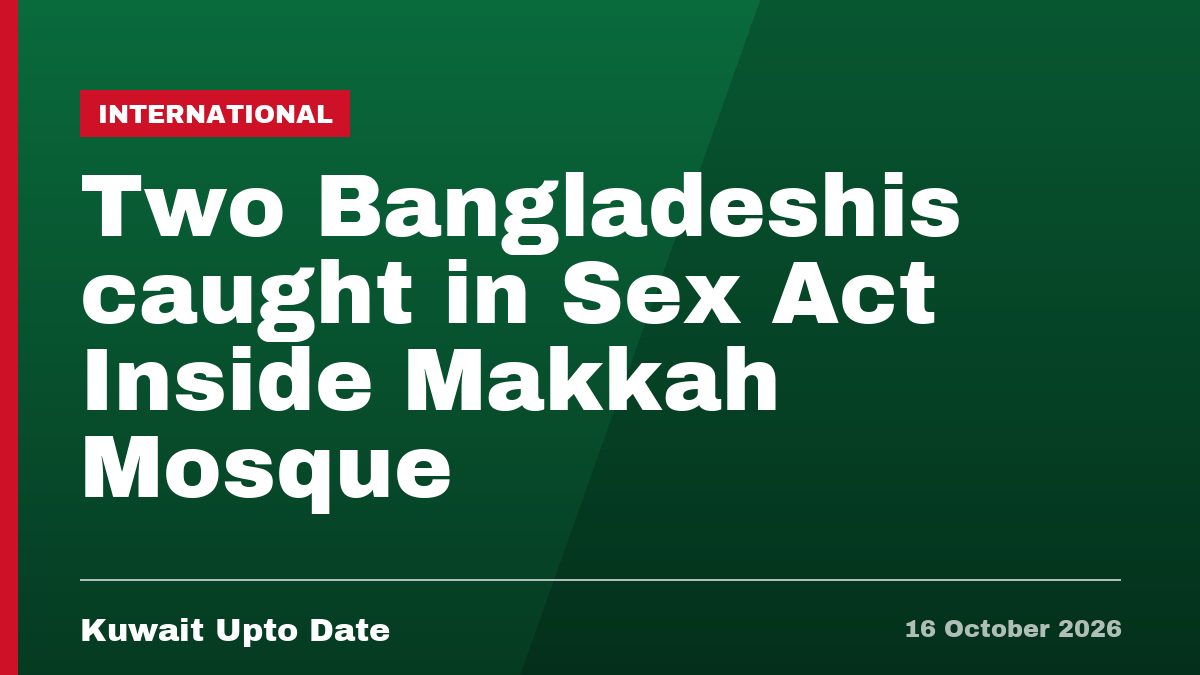
Two Bangladeshi nationals, identified by Saudi authorities as Nazrul Islam Abdul Basir and Siti Akhtar, were executed this week after being convicted over what the Kingdom’s Ministry of Interior described only as an immoral act, sexual intercourse, committed inside a mosque in Makkah.
For anyone following news out of Saudi Arabia, the case has landed with a jolt. Mosques in Makkah sit at the centre of the Islamic world, and the idea that two people were put to death over something that happened inside one has left plenty of people, in Kuwait and well beyond it, trying to piece together exactly what occurred.
The trouble is, the official version leaves a lot unanswered.
- Saudi Arabia executed Nazrul Islam Abdul Basir and Siti Akhtar on Wednesday, 14 October 2026, in the Makkah region.
- The Ministry of Interior said they were convicted of an immoral act inside a mosque in Makkah; it did not name the mosque or give further detail on the act itself.
- A court sentenced them to death under ta’zir, a discretionary punishment available under Islamic law, and a royal order authorised the executions.
- Bangladesh’s Consulate General in Jeddah says it was not told in advance and has formally asked Saudi authorities for clarification.
How the case unfolded
According to the Interior Ministry’s statement, carried by the Saudi Press Agency, security authorities arrested the two Bangladeshi nationals after the incident took place. From there, investigators built a case, formal charges were filed, and the matter was referred to court.
The court convicted both of them and handed down the death penalty under ta’zir. Unlike fixed punishments (hudud) set out explicitly in Islamic law for specific offences, ta’zir gives judges room to decide a punishment based on the severity and circumstances of a crime. In this case, the ministry said the court weighed the gravity of the offence and the fact that it violated the sanctity of both the place, a mosque, and the time in which it happened, though the statement did not specify what that timing was.
The verdict was then upheld by what the ministry called the competent authority, making it final. A royal order followed, authorising the executions to go ahead. Both were carried out on Wednesday, 14 October, in the Makkah region.
What Saudi authorities said about it
In its statement, the Ministry of Interior framed the executions as part of a broader commitment to security, justice and the enforcement of Islamic law, specifically against anyone who violates the sanctity of mosques or commits offences against personal honour. It added a warning: anyone found committing similar offences would face the punishment set out by law.
What the ministry did not do is fill in the practical details people naturally want to know. It didn’t name the mosque where the incident reportedly took place. It didn’t say when or where the two were arrested. And it didn’t describe, beyond the phrase used in the statement, exactly what the act involved. For now, that’s simply not public information.
Bangladesh says it wasn’t told
The case has also opened a diplomatic question. Bangladesh’s Consulate General in Jeddah told The Daily Star, in a report published on 16 October, that it had not received advance notice of the executions. A consular official said the mission had since submitted a diplomatic note to Saudi Arabia’s Ministry of Foreign Affairs, formally asking for acknowledgement of what happened to its two nationals.
That’s a notable gap. Countries usually expect to be informed, even if only after the fact, when their citizens face capital punishment abroad. Whether Bangladesh receives a fuller response, and what that response contains, is something worth watching in the days ahead.
What this means if you live in Kuwait
This case happened in Saudi Arabia, not Kuwait, and nothing in the ministry’s statement suggests any link to Kuwaiti residents or institutions. Still, the story carries weight for the large Bangladeshi and South Asian communities across the Gulf, including in Kuwait, where family members and friends may be following the consulate’s efforts to get answers.
It’s also a reminder, for anyone travelling to Saudi Arabia for Umrah or Hajj, of how seriously Saudi authorities treat offences they consider a violation of a mosque’s sanctity, and how differently capital cases there can proceed compared with courts in Kuwait or South Asia. Ta’zir sentencing gives Saudi judges wide discretion, and sentences of this kind are rarely detailed publicly beyond an official statement.
Quick answers
What exactly did the two people do?
The Saudi Interior Ministry described it only as an immoral act, specifically sexual intercourse, taking place inside a mosque in Makkah. No further detail on the circumstances has been made public.
What is ta’zir?
It’s a category of punishment under Islamic law that is left to a judge’s discretion, rather than a fixed penalty prescribed for a specific crime. Saudi courts can and do apply the death penalty under ta’zir in cases they consider severe enough.
Did Bangladesh know this was coming?
Its Consulate General in Jeddah says no. It has submitted a formal note to Saudi Arabia’s Ministry of Foreign Affairs seeking acknowledgement and further information.
Has the mosque or exact location been named?
No. The Saudi authorities’ statement did not identify the mosque, nor did it say when or where the arrests took place.
Cases like this tend to raise more questions than the official statements answer. If Bangladesh’s consulate gets a fuller response from Riyadh, it’s likely to shape how this story is understood going forward.
📌 Related stories




Latest News
 Local
17 Arrested in Kuwait’s 5 stars Hotel
Local
17 Arrested in Kuwait’s 5 stars Hotel
 2
Local Kuwait Scam: One App Approval Wipes Out Bank Balance
Read more →
2
Local Kuwait Scam: One App Approval Wipes Out Bank Balance
Read more →
 3
Local Employer Not Paying Your Indemnity? Here’s What to Do
Read more →
3
Local Employer Not Paying Your Indemnity? Here’s What to Do
Read more →
 4
Local Karen Wazen x Joe & The Juice Drop a Silver Sandwich Collab
Read more →
4
Local Karen Wazen x Joe & The Juice Drop a Silver Sandwich Collab
Read more →
 5
International Tesla Roadster With Rocket Thrusters: Price, Specs and 2028 Launch
Read more →
5
International Tesla Roadster With Rocket Thrusters: Price, Specs and 2028 Launch
Read more →
 6
Local Man claimed to be doctor at Jahra Hospital, say police
Read more →
6
Local Man claimed to be doctor at Jahra Hospital, say police
Read more →
 7
Local Video – New Souq Sharq set for seaside makeover.
Read more →
7
Local Video – New Souq Sharq set for seaside makeover.
Read more →
 8
International Oman and Pakistan sign visa-free deal
Read more →
8
International Oman and Pakistan sign visa-free deal
Read more →
 9
International US may use ‘Mother of All Bombs’ option against Iran
Read more →
9
International US may use ‘Mother of All Bombs’ option against Iran
Read more →
 10
Local Is Ronaldo coming to Kuwait ?
Read more →
10
Local Is Ronaldo coming to Kuwait ?
Read more →
 11
International Video – Thousands of iPhones are floating in the sea.
Read more →
11
International Video – Thousands of iPhones are floating in the sea.
Read more →
 12
Local Changing Jobs Before Your Kuwait Contract Ends: What to Know
Read more →
12
Local Changing Jobs Before Your Kuwait Contract Ends: What to Know
Read more →
 13
Local Kuwait court: mother’s move abroad doesn’t cancel custody
Read more →
13
Local Kuwait court: mother’s move abroad doesn’t cancel custody
Read more →
 14
Local Filipino man gets 5 years prisoner in Kuwait
Read more →
14
Local Filipino man gets 5 years prisoner in Kuwait
Read more →
 15
Local A citizen posted a video of a bike rider.
Read more →
15
Local A citizen posted a video of a bike rider.
Read more →
Leave a Reply